

Why Rocky Mountain Power Rebates Change the AC Repair vs Replace Decision in Utah
Understanding how Rocky Mountain Power rebates factor into the ac repair vs replace decision can completely change the math for Utah homeowners. A repair that seems like the cheaper short-term choice may actually cost more over time — especially once you account for available rebates, rising energy bills, and the efficiency gap between old and new systems.
Here’s a quick breakdown of how rebates shift the comparison:
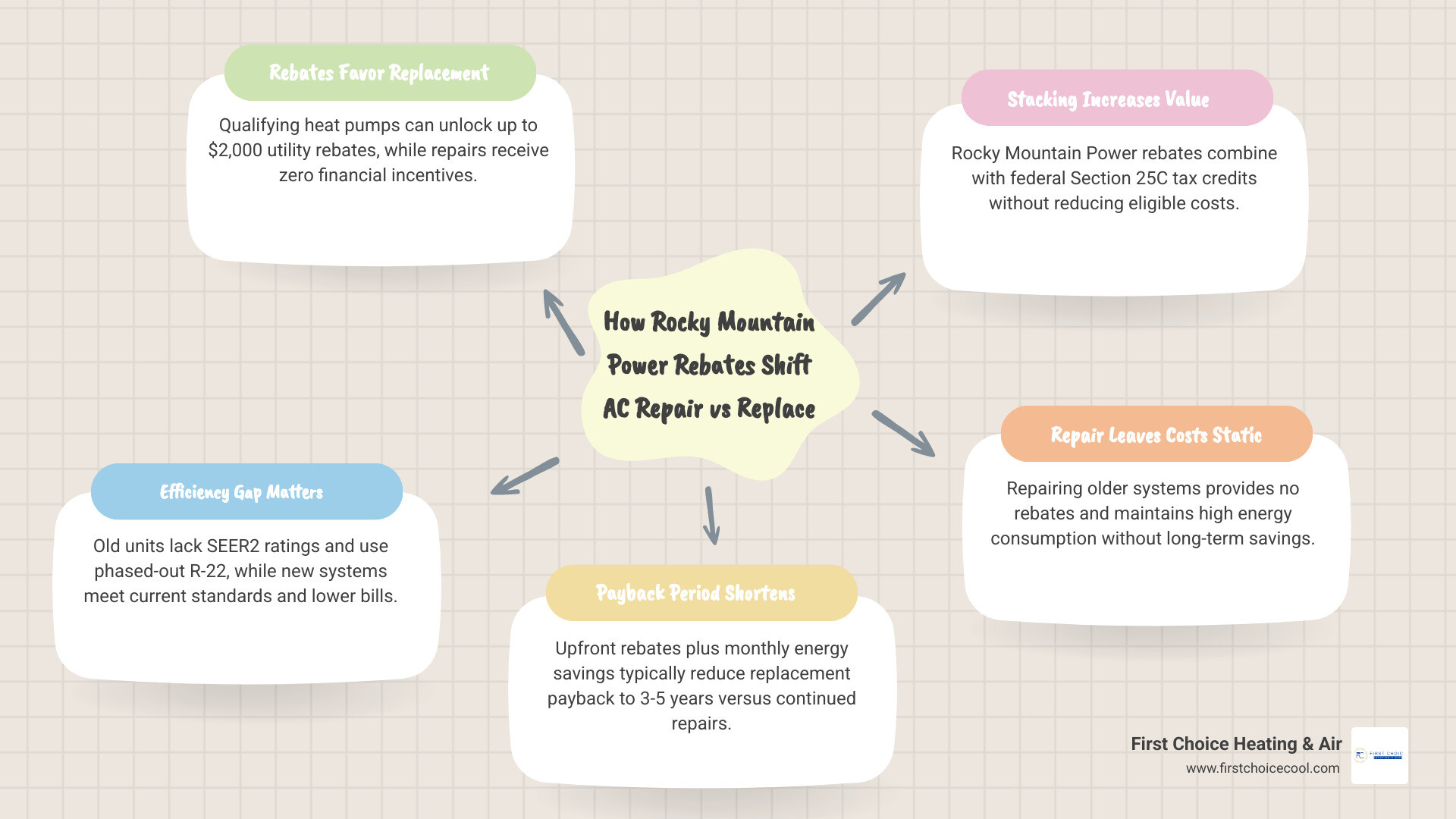
- Replacing with a qualifying heat pump or high-efficiency AC can unlock rebates that meaningfully reduce the upfront cost of a new system
- Repairing an older, inefficient unit gets no rebate benefit and leaves your energy bills unchanged
- Cold-climate heat pumps that meet Rocky Mountain Power’s Wattsmart efficiency thresholds can qualify for up to $2,000 in utility rebates — and that’s before stacking federal tax credits
- Standard high-efficiency central ACs (19 SEER2 or better) can qualify for a $350 Wattsmart rebate
- Smart thermostats added during a replacement project can add another $75–$100 in rebates
- Federal Section 25C tax credits can be combined with Rocky Mountain Power rebates, since the utility rebate does not reduce the gross cost used to calculate your federal credit
The bottom line: Rocky Mountain Power’s Wattsmart program makes replacement significantly more competitive against repair — especially for systems that are 10 or more years old, use R-22 refrigerant, or have a history of repeated breakdowns.
If your system is aging and repair quotes are climbing, the rebate picture in June 2026 is one of the strongest it’s ever been for Utah homeowners considering a switch to a heat pump or high-efficiency AC.
Key Factors in the AC Repair vs. Replace Dilemma
When your air conditioner starts acting up on a hot July afternoon in the Salt Lake Valley, it is easy to make an emotional decision. However, choosing between a quick fix and a complete system upgrade requires looking at several objective criteria.
By analyzing your system’s overall health, you can determine if you are dealing with a simple maintenance issue or if you are witnessing the Signs Your Home Needs New AC System. There are three primary technical factors that should guide your decision: the age of your system, its efficiency rating, and the type of refrigerant it uses.
The 50% Rule and System Age
Most central air conditioning units installed in Utah’s dry, high-altitude climate have a typical operational lifespan of 12 to 15 years. As a system ages past the 10-year mark, its mechanical components begin to degrade systematically.
To take the emotion out of the decision, we recommend using two classic industry benchmarks:
- The 50% Rule: If the cost of a single repair exceeds 50% of the cost of a brand-new system, replacement is almost always the smarter financial choice.
- The $5,000 Rule: Multiply the age of your air conditioner by the repair estimate. If the resulting number is greater than $5,000, you should replace the system. For example, a repair on a 12-year-old system that costs more than $420 is a strong signal to upgrade.
Major component failures, such as a burnt-out compressor or a leaking evaporator coil, are incredibly costly to address. If your system is over 8 years old and suffers a compressor failure, throwing money at a temporary fix is often a sunk cost. Knowing When to Replace vs Repair Aging AC System can save you from a cycle of endless service calls. Before approving a major fix, ask yourself: Is Repairing Your Air Conditioner Necessary? or is it simply delaying the inevitable?
Environmental and Efficiency Standards
Older cooling systems operate on much lower efficiency standards than modern equipment. Air conditioners manufactured before 2015 typically run at SEER (Seasonal Energy Efficiency Ratio) ratings between 10 and 13. Today, the minimum standard for new residential systems in Utah is 14.3 SEER2 (equivalent to roughly 15 SEER under the old rating system). High-efficiency models can easily exceed 20 SEER2. Upgrading from an old SEER 9 system to a modern SEER2 unit can slash your cooling energy consumption by 35% or more.
Another critical factor is the refrigerant type. If your AC was manufactured before 2010, it likely runs on R-22 (Freon). Because R-22 has been completely phased out due to its environmental impact, sourcing it for a repair is incredibly expensive. A simple refrigerant recharge can end up costing a significant portion of a new system.
Furthermore, our local geography plays a role in system wear. Utah’s 4,200-foot average altitude (and even higher in areas along the Wasatch Bench) forces AC compressors to work harder to reject heat compared to sea-level installations. Winter inversions also trap particulate matter that can coat outdoor coils, accelerating wear and tear. When choosing a new system, Choosing the Right Air Conditioner for Your Home means selecting a unit that can handle these unique local environmental pressures while maintaining peak efficiency.
How Rocky Mountain Power Rebates Factor Into the AC Repair vs Replace Decision
The upfront cost of a new HVAC system is the primary reason homeowners hesitate to replace aging equipment. However, Rocky Mountain Power’s Wattsmart program dramatically alters this cost-benefit analysis by offering direct cash rebates that lower the net cost of replacement.
| Decision Factor | Continuing to Repair | Replacing with Wattsmart Rebates |
|---|---|---|
| Upfront Cost | Lower immediate cost per repair | Higher upfront cost (significantly offset by rebates) |
| Utility Rebate Eligibility | $0 | Up to $2,000 for Heat Pumps / $350 for AC |
| Federal Tax Credits (25C) | $0 | 30% of project cost (up to $2,000) |
| Monthly Energy Bills | Remains high (or increases as system degrades) | Decreases by 20% to 35% |
| Reliability & Warranty | High risk of future breakdowns; no warranty | 10+ year manufacturer warranty |
When you look at the total financial picture, continuing to patch up a failing system often costs more over a three-to-five-year period than upgrading immediately. By utilizing promotions like our Promotion: Up to 1800 in Instant Rebates Available or our Promotion: Up to 5900 in Rebates Available, you can stack manufacturer incentives with utility rebates to make the transition incredibly affordable.
Understanding How Rocky Mountain Power Rebates Factor Into the AC Repair vs Replace Decision for Older Units
When replacing an older unit, you are no longer limited to standard central air conditioners. Modern electric heat pumps have become the premier choice for Wasatch Front homes because they provide both high-efficiency cooling in the summer and primary heating in the winter.
Rocky Mountain Power structures its Wattsmart rebates into tiers based on equipment type and efficiency:
- Tier 3 Cold-Climate Heat Pumps: Qualify for a $2,000 rebate. These systems must meet strict performance criteria, including an efficiency rating of at least 17 SEER2 and 8.5 HSPF2 (Heating Seasonal Performance Factor), and they must be listed on the Northeast Energy Efficiency Partnerships (NEEP) cold-climate product list.
- Standard Heat Pumps: Qualify for a $1,000 rebate (requiring at least 15.2 SEER2 and 7.5 HSPF2).
- High-Efficiency Central Air Conditioners: Qualify for a $350 rebate if the system achieves a SEER2 rating of 19 or higher.
Because heat pumps move heat rather than generating it through combustion, they are incredibly efficient. If you are wondering, “How Much Money Can I Save with a New Heat Pump,” the combination of lower winter heating bills and reduced summer cooling costs can save the average Utah household hundreds of dollars annually.
How Rocky Mountain Power Rebates Factor Into the AC Repair vs Replace Decision and Payback Periods
To understand the true value of these rebates, we can look at the independent program evaluations of Rocky Mountain Power’s Wattsmart Homes Program. In the program evaluations, HVAC measures accounted for 42% of net evaluated program savings (totaling 1,963,510 kWh in regional savings).
These reports highlight two vital metrics that prove the reliability of upgrading:
- 98% Realization Rate: This means that the actual, real-world energy savings achieved by homeowners who upgraded their HVAC systems matched 98% of the utility’s engineering estimates. You can trust that the promised energy savings on your monthly bill will actually manifest.
- 70% Net-to-Gross (NTG) Ratio: This high ratio indicates that the availability of Rocky Mountain Power rebates was the decisive factor that influenced homeowners to choose high-efficiency replacements over cheaper, standard-efficiency units or continued repairs.
During the evaluated period, 2,225 HVAC units were incentivized through the program, resulting in $2,805,014 in gross evaluated savings. By reducing the initial purchase price with a rebate, the “payback period” — the time it takes for your monthly energy savings to cover the net cost of the new system — is cut by several years.
Rocky Mountain Power Rebate Eligibility and Application Process in Utah and Wyoming
To ensure your replacement qualifies for Rocky Mountain Power rebates, you must follow specific program guidelines. The utility enforces strict standards to guarantee that systems are sized and installed correctly for our unique climate.
First and foremost, the equipment must be installed by a registered Wattsmart Trade Ally contractor. Because Professional AC Installation Crucial to achieving the rated efficiency of modern equipment, Rocky Mountain Power will not issue rebates for DIY installations or work completed by unapproved contractors. Proper refrigerant charge, correct airflow, and precise system sizing are verified during the installation process to ensure AC Installation Optimal HVAC Performance.
If you are ready to move forward with an upgrade, our team specializes in AC Replacement Bluffdale UT and across the Salt Lake Valley, ensuring all utility paperwork is filled out flawlessly.
To apply for your rebate, you must submit the following items through the Rocky Mountain Power online portal within 180 days of the installation date:
- Your active Rocky Mountain Power account number
- An itemized invoice showing the purchase date, model numbers, and serial numbers of the outdoor condenser and indoor coil/air handler
- The Air-Conditioning, Heating, and Refrigeration Institute (AHRI) Certificate of Product Ratings
- The yellow EnergyGuide labels for the equipment
Stacking Utility Rebates with Federal Incentives
One of the greatest financial advantages of replacing your system in June 2026 is the ability to stack utility rebates with federal tax incentives. Under the Inflation Reduction Act, homeowners can claim the Section 25C Energy Efficient Home Improvement Credit.
This federal tax credit allows you to deduct 30% of the total installation cost directly from your federal tax liability, up to a maximum of $2,000 per year for qualifying heat pumps, or up to $600 per year for qualifying central air conditioners.
Importantly, Rocky Mountain Power rebates are treated as non-taxable utility bill reductions or cash incentives. This means you do not have to subtract your utility rebate from the gross project invoice when calculating your 30% federal tax credit.
By combining a $2,000 cold-climate heat pump rebate from Rocky Mountain Power with a $2,000 federal tax credit, you can offset a massive portion of your total project cost. You can also add a smart thermostat to your installation to claim an additional $75–$100 utility rebate, plus a 30% federal credit on the device.
Frequently Asked Questions About HVAC Rebates
Can I combine Rocky Mountain Power rebates with federal tax credits?
Yes! You are highly encouraged to stack these incentives. The Rocky Mountain Power rebate is issued as a direct check or utility bill credit, while the federal Section 25C credit is claimed on your annual tax return using IRS Form 5695. Because the utility rebate does not reduce the gross project cost for tax purposes, you can maximize both programs simultaneously to cover a substantial portion of your replacement project.
What are the efficiency requirements for the maximum heat pump rebate?
To qualify for the maximum $2,000 Tier 3 Cold-Climate Heat Pump rebate, the system must meet the following criteria:
- A minimum efficiency rating of 17 SEER2 and 8.5 HSPF2.
- The system must be listed on the Northeast Energy Efficiency Partnerships (NEEP) Cold-Climate Air Source Heat Pump Product List.
- The system must serve as the primary heating source for at least 80% of the home’s conditioned living space.
How long does it take to receive a Wattsmart rebate check?
Once your Wattsmart Trade Ally contractor submits the complete documentation — including the itemized invoice, AHRI certificate, and your utility account details — through the online portal, most applications are processed quickly. Once approved, the rebate check is typically issued and mailed within 14 business days.
Conclusion
Deciding whether to repair or replace a struggling air conditioner does not have to be a guessing game. By factoring in Rocky Mountain Power’s generous Wattsmart rebates, the long-term energy savings of modern SEER2 equipment, and federal tax incentives, replacing an aging system is often the most financially sound path forward.
At First Choice Heating & Air, we are proud to serve our neighbors in Bluffdale, Salt Lake City, West Jordan, and across Salt Lake and Utah Counties. As a community-focused team, we offer competitive financing options, robust maintenance plans to keep your new system running perfectly, and industry-leading warranties to give you total peace of mind.
Don’t spend another summer worrying if your old AC will make it through the next heatwave. Contact us at First Choice Heating & Air today to schedule a free home energy consultation, and let us help you maximize your rebates for a cooler, more comfortable home!