
My AC is struggling with the Utah heat. How often should I have it serviced by a professional in Salt Lake City?
How often should you service your air conditioner in a hot dry Utah climate is one of the most important questions a Wasatch Front homeowner can ask — and the answer is more frequent than most people expect.
Here is the short answer:
Recommended AC Service Frequency in Utah’s Hot, Dry Climate
| System Type | Minimum Service Frequency |
|---|---|
| Standard central AC | Once per year (early spring) |
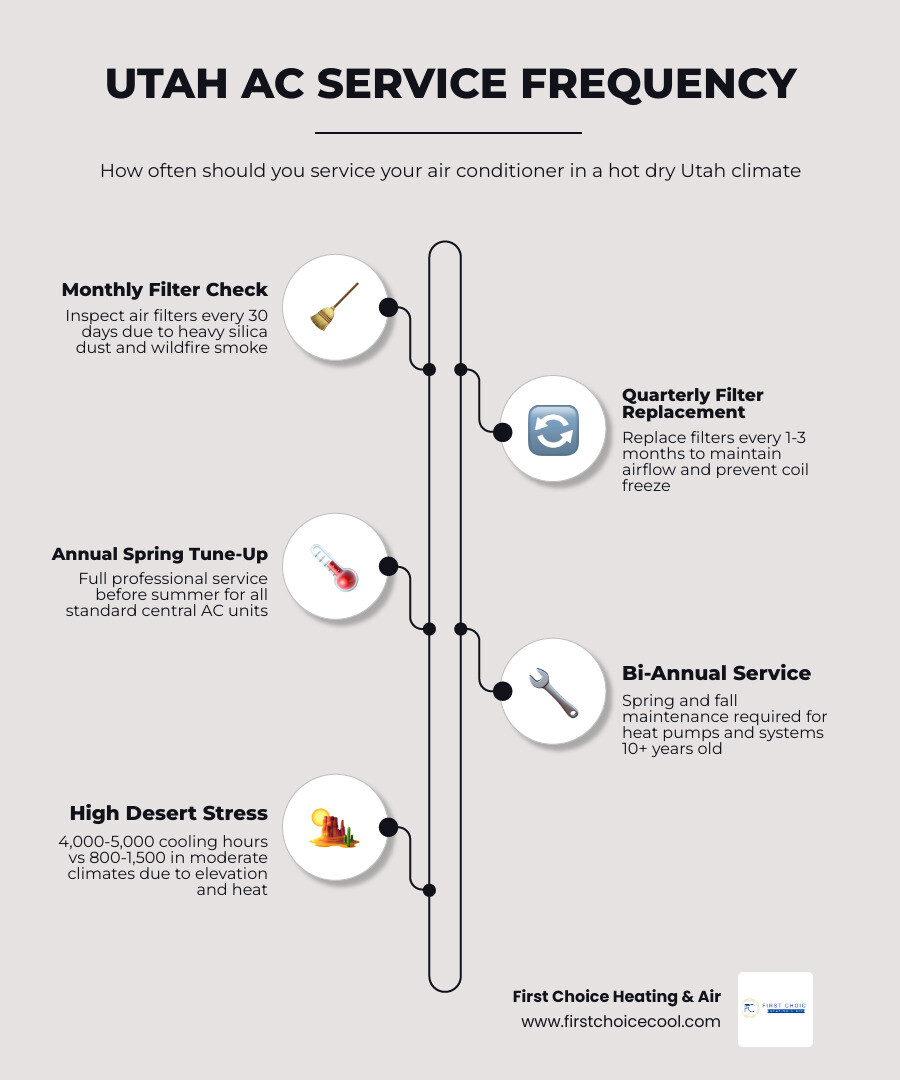
| Heat pump | Twice per year (spring and fall) |
| System 10+ years old | Twice per year or more |
| All systems | Filter check every 30 days; replace every 1-3 months |
Utah’s combination of triple-digit summer heat, elevation above 4,000 feet, ultra-low humidity, and heavy dust loading puts far more stress on AC equipment than most other climates. Where a system in a moderate climate might log 800 to 1,500 cooling hours per year, a high desert system here can log 4,000 to 5,000. That is not a small difference — it accelerates wear on every moving part inside your unit, and it shows up as higher energy bills, unexpected breakdowns, and shorter system life.
Skipping regular maintenance in this environment does not just lead to unexpected breakdowns down the road. It can take years off the life of your system.
How Often Should You Service Your Air Conditioner in a Hot Dry Utah Climate?
When we talk about scheduling a professional tune-up, many homeowners view it as an optional luxury. In reality, regular Home Maintenance is the single most effective way to keep your energy consumption under control and prevent emergency repairs.
For a standard central air conditioning system along the Wasatch Front, the baseline recommendation is at least once per year, ideally in the early spring (between March and May). Scheduling your tune-up during these months ensures your system is thoroughly cleaned, tested, and calibrated before the first major heatwave hits in late May or June.
Skipping this annual visit has immediate consequences. Industry data shows that an unserviced air conditioner can lose roughly 5% of its operating efficiency every single year. Over a five-year period of neglect, your system could be consuming 25% more electricity just to provide the same amount of cooling. On the flip side, a well-tuned AC can significantly improve your monthly utility efficiency while preventing an estimated 70% to 80% of all sudden HVAC breakdowns.
Why twice-yearly checks matter for Utah heat pumps?
If your home utilizes a heat pump rather than a traditional split system (AC paired with a furnace), the rules change. Because heat pumps work double-time to provide both cooling in the summer and heating in the winter, they experience year-round wear and tear.
For these systems, we recommend twice-yearly professional maintenance—once in the spring to prepare for the cooling season, and once in the fall before the heating season begins. This ensures that the reversing valve, defrost controls, and auxiliary heating elements are fully operational before extreme temperatures put them to the test.
The baseline frequency: how often should you service your air conditioner in a hot dry utah climate if it is an older system?
If your air conditioning unit is 10 years old or older, relying on a single annual check-up might not be enough to keep it running reliably. Older systems naturally suffer from mechanical degradation and cumulative wear. In our harsh high desert environment, systems can lose between 0.5 and 1.0 SEER (Seasonal Energy Efficiency Ratio) points every single year if they are neglected. A unit that started its life at a respectable 16 SEER may be operating at a measly, energy-wasting 10 SEER after just a decade of desert abuse.
For older units, scheduling a quick mid-summer inspection or a secondary check-up can be the difference between a comfortable home and a costly compressor failure on a 100-degree Sunday afternoon. Catching a failing capacitor or a minor refrigerant leak early prevents the chain-reaction failures that typically force an expensive, unplanned system replacement.
The Sandpaper Effect: How Utah’s High Desert Climate and Elevation Stress Your AC
To understand why Utah air conditioners require such diligent care, we have to look at the unique physical stresses of our geography. The Wasatch Front sits in a high desert basin characterized by intense solar radiation, extreme daily temperature swings, and a constant barrage of airborne particulates.
We call the primary threat the “Sandpaper Effect.” Because Utah is incredibly dry, fine silica dust and soil particles are constantly swept up by the wind, especially near open foothills, construction zones, and developing neighborhoods in Salt Lake and Utah Counties. This dust behaves like microscopic glass shards. As your outdoor condenser fan pulls thousands of cubic feet of air through the unit daily, these abrasive particles coat the delicate aluminum fins, wear down the fan motor bearings, and erode wire insulation.
Furthermore, when daily temperatures swing by 30 to 40 degrees Fahrenheit between hot afternoons and cool desert nights, the metal components in your system undergo rapid expansion and contraction. This thermal cycling puts immense physical stress on copper refrigerant lines and rubber gaskets, making them highly vulnerable to premature cracking and leaks.
| Stress Factor | Moderate Climate | Utah High Desert Climate | Impact on AC System |
|---|---|---|---|
| Annual Cooling Hours | 800 – 1,500 hours | 4,000 – 5,000 hours | Multiplies mechanical wear on compressors and motors |
| Relative Humidity | 50% – 80% | Often below 15% | Accelerates dry-out of rubber seals and gaskets |
| UV Radiation Intensity | Baseline | up to 20% Higher (at 4,300+ feet) | Degrades exposed electrical wiring and plastic components |
| Airborne Dust & Silica | Low to Moderate | High (Silica-rich dust) | Clogs condenser coils, creating an insulating barrier |
| Average Lifespan | 15 – 20 years | 12 – 16 years (often 8-10 if neglected) | Shorter functional life, reduced system longevity |
High Altitude and Thin Air Adjustments
Our elevation—averaging around 4,300 feet in the Salt Lake Valley and climbing higher in surrounding bench communities—directly impacts how your air conditioner transfers heat. Thinner air is less dense, meaning it cannot carry heat away from your home’s indoor coil as efficiently as denser sea-level air.
Because of this physical limitation, HVAC systems operating at high altitudes require specific calibration. Blower motor speeds must be carefully adjusted to ensure proper air mass flow across the evaporator coil. If the airflow is too slow, the coil temperature will drop rapidly, leading to system freeze-ups. Additionally, our technicians must adjust refrigerant pressure targets during a tune-up to account for local atmospheric pressures, a step that technicians in lower-elevation states never have to consider.
Winter Inversion and Dormant Particulate Buildup
Utah’s winter inversion season (typically running from November through February) presents a silent threat to your cooling system. During an inversion, cold air is trapped on the valley floor beneath a warm layer of air, pooling fine particulate matter (PM2.5), wood smoke, and vehicle emissions close to the ground.
Even though your air conditioner sits dormant during these cold months, these microscopic, sticky soot particles settle deep inside your outdoor condenser unit. If this accumulation is left unaddressed, the grime acts as a thermal blanket when you turn the system back on in the spring. The trapped heat forces the compressor to run at elevated internal temperatures, breaking down the compressor oil and drastically shortening the lifespan of the system’s most expensive component.
Essential Maintenance Tasks for Utah Homeowners
Keeping your air conditioner running perfectly requires a partnership between your seasonal DIY habits and our professional expertise. While complex mechanical and electrical tasks should always be left to licensed professionals, there are several critical steps you can take to protect your investment.
- Keep the Outdoor Unit Clear: Maintain at least two feet of clear space around your outdoor condenser unit. Trim back sagebrush, weeds, and ornamental grasses.
- Gently Clean the Condenser Fins: After heavy windstorms or during the spring cottonwood shedding season (often called “Utah snow”), gently rinse the outdoor unit’s coils with a garden hose. Never use a pressure washer, as the high-pressure stream will instantly bend and ruin the delicate aluminum fins, permanently restricting airflow.
- Monitor Thermostat Performance: Ensure your thermostat is reading room temperatures accurately and is programmed to prevent short-cycling (turning on and off rapidly).
How often should you service your air conditioner in a hot dry utah climate with filter replacements?
In a standard environment, changing your HVAC air filter every 90 days is perfectly acceptable. However, in Utah’s dusty high desert, you should check your filter every 30 days and replace it every 1 to 3 months.
If you live near active construction, have pets, suffer from seasonal allergies, or during active wildfire seasons when smoke and ash drift into our valleys, monthly filter replacements are highly recommended. A dirty filter restricts airflow, forcing your blower motor to work harder and consume more electricity.
When choosing a filter, aim for a MERV 8 to MERV 11 rating. While high-efficiency MERV 13+ filters are excellent at trapping tiny particles, they can restrict airflow too much when paired with our thin mountain air, causing your blower motor to overheat and your evaporator coils to freeze.
Professional 25-Point Inspection vs DIY Tasks
While homeowners can easily handle filters and clearance, a professional tune-up goes deep into the mechanical heart of the system. Handling refrigerant and electrical systems requires specialized tools and professional expertise.
During a professional 25-point inspection, our team performs tasks that are impossible to do safely as a DIYer:
- Refrigerant Charge Verification: We check for micro-leaks and ensure the system has the exact refrigerant volume needed for high-altitude operation.
- Capacitor Testing: Capacitors act as the system’s batteries, providing the electrical surge needed to start the motors. Because capacitors are highly sensitive to heat and are rated for a maximum temperature of 131°F, sustained Utah summer heat can easily push them to the brink of failure. We test their electrical capacitance to catch failures before they leave you stranded.
- Electrical Tightening & Amp Draw Checks: We inspect and tighten all wiring harnesses, which can wiggle loose over time due to thermal expansion and contraction.
- Condensate Drain Flushing: Algae and dust can combine in your indoor drain line to create a thick bio-slime, leading to water backups that can ruin ceilings and basements. We flush these lines to ensure clear drainage.
- Deep Coil Cleaning: We chemically clean the indoor and outdoor coils to restore optimal heat transfer efficiency.
When to Repair vs. Replace Your Utah AC Unit
Even with meticulous maintenance, every air conditioner eventually reaches the end of its reliable service life. Because of the intense environmental stress in Utah, the average lifespan of a central AC system along the Wasatch Front is 12 to 16 years, compared to the national average of 15 to 20 years. If a system is neglected, that lifespan can easily drop to just 8 to 10 years.
When deciding whether to repair or replace an aging system, you can consult resources like our AZ Guide to AC Repair vs Replace to help evaluate your options. Generally, if your system is over a decade old and requires frequent attention to keep running, investing in a new, highly efficient system is the smarter long-term decision.
Upgrading to a modern system with a higher SEER2 rating can reduce your seasonal energy consumption by 20% to 40% compared to a unit installed 10 to 15 years ago. Furthermore, local utility programs, such as Rocky Mountain Power’s Wattsmart Homes program, frequently offer attractive rebates for qualifying energy-efficient upgrades, helping to offset your initial investment.
Frequently Asked Questions About Utah AC Maintenance
Can Utah’s dry air cause my AC coils to freeze?
Yes, absolutely. While homeowners in humid climates experience frozen coils due to excess moisture, the primary culprit behind frozen coils in Utah is airflow restriction.
When fine high-desert dust and pet dander bypass a dirty or poorly fitted air filter, they coat the wet surface of your indoor evaporator coil. This dust acts as an insulating barrier and physically blocks air from passing through the coil. Without warm indoor air flowing over the coil to keep it warm, the refrigerant temperature drops below freezing, turning any lingering condensation on the coil into solid ice. If you notice ice forming on your indoor unit or the copper lines outside, turn the system off immediately and call for professional service to prevent damaging your compressor.
What are the signs my AC needs immediate professional attention?
You should not wait for your annual scheduled visit if you notice any of the following warning signs:
- Short Cycling: The system turns on, runs for two to three minutes, and then shuts down, repeating this cycle constantly. This places immense strain on the compressor.
- Unusual Noises: Squealing, grinding, or loud clicking sounds indicate failing bearings, a bad capacitor, or a loose fan blade.
- Weak or Warm Airflow: If the air coming from your registers feels weak or warm, you may have a failing blower motor, a refrigerant leak, or severely leaking ductwork. (That ductwork leaks in homes with basements can cause a 20% to 30% loss of conditioned air before it ever reaches your living spaces).
- Sudden Energy Spikes: A sudden, unexplained 20% increase in your monthly utility bill is a classic sign of system inefficiency or mechanical struggle.
Does skipping annual AC maintenance void my manufacturer warranty?
Yes, in many cases, it does. Almost all major air conditioner manufacturers require documented annual professional maintenance to keep their parts warranties valid. If your compressor fails within its warranty period but you cannot provide proof of annual professional service, the manufacturer may deny your claim, leaving you responsible for the replacement parts. Keeping your annual service receipts is your insurance policy against major out-of-pocket component failures.
Conclusion
Operating an air conditioner in Utah’s beautiful but punishing high desert climate requires a proactive approach. By scheduling professional maintenance once a year for central ACs and twice a year for heat pumps, you protect your system from the destructive effects of silica dust, high UV radiation, and intense summer heatwaves.
At First Choice Heating & Air, we are proud to provide community-focused, reliable HVAC services to our neighbors in Bluffdale, Salt Lake City, West Jordan, and throughout Salt Lake and Utah Counties. Our custom maintenance plans, strong warranties, and competitive financing options make it easier than ever to keep your home comfortable through every extreme season.
Don’t wait for the next triple-digit heatwave to find out if your cooling system is ready. Schedule your professional AC service today and breathe easy knowing your home is prepared for whatever the Utah climate throws your way!