

Why Is My AC Blowing Warm Air During a Utah Summer Heat Wave?
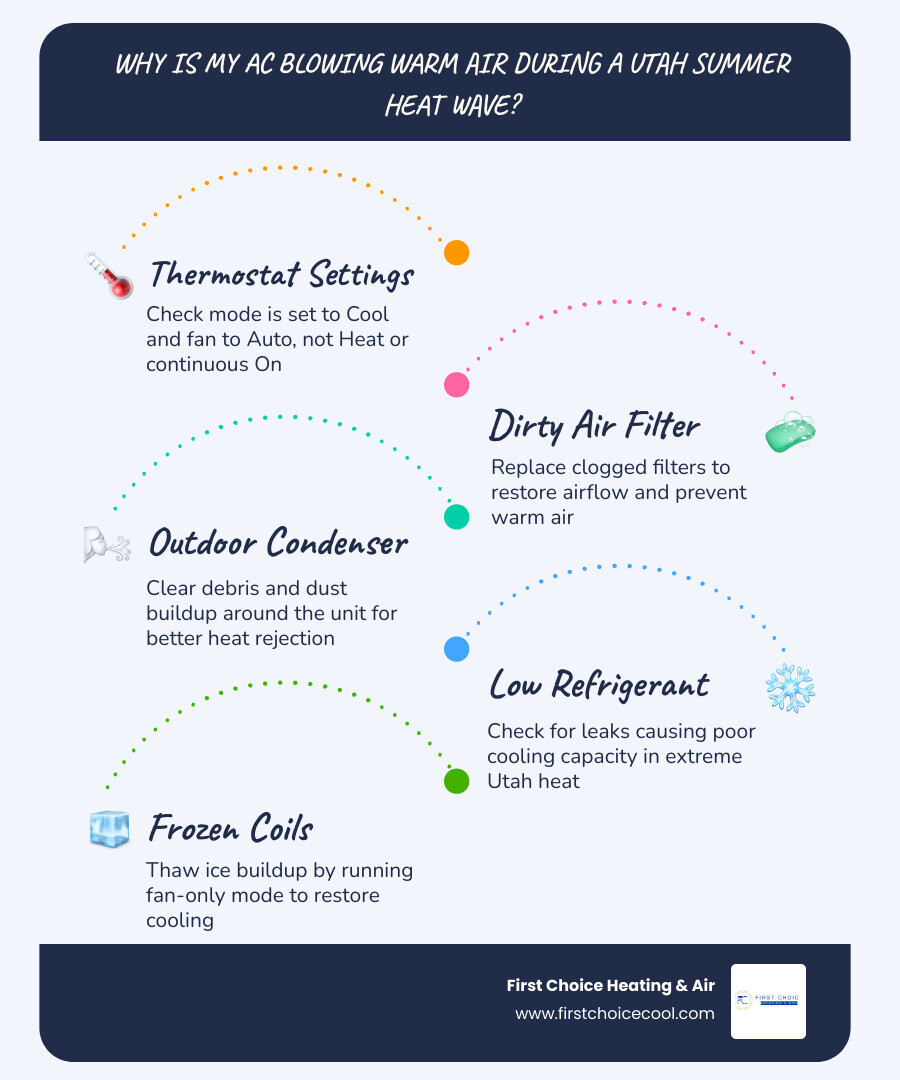
If you’re dealing with why is my ac blowing warm air during a utah summer heat wave, you’re not alone — and the fix is usually one of a handful of common problems. Here’s a quick look at the most likely causes:
Most Common Reasons Your AC Is Blowing Warm Air in Utah:
- Wrong thermostat setting — Fan is set to “ON” instead of “AUTO,” or mode is set to “Heat”
- Dirty air filter — Restricted airflow is the single most preventable cause of warm air
- Clogged or dirty condenser coils — Utah’s dust and dry heat clog outdoor units fast
- Low refrigerant or a leak — The system can’t absorb heat without a proper refrigerant charge
- Frozen evaporator coils — Caused by poor airflow or low refrigerant
- Tripped circuit breaker — The outdoor unit loses power while the indoor fan keeps running
- Failing compressor or capacitor — More common during triple-digit Utah summers
Utah summers are brutal. Temperatures across the Wasatch Front regularly climb past 100°F, and your AC is working harder than it was ever designed to — sometimes running nonstop for days. When something goes wrong during a heat wave, it’s not just uncomfortable. It can become a real health risk, especially for kids, older adults, and pets.
The good news? Most warm air problems have a clear cause and a straightforward fix. This guide walks you through exactly what to check, what to do yourself, and when to call a professional.
When a heat wave hits places like Salt Lake City, West Jordan, and Bluffdale, the demands on our cooling systems skyrocket. Air conditioners account for nearly 20% of yearly electricity consumption in the United States, and during a scorching July or August stretch, that percentage feels much higher at home.
Utah’s unique geography and climate create a double-whammy for air conditioning systems. The Salt Lake Valley sits at roughly 4,300 feet above sea level. At this altitude, the air is thinner, meaning your air conditioner moves less air mass per hour compared to a system running at sea level. When you pair this altitude with relative humidity levels that often drop below 15% and temperatures that exceed 100°F, your system is running a literal marathon.
Furthermore, our local weather patterns don’t just stress your system in the summer. The particulate matter trapped during our winter inversion season settles quietly on your dormant outdoor equipment, creating a layer of grime that acts as an insulating blanket when summer arrives. If you neglect seasonal Home Maintenance, your air conditioner will struggle to reject heat into the already boiling outdoor air.
Thermostat Settings: Why Is My AC Blowing Warm Air During a Utah Summer Heat Wave?
Before we assume your system has suffered a catastrophic mechanical breakdown, we always start with the simplest, most common culprit: the thermostat. It is incredibly easy for a family member to accidentally bump the thermostat, or for a quick power flicker to reset your settings.
There are two primary thermostat issues that cause an AC to blow warm air:
- The Mode is Set to “Heat”: It sounds silly, but it happens more often than you think. If someone was trying to turn off the system or adjust the temperature in a hurry, they might have toggled the system into heating mode.
- The Fan is Set to “ON” Instead of “AUTO”: When your thermostat fan setting is set to “ON,” the indoor blower fan runs continuously, 24 hours a day, regardless of whether the outdoor cooling unit is actually running. When the cooling cycle pauses, the fan will continue to push air through your home. Because the air isn’t being actively cooled, it will feel warm, dry, and stagnant. Setting the fan to “AUTO” ensures the fan only blows when the system is actively cooling the air.
In addition, weak or dying thermostat batteries can cause the device to lose connection with your HVAC system, leading to erratic signaling where the indoor fan runs but the outdoor condenser never receives the command to turn on.
Airflow Restrictions: Why Is My AC Blowing Warm Air During a Utah Summer Heat Wave?
Air conditioning systems do not actually “create” cold air; instead, they remove heat from your indoor air, carpet, furniture, and walls, transferring that heat outside. To do this efficiently, the system requires a massive, uninterrupted volume of air flowing across the indoor evaporator coil.
When airflow is restricted, the delicate balance of the cooling cycle is broken. The primary causes of restricted airflow include:
- Dirty Air Filters: A simple task such as changing the air filter on your HVAC system can improve efficiency by up to 15%. Dirty filters are the most frequent and preventable cause of warm air problems. When a filter is clogged with dust, pet dander, and Utah valley soil, the blower fan can’t pull enough air over the evaporator coil.
- Clogged Condenser Coils: The outdoor unit (the condenser) needs to release the heat it gathered from inside your home. If the metal fins of the outdoor unit are caked in dirt, cottonwood seeds, or dry grass clippings, the heat remains trapped inside the refrigerant loop, sending warm air right back into your living spaces.
- Blocked Vents and Registers: Closing too many interior doors or blocking supply and return registers with furniture restricts the system’s breathing capacity, forcing it to work harder and occasionally overheat.
5 Steps to Troubleshoot and Fix Your Warm AC Air
If your home is starting to feel like a sauna, don’t panic. Follow these five practical steps to diagnose and potentially resolve the problem before calling in the professionals.
Step 1: Verify Thermostat Settings and Power
Walk over to your thermostat and take a close look at the display screen.
- Ensure the system is explicitly set to COOL and the fan is set to AUTO.
- Lower the target temperature at least 5 degrees below the current room temperature to force the system to call for cooling.
- If the display is blank or flashing a low-battery icon, replace the batteries immediately.
- Next, head to your home’s electrical panel. Look for the circuit breaker labeled “AC” or “Air Conditioner.” During extreme heat waves, the outdoor compressor draws a significant amount of electrical current. If the breaker has tripped to the middle position, switch it completely to OFF and then back to ON. Note: If the breaker trips again immediately, do not attempt to reset it a second time. This indicates a serious electrical fault that requires professional attention.
Step 2: Inspect and Replace the Air Filter
Locate your return air filter slot (usually found in a hallway ceiling, wall, or directly next to your indoor furnace/air handler unit). Pull the filter out and hold it up to a light source. If you cannot see light passing through the fibers, or if it is covered in a gray layer of dust, it must be replaced.
During the peak of a Utah summer heat wave, your system runs almost continuously. We recommend replacing basic 1-inch pleated filters every 30 days during July and August to maintain optimal airflow and prevent system strain.
Step 3: Clear Debris Around the Outdoor Condenser
Walk outside and inspect your outdoor condenser unit. Over the spring and summer, wind-blown weeds, leaves, and dirt can accumulate around the base of the machine.
- Ensure there is at least a two-foot clearance of open space around the entire perimeter of the unit. Trim back any bushes, trees, or decorative plants.
- Turn off the power to the outdoor unit (using the outdoor disconnect switch box mounted on your home’s siding).
- Take a gentle garden hose (never a high-pressure power washer, which will bend and ruin the delicate aluminum fins) and spray down the exterior coils at a downward angle to wash away accumulated dirt and pollen.
Step 4: Check for Frozen Evaporator Coils
If your air handler is running but the air coming out of the vents is barely moving and warm, your indoor evaporator coil may have frozen into a solid block of ice.
- Look at the brass refrigerant lines entering your indoor unit. Do you see frost or ice buildup?
- If so, turn your thermostat setting from COOL to OFF, but switch the fan setting to ON.
- This runs the blower motor without running the compressor, allowing the warm indoor air to safely thaw the ice over the course of several hours. Keep a close eye on your condensate drain pan to ensure the melting ice doesn’t overflow.
Step 5: Examine Ductwork and Vents
Ensure that all supply registers throughout your home are open and completely unobstructed by drapes, rugs, or furniture. While it might seem smart to close vents in unused rooms, doing so actually increases static pressure inside your ductwork, which can cause the system to freeze up or blow warm air. Additionally, quickly inspect any accessible ductwork in your basement or utility closet for obvious disconnected joints or large tears that could be sucking in hot, unconditioned air.
Mechanical Failures and Refrigerant Issues in Extreme Heat
When basic troubleshooting steps don’t resolve the issue, the problem is likely a mechanical or chemical failure within the cooling loop. During extreme heat waves, internal components are subjected to intense thermal stress, which can cause older or weakened parts to fail completely.
To help you understand what you can handle versus what requires our specialized tools, review this quick reference guide:
| Troubleshooting Area | Can Be Done DIY? | Requires Professional HVAC Technician? |
|---|---|---|
| Thermostat Settings & Battery Replacement | Yes | No |
| Air Filter Replacement | Yes | No |
| Clearing Debris & Hosing Condenser Coils | Yes | No |
| Resetting a Tripped Breaker (Once) | Yes | No |
| Diagnosing & Repairing Refrigerant Leaks | No (Requires EPA Certification) | Yes |
| Replacing a Blown Capacitor | No (High Voltage Danger) | Yes |
| Replacing a Failed Compressor | No | Yes |
| Repairing Leaky Attic Ductwork | No | Yes |
Low Refrigerant and Leaks
Refrigerant is the lifeblood of your air conditioner. It circulates in a closed loop between the indoor evaporator coil and the outdoor condenser coil, absorbing heat from inside and releasing it outside.
A common misconception is that air conditioners “consume” refrigerant over time. In reality, your system should never need to be topped off or recharged unless there is a physical leak in the copper lines or coils.
When refrigerant levels run low due to a leak:
- The system cannot absorb heat efficiently, resulting in lukewarm air coming from your vents.
- You may hear a distinct hissing or bubbling sound near the indoor or outdoor unit.
- The drop in pressure will cause the indoor coil to drop below freezing, leading to significant ice buildup on the copper lines.
Warning: Handling refrigerant requires strict EPA Section 608 certification. Attempting to add refrigerant yourself without proper training and licensing is illegal, dangerous, and can permanently ruin your compressor.
Compressor and Capacitor Failures
The outdoor unit houses two critical electrical components: the compressor (which pumps the refrigerant) and the capacitor (which acts like a large battery to assist the fan motor and compressor during startup).
During a Utah heat wave, capacitors fail at an incredibly high rate. When outdoor temperatures exceed 95°F, the interior of the electrical cabinet on your outdoor unit can easily reach 140°F. This extreme heat degrades the electrical seals inside the capacitor, causing it to swell, leak, or fail entirely.
If your capacitor fails, you may hear a faint humming noise from the outdoor unit, but the fan and compressor won’t start. If the compressor itself is failing, you might hear a loud, metallic shrieking or clattering sound when the system attempts to turn on, often followed by a tripped circuit breaker.
Long-Term Solutions for Utah’s Unique Climate Challenges
If you find yourself constantly calling for repairs every time the temperature climbs past 95 degrees, it may be time to look at long-term solutions designed specifically for our high-desert climate. Replacing a decade-old air conditioner could save you up to 50% on your monthly utility bills while restoring reliable comfort. If you are debating whether to keep patching up your current system or invest in a new one, take a look at our comprehensive AZ Guide to AC Repair vs Replace to weigh your options.
The Impact of Utah’s Winter Inversion on Summer Cooling
Many homeowners don’t realize that our winter weather directly impacts our summer cooling performance. During the winter inversion season, fine particulate matter (PM2.5), soot, and road salt become heavily concentrated in the valley air.
Because outdoor AC units sit dormant through the winter, these microscopic particles settle deep within the metal fins of your condenser. When spring arrives and the system is turned on, this accumulation acts as a barrier, preventing efficient heat transfer. This is why annual spring maintenance is absolutely critical along the Wasatch Front. A professional cleaning washes away the winter’s grime, ensuring your system is fully prepared to handle the summer heat.
Upgrading and Sizing Your AC for Extreme Heat
When it is time to upgrade, proper system sizing is everything. An oversized AC will cycle on and off rapidly (short-cycling), which wears out components and fails to remove humidity. An undersized unit will run continuously without ever cooling your home down to your thermostat’s setpoint.
We utilize precise load calculations that factor in Utah’s dry climate, your home’s orientation to the sun, and attic insulation levels. For homes with uneven temperatures—such as a hot second story—we often recommend:
- Zoning Systems: Dampers installed inside your ductwork allow you to direct cooling power exactly where it’s needed, keeping your bedrooms comfortable without freezing your basement.
- Ductless Mini-Splits: These systems provide targeted, highly efficient cooling to specific rooms or additions without relying on traditional ductwork.
Frequently Asked Questions about Warm AC Air
Is it safe to keep running my AC if it is blowing warm air?
No, it is not safe to keep running your system. If your air conditioner is blowing warm air, continuing to run it can cause severe, permanent damage. For example, if the issue is a simple dirty filter causing the coils to freeze, running the system continuously can force liquid refrigerant back into the compressor. This can wash away the compressor’s lubricating oil and destroy its internal valves, turning a simple filter replacement into an expensive compressor failure. Turn the system off at the thermostat immediately.
Why does my AC only blow warm air during the hottest part of the day?
If your system cools perfectly fine in the morning and evening but struggles to keep up between 2:00 PM and 6:00 PM, it is usually a sign of one of three things:
- Dirty Condenser Coils: The unit can reject heat when the outdoor air is 80°F, but cannot do so when the air is 100°F.
- Poor Attic Insulation: An under-insulated attic can reach temperatures of 140°F, radiating heat back down into your living spaces and overwhelming your AC. Proper attic insulation can reduce overall cooling energy consumption by up to 40%.
- An Undersized Unit: The system simply doesn’t have the capacity to keep up with the peak heat load of the day.
How often should I change my AC filter during a Utah summer?
In Utah’s dry, dusty climate, we recommend checking your air filter once a month during the peak cooling season (June through September). If you have pets, live near a construction zone, or are close to the dusty foothills, you may need to replace your filter every 30 days to keep your system running efficiently.
Conclusion
Surviving a triple-digit Utah summer heat wave requires a cooling system that is clean, well-maintained, and running efficiently. While simple issues like a wrong thermostat setting or a dirty air filter can easily be resolved on your own, mechanical failures and refrigerant leaks require professional expertise.
At First Choice Heating & Air, we are proud to serve our neighbors throughout Bluffdale, Salt Lake City, West Jordan, and the surrounding Salt Lake and Utah counties. We are committed to providing reliable, community-focused service backed by competitive financing, comprehensive maintenance plans, and strong warranties.
If you are new to our community or just want to learn more about our team, read our Hello World post to get to know us better.
Don’t spend another afternoon sweating in your own living room. Schedule professional AC service with First Choice Heating & Air today, and let us restore the cool, comfortable sanctuary your family deserves!