


What the SEER2 Transition Means for Utah Homeowners — And Why It Matters Now
How SEER2 replaced the old seer rating and what it means for utah homeowners comes down to one key change: in January 2023, the U.S. Department of Energy updated the way air conditioners and heat pumps are tested, resulting in a new efficiency label called SEER2. If you’re shopping for a new system in Utah — or just trying to understand your energy bills — here’s what you need to know right away:
Quick Summary
- SEER2 replaced SEER on January 1, 2023, under a new Department of Energy testing standard called Appendix M1
- SEER2 numbers run about 4.7% lower than old SEER numbers for the exact same equipment — the units aren’t less efficient, the test is just more realistic
- Utah is in the DOE’s North Region, which sets these minimums for new systems installed today:
- Split system central AC (under 45,000 BTU): 13.4 SEER2
- Split system central AC (45,000 BTU and above): 14.0 SEER2
- Heat pumps: 14.3 SEER2
- Gas furnaces: 81% AFUE
- Your existing system is not affected — the rules only apply to new equipment installed after January 1, 2023
- A quick conversion: multiply any old SEER rating by 0.95 to get its rough SEER2 equivalent (e.g., 14 SEER ≈ 13.4 SEER2)
If your home’s AC is aging, running longer than it used to, or pushing your summer utility bills higher, understanding these standards helps you make a smarter decision when it’s time to replace.
The shift to SEER2 confused a lot of Utah homeowners — and understandably so. A brand-new unit showing a lower number on the label than the one it’s replacing can feel like a step backward. It isn’t. The number changed; the efficiency didn’t. What changed is that the test now reflects the real pressure and resistance inside your home’s ductwork, giving you a more honest picture of what you’re actually buying.
The sections below break down exactly how the testing changed, what the numbers mean for your home in Salt Lake or Utah County, and how to use this information to choose the right system with confidence.
How SEER2 Replaced the Old SEER Rating and What It Means for Utah Homeowners
To understand how this shift impacts your home comfort, we have to look at how we got here. For decades, the Seasonal Energy Efficiency Ratio (SEER) was the gold standard for measuring how much electricity an air conditioner consumed over an average cooling season.
However, as homes became more tightly sealed and duct systems grew more complex, the old laboratory testing methods began to drift away from reality. The Department of Energy realized that systems operating in real homes were facing much higher resistance than they did in pristine laboratory conditions.
This realization led to the creation of the SEER2 standard under the Appendix M1 testing procedure. This is not just a cosmetic update; it changes the physical demands placed on manufacturers. To meet these new, tougher testing standards, manufacturers had to upgrade their system components, including installing more robust blower motors and redesigning evaporator coils. For proactive homeowners, keeping up with these changes is a fundamental part of smart Home Maintenance.
Understanding How SEER2 Replaced the Old SEER Rating and What It Means for Utah Homeowners
At its core, SEER measures a system’s cooling output (measured in British Thermal Units, or BTUs) divided by its total electrical energy input (measured in watt-hours) over a simulated cooling season.
Because the new SEER2 testing protocol uses a much higher external static pressure to simulate real-world ductwork, every air conditioner tested under the new system receives a rating that is roughly 4.7% lower than it would have under the old SEER system.
It is incredibly important to remember: the physical efficiency of the air conditioner has not decreased. Instead, the ruler we use to measure that efficiency has simply become more accurate.
To help you compare older, legacy systems with the new equipment available today in West Jordan, Salt Lake City, and across Salt Lake County, we have compiled a quick conversion table:
| Legacy SEER Rating | New SEER2 Equivalent (Approx. 4.7% Lower) |
|---|---|
| 14.0 SEER | 13.4 SEER2 |
| 15.0 SEER | 14.3 SEER2 |
| 16.0 SEER | 15.2 SEER2 |
| 18.0 SEER | 17.1 SEER2 |
| 20.0 SEER | 19.0 SEER2 |
| 24.0 SEER | 22.8 SEER2 |
Why How SEER2 Replaced the Old SEER Rating and What It Means for Utah Homeowners Matters for Upgrades
If you already own an older HVAC system in Utah County or Salt Lake County, there is no need to panic. The Department of Energy did not pass a law requiring you to tear out your existing air conditioner. A “grandfather clause” protects homeowners, meaning you can legally run your current SEER-rated system until it naturally reaches the end of its operational lifespan.
However, when your system does eventually break down, or if you are currently facing a major repair, the transition to SEER2 becomes highly relevant. Any new system we install for you today must meet the updated SEER2 minimum standards. If you are trying to decide whether to fix your aging unit or invest in a modern, compliant upgrade, you can weigh your options using our comprehensive AZ Guide to AC Repair vs Replace.
Why the Department of Energy Updated Testing Standards
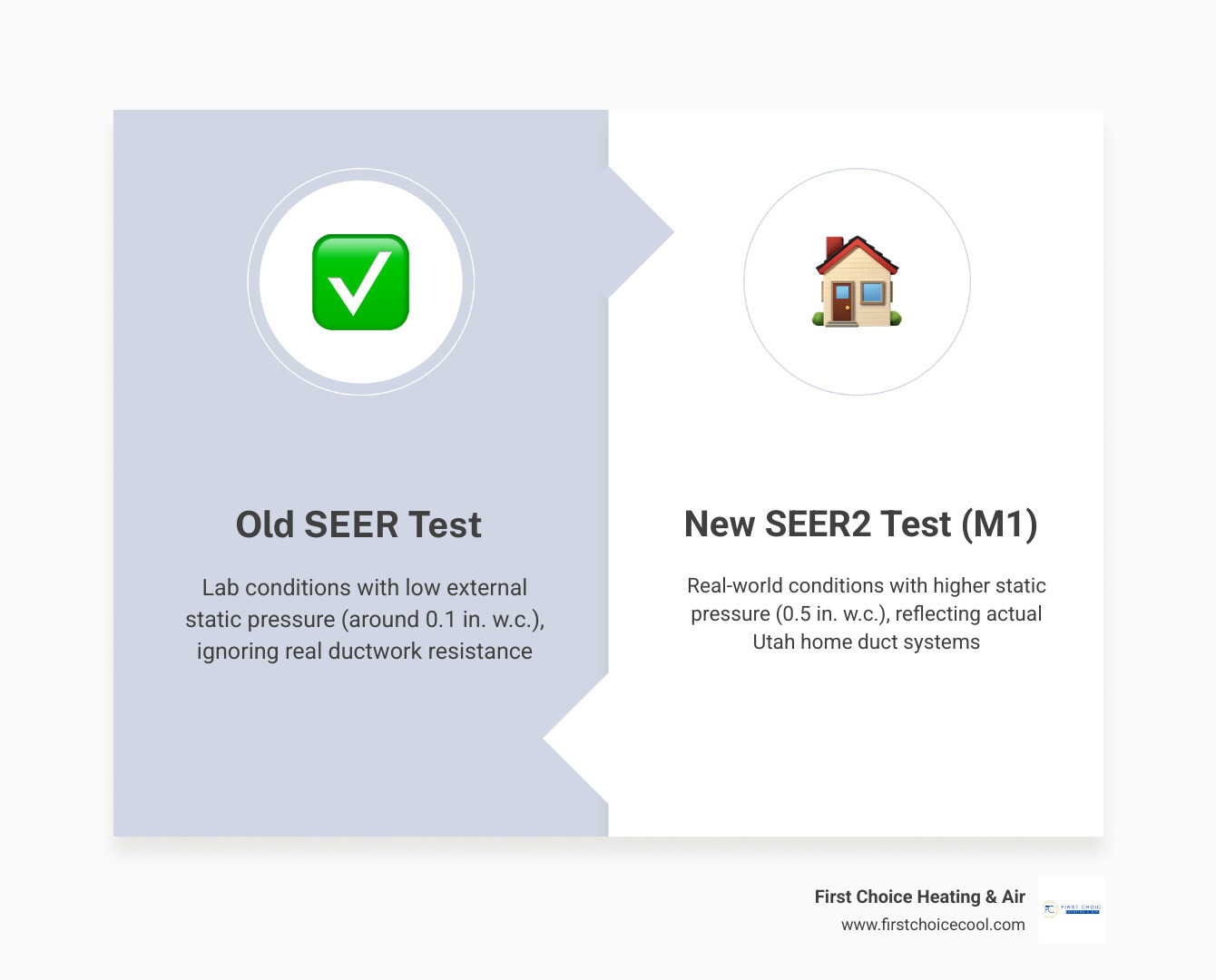
To truly appreciate the value of SEER2, we have to look inside a standard home’s duct system. The old SEER standard, designed decades ago, evaluated air conditioners under an external static pressure of only 0.1 inches of water column (in. w.c.).
In a laboratory, 0.1 in. w.c. of pressure is easy to maintain. But in a real Utah home, air has to travel through return grilles, tight bends, physical ductwork, and internal air filters. This creates friction and resistance. In the real world, the average residential duct system operates at a static pressure closer to 0.5 in. w.c.—five times higher than the old testing environment!
Because the old test underestimated this resistance, homeowners often noticed a “performance gap.” A system rated at 16 SEER in a lab might only deliver the equivalent of 14 SEER once connected to restrictive residential ductwork. By raising the testing standard to 0.5 in. w.c., the DOE forced manufacturers to build systems that maintain their rated efficiency even when pushing air through real, imperfect home ducts.
Utah Minimum Efficiency Requirements and Regional Standards
The Department of Energy divides the United States into three distinct regions for cooling standards: the North, the Southeast, and the Southwest. Because of our geographical location and climate patterns, Utah is categorized under the North Region.
As a result, Utah homeowners must adhere to the following minimum efficiency standards for any new equipment installations:
- Central Air Conditioners (Under 45,000 BTU): Must meet a minimum of 13.4 SEER2 (which corresponds to the old 14.0 SEER standard). These are typical for small-to-medium residential homes.
- Central Air Conditioners (45,000 BTU and Above): Must meet a minimum of 14.0 SEER2. These larger systems require slightly more robust baseline efficiency to manage their higher energy load.
- Heat Pumps: Must meet a minimum of 14.3 SEER2 (equivalent to 15.0 SEER) and 7.5 HSPF2 (equivalent to 8.8 HSPF).
- Gas Furnaces: Must meet a minimum of 81% AFUE (Annual Fuel Utilization Efficiency).
These regional rules are strictly enforced for manufacturers and installers. When we help you select a system for your home in Bluffdale or Salt Lake City, we ensure that every piece of equipment complies perfectly with these regional baselines.
Beyond SEER2: Companion Ratings for Utah Climates
While SEER2 is the primary rating you will see on an air conditioner’s yellow EnergyGuide label, it is not the only metric that matters. To get a complete picture of your home’s year-round utility costs and comfort, you should also pay attention to these companion ratings:
- EER2 (Energy Efficiency Ratio 2): While SEER2 calculates average efficiency over an entire season, EER2 measures steady-state efficiency at a fixed, high outdoor temperature of 95°F. On our hottest July days in the Salt Lake Valley, EER2 tells us exactly how hard your system has to work to keep you cool.
- HSPF2 (Heating Seasonal Performance Factor 2): If you use an electric heat pump to both heat and cool your home, HSPF2 measures its heating efficiency over the winter season. Just like SEER2, HSPF2 uses more realistic testing pressures, meaning a minimum of 7.5 HSPF2 is required in Utah.
- AFUE (Annual Fuel Utilization Efficiency): For homes relying on a gas furnace during our freezing Utah winters, AFUE measures how efficiently the system converts natural gas into usable heat. A system with an 81% AFUE rating converts 81% of the fuel to heat, while the remaining 19% escapes through the chimney or flue. High-efficiency condensing furnaces can reach up to 95% to 98% AFUE.
The Power of Variable-Speed Technology
If you choose a system that sits well above the minimum standards (such as 18 or 20+ SEER2), it will likely feature a variable-speed inverter compressor.
Unlike traditional single-stage systems that turn on at 100% capacity and shut off completely, variable-speed systems can adjust their output in tiny increments (sometimes down to 25% capacity). This allows them to run continuously at lower speeds, providing superior humidity control, quieter operation, and significantly lower energy consumption during mild spring and autumn days.
Upfront Investment, Payback Periods, and Financial Incentives
It is a simple reality of the HVAC industry that higher efficiency standards require more advanced components, such as electronically commutated blower motors (ECM) and larger thermal transfer coils. As a result, systems with higher SEER2 ratings carry a higher upfront investment compared to minimum-efficiency models.
However, this initial cost is balanced by long-term operating savings. For example, upgrading to a 20 SEER2 unit can reduce your cooling energy consumption by approximately 43% compared to a baseline 14 SEER2 unit. Over the typical 15-year lifespan of a central air conditioner, these monthly utility savings can pay back the initial premium of the high-efficiency system.
Maximizing Your Savings with Incentives
To make these high-efficiency upgrades more accessible, there are several financial incentives available to Utah homeowners:
- Federal Tax Credits (Inflation Reduction Act – Section 25C): You can claim up to 30% of the installation cost (up to a maximum of $2,000) for qualifying high-efficiency heat pumps that meet CEE Tier 1 standards. For qualified high-efficiency air conditioners, credits of up to $600 are available.
- Local Utility Rebates: Rocky Mountain Power and Dominion Energy frequently offer cash-back rebates for homeowners who install smart thermostats, high-efficiency heat pumps, or qualifying gas furnaces.
- Flexible Financing: To help manage the initial investment without putting stress on your household budget, we offer competitive financing options tailored to your specific project goals.
Frequently Asked Questions About SEER2 in Utah
Do I need to replace my existing SEER-rated air conditioner?
No. There is no legal requirement to replace a functioning, older system. The SEER2 regulations only govern the manufacture and installation of new equipment. You can continue to run, service, and maintain your existing system for its entire natural lifespan.
How do I find my current system’s SEER2 rating?
You can find this information on the yellow EnergyGuide label affixed to your outdoor condenser unit. If the label has faded or peeled off, simply locate the manufacturer’s data plate on the side of the cabinet, note the model number, and look it up in the AHRI (Air-Conditioning, Heating, and Refrigeration Institute) Directory of Certified Product Performance.
What is considered a good SEER2 rating for a Utah home?
- 13.4 to 14.3 SEER2 (Standard/Budget): Great for homeowners looking for a reliable, code-compliant system with the lowest upfront equipment cost.
- 15 to 16 SEER2 (Mid-Range/Value): Often considered the “sweet spot” for many Utah families, offering a great balance of energy savings and reasonable upfront pricing.
- 17 to 19 SEER2 (High-Efficiency): Excellent for larger homes or homeowners looking to significantly reduce their carbon footprint and monthly utility bills.
- 20+ SEER2 (Ultra-Premium): Typically variable-speed systems that offer the absolute highest level of indoor temperature precision, humidity control, and quiet performance.
Conclusion
Navigating the transition from SEER to SEER2 doesn’t have to be overwhelming. By aligning laboratory testing with real-world residential duct pressures, the Department of Energy has made it easier for you to invest in a system that actually delivers on its efficiency promises.
At First Choice Heating & Air, we are proud to serve our neighbors in Bluffdale, Salt Lake City, West Jordan, and across Salt Lake and Utah Counties. As a community-focused team, we prioritize your long-term comfort and financial peace of mind. Whether you are looking for energy-efficient system installations, customized zoning solutions, or competitive financing options to help bring your home comfort dreams to life, we are always here to help.
Ready to explore your options or get a professional assessment of your home’s current efficiency? Contact us today at First Choice Heating & Air to schedule a consultation with our friendly, local HVAC experts!