


Is an HVAC Maintenance Plan Worth It in Utah’s Hot Summers and Cold Winters?
Is an HVAC maintenance plan worth it in a hot summer and cold winter Utah climate? Yes — and more so than in most other states. Utah’s Wasatch Front puts extreme seasonal demands on heating and cooling equipment that simply don’t exist in milder climates. Systems here work harder, wear faster, and face unique environmental stressors like high-desert dust, dry air, and altitude that quietly chip away at efficiency all year long.
Here’s the short answer for homeowners evaluating whether a plan makes sense:
An HVAC maintenance plan is worth it in Utah if:
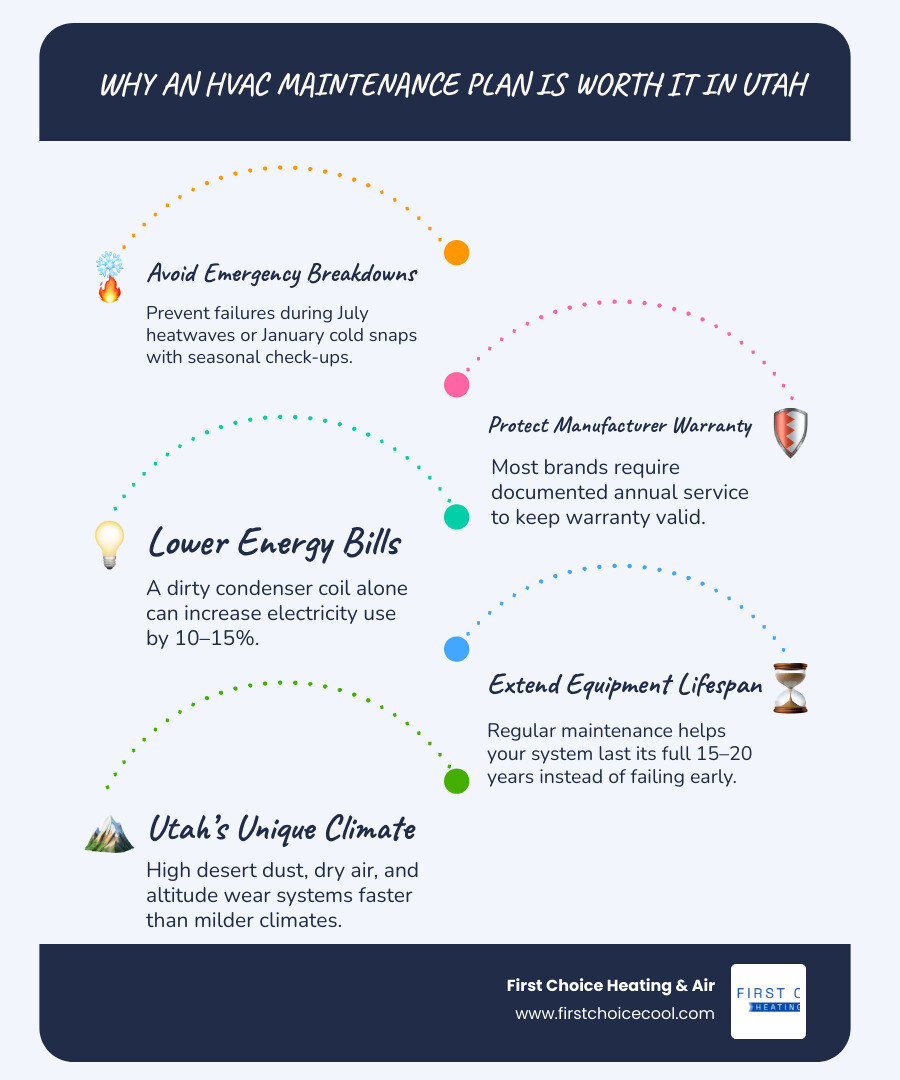
- Your system is your primary source of heating and cooling (most homes on the Wasatch Front)
- You want to avoid emergency breakdowns during a July heatwave or a January cold snap
- You want to keep your manufacturer warranty valid — most brands require documented annual service
- You want lower energy bills (a dirty coil alone can increase electricity use by 10–15%)
- You want your equipment to last its full 15–20 year lifespan instead of failing 3–5 years early
It may be less critical if:
- Your system is brand new and still under full manufacturer coverage with no maintenance documentation requirement
- You plan to sell your home within the next few months
For the vast majority of Utah homeowners dealing with 100°F summers and single-digit winter nights, a structured maintenance plan is one of the most cost-effective decisions you can make for your home.
Think of it this way: a furnace that sits idle all summer can fail on the very first cold night of autumn if no one checked it in the fall. That’s not a hypothetical — it’s one of the most common service calls HVAC technicians across northern Utah respond to every October.
The sections below break down exactly what a plan covers, what it costs to skip one, and how Utah’s specific climate conditions make preventative care more valuable here than almost anywhere else.
Is an hvac maintenance plan worth it in a hot summer and cold winter utah climate terms to know:
- AC Tune-Up for Wasatch Front Homeowners
- How Often Should You Service Your Air Conditioner in a Hot Dry Utah Climate
- Summer AC Maintenance Checklist for Sandy, Bluffdale, and Saratoga Springs Homeowners
Why the Wasatch Front Demands Specialized HVAC Care
To understand why preventative service is so vital here, we have to look at the unique geographical factors of our region. As we discuss in our detailed guide on Why the Salt Lake Valley is One of the Most Demanding HVAC Climates in the West, our local environment acts as a constant obstacle course for your heating and air conditioning systems.
From Bountiful down to Bluffdale, and throughout Salt Lake County and Utah County, your outdoor AC condenser unit is constantly bombarded by desert dust, seasonal pollen, and agricultural debris. In late spring, cottonwood seeds act like a thick blanket, wrapping around your condenser coils and choking off vital airflow.
Add to this the reality of summer wildfire smoke and winter inversions. During inversion season, cold air traps particulate pollution close to the valley floor. Your HVAC system is your home’s primary defense mechanism, filtering out these heavy pollutants. Without regular maintenance and filter changes, these airborne particles clog your system, restrict airflow, and force your blower motor to run hotter and work harder than it was ever designed to do.

How Utah’s Altitude and Dry Air Impact Your System
Our high altitude—averaging over 4,500 feet across the Salt Lake Valley—means the air is thinner and contains less oxygen. This directly impacts gas furnaces. Because combustion requires a precise ratio of fuel to oxygen, furnaces in Utah must be carefully calibrated to ensure clean, efficient burning. If your burners are dirty or out of calibration, the system will lose efficiency, waste fuel, and potentially produce elevated levels of carbon monoxide.
Furthermore, Utah’s dry mountain air presents its own challenges. In the winter, relative humidity drops significantly. Many homeowners rely on whole-home humidifiers integrated directly into their ductwork to keep indoor air comfortable and protect hardwood floors. These humidifiers require annual pad replacements and solenoid valve inspections to prevent mineral buildup from our hard local water.
In the summer, our dry air actually helps air conditioners cool more efficiently because there is less latent moisture to remove. However, the high volume of dry dust easily mixes with the small amount of moisture that does condense on your indoor evaporator coil, turning into a sticky grime that can clog your condensate drain lines and lead to water damage in your basement or utility room.
Is an HVAC maintenance plan worth it in a hot summer and cold winter utah climate when dealing with extreme temperature swings?
Utah is famous for its rapid weather shifts. It is not uncommon to experience 30-to-40-degree temperature swings within a single 24-hour period, especially during the spring and autumn transition months.
These extreme temperature fluctuations cause rapid thermal expansion and contraction within your HVAC equipment. Copper refrigerant lines, electrical connections, and metal heat exchangers expand when hot and contract when cold. Over time, this physical movement can loosen electrical terminals, stress soldered joints, and cause minor refrigerant leaks.
Without a proactive maintenance plan to catch these issues during the mild spring and fall seasons, a loose wire or a slightly low refrigerant charge will inevitably turn into a complete system shutdown on the first afternoon the outdoor temperature hits 100°F.
Is an HVAC maintenance plan worth it in a hot summer and cold winter utah climate?
When you look at the physical toll our weather takes on mechanical equipment, the value of structured preventative care becomes clear. When exploring the core reasons to invest in your system, we highly recommend reading Why Choose a Maintenance Plan? Explore Preventative Benefits to understand how consistent, professional attention keeps your home safe and comfortable.
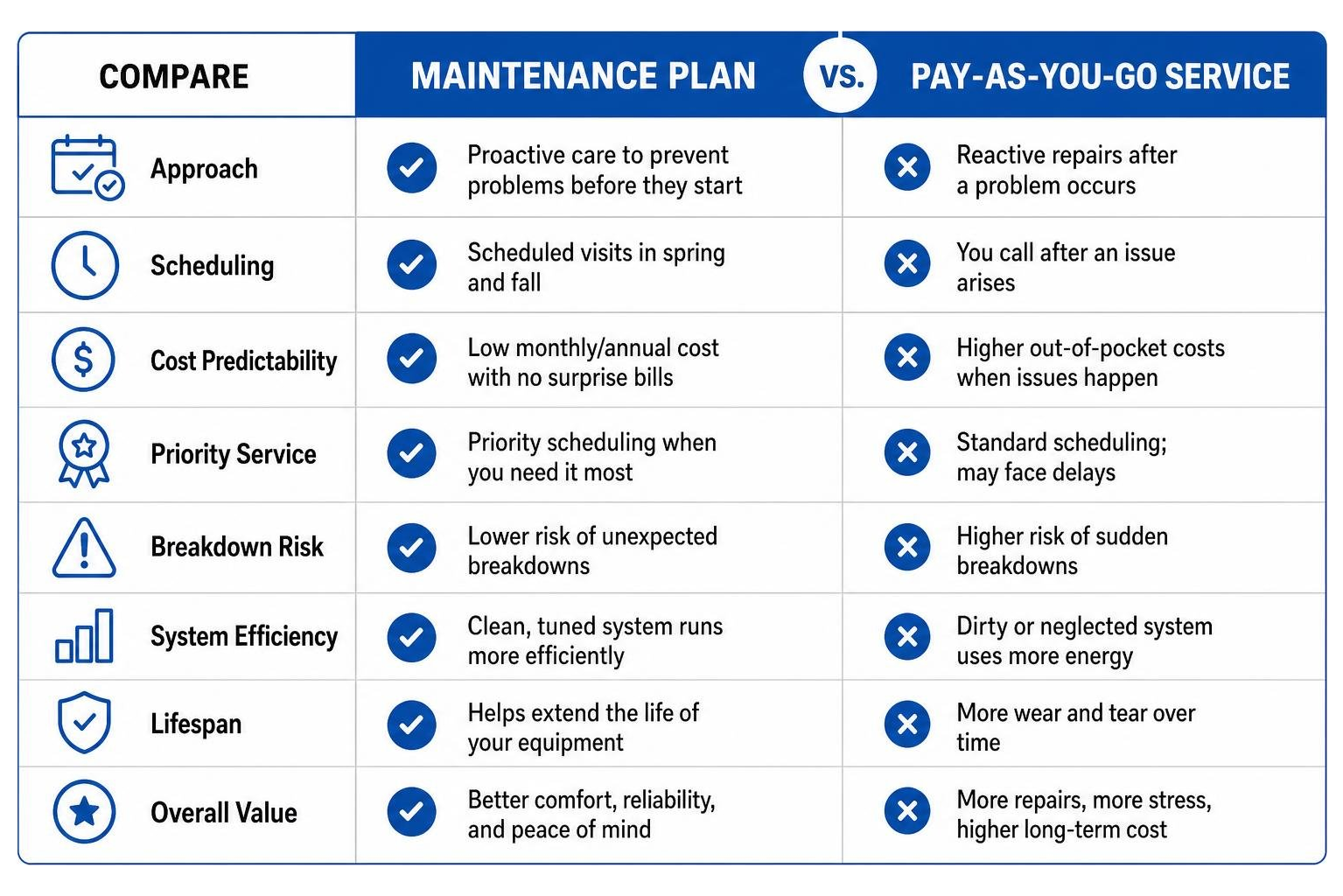
Rather than waiting for something to break and calling for an emergency repair, a maintenance plan shifts your home care into a proactive model.
The Financial ROI of Preventative Maintenance
Skipping maintenance to save a quick buck is a classic example of being penny-wise and pound-foolish. The math of running an unmaintained system simply does not add up over the long term.
For starters, consider your monthly utility bills. According to the Department of Energy, heating and cooling account for roughly half of a home’s energy consumption. When your outdoor condenser coil is caked in fine desert dust, your system cannot shed heat efficiently. An AC operating with a dirty condenser coil uses 10% to 15% more electricity to achieve the exact same cooling output as a clean coil.
On the heating side, a furnace operating with a partially clogged filter and dirty burner can easily lose 8% to 12% of its rated efficiency. Over our long Utah heating season—which typically runs for five to six active months—that wasted fuel translates to a significant amount of money literally vanishing into thin air.
For a deeper dive into how these savings stack up, check out our guide on 6 Reasons Why Getting a Maintenance Plan is a Good Choice for You. The reality is that over a ten-year period, a homeowner who invests in a regular maintenance plan spends far less overall than a homeowner who neglects their system, suffers a major component failure (like a failed compressor or blower motor), and is forced to replace their system years ahead of schedule.
Protecting Your Manufacturer Warranty and Equipment Lifespan
Many homeowners are surprised to learn that their equipment’s manufacturer warranty is not unconditional. Major brands like Carrier, Lennox, and Trane explicitly state in their warranty terms that the equipment must be serviced annually by a licensed HVAC professional to keep the parts warranty valid.
If your compressor fails five years into its life, the manufacturer may require you to provide documented service records proving the system was maintained. If you cannot produce those records, your claim could be denied, leaving you to pay for a costly replacement out of pocket.
Regular maintenance also directly extends the physical lifespan of your system. While a well-maintained furnace can easily last 15 to 20 years along the Wasatch Front, a neglected system under constant stress from clogged filters and dirty coils is likely to suffer a catastrophic failure 3 to 5 years earlier. Preventing this premature replacement is the single biggest hidden financial benefit of a maintenance plan.
What a Comprehensive Utah HVAC Maintenance Plan Includes
A true maintenance plan is not just a quick visual inspection. It is a rigorous, multi-point technical tune-up performed twice a year to prepare your home for the upcoming seasonal shift. In our guide on Spring and Fall HVAC Seasonal Check-Ups, we detail how these visits are strategically timed to give you complete peace of mind.
During these visits, a qualified technician will perform critical tasks such as:
- Tightening all electrical terminals and inspecting wiring for signs of heat damage or arcing
- Verifying exact refrigerant charges using physical gauges to ensure peak efficiency
- Testing safety controls, limit switches, and thermostat calibration
- Flushing condensate drain lines to prevent water backups and basement flooding
Spring AC Tune-Up Essentials
Scheduled in March or April before the first major heatwave hits the valley, the spring visit focuses heavily on restoring your air conditioner’s cooling capacity. To see how timing impacts your system’s health, read our resource on How Frequently Should an HVAC System Be Maintained?.
Key spring tasks include:
- A thorough cleaning of the outdoor condenser coil to remove winter grime, dirt, and cottonwood seeds
- Testing the compressor’s amp draw to ensure it is operating within manufacturer specifications
- Checking the outdoor fan motor and lubricating moving parts to reduce friction
- Testing the capacitor, which is the most common component to fail during a summer heatwave
Fall Furnace Tune-Up Essentials
Scheduled in September or October, the fall visit is all about ensuring your home stays warm safely. The most critical step during a furnace tune-up is a meticulous inspection of the heat exchanger. Because a furnace is a combustion appliance, any microscopic crack or rust hole in the heat exchanger can allow toxic carbon monoxide to mix with the air circulating through your home.
Other essential fall steps include:
- Performing a professional combustion analysis to verify burner efficiency and safety
- Cleaning the burners and flame sensor to prevent ignition failures on freezing nights
- Inspecting and cleaning the blower motor assembly to maintain proper airflow
- Checking the integrity of venting systems and draft inducer motors
Is an HVAC maintenance plan worth it in a hot summer and cold winter utah climate for heat pump owners?
Absolutely. In fact, if you own a heat pump, a maintenance plan is even more critical. Unlike a traditional split system where the furnace runs in the winter and the AC runs in the summer, a heat pump operates year-round to provide both heating and cooling.
Because a heat pump works almost continuously, it accumulates double the wear and tear of a standard system. During a freezing Utah winter, your heat pump must regularly enter a “defrost cycle” to melt ice that naturally accumulates on the outdoor coils. If your reversing valve is sticking or your defrost controls are out of calibration, ice will quickly encase the unit, choking off airflow and potentially destroying the compressor. Twice-yearly professional maintenance is the only way to keep these complex, bidirectional systems running reliably.
Frequently Asked Questions About Utah HVAC Maintenance
How often should HVAC systems be serviced in Utah?
For optimal performance, safety, and efficiency, your heating and cooling systems should be serviced twice a year—once in the spring for your air conditioner, and once in the fall for your furnace. If you utilize a year-round heat pump, twice-yearly service is highly recommended by manufacturers to handle the continuous operational demand.
Do maintenance plans offer priority service during extreme weather?
Yes. One of the greatest non-financial benefits of a maintenance plan is priority scheduling. When temperatures soar past 100°F in July or drop below zero in January, local HVAC companies are flooded with emergency repair calls. While non-members may have to wait days for an open appointment, maintenance plan members are moved to the front of the line, ensuring your home’s comfort is restored as quickly as possible.
What are the hidden risks of skipping seasonal maintenance?
The most dangerous risk of skipping maintenance is an undetected cracked heat exchanger, which can leak deadly, odorless carbon monoxide into your home. Other risks include frozen water pipes in your walls if your heating fails while you are away, expensive emergency diagnostic fees, and the “domino effect” of part failure—where a simple, inexpensive worn component (like a failing capacitor) is left unaddressed and eventually destroys a major, expensive component (like your compressor).
Conclusion
When you live along the Wasatch Front, your HVAC system isn’t just an appliance—it is the heartbeat of your home’s daily comfort and safety. From the dusty, scorching summer afternoons in West Jordan to the freezing, inversion-heavy winter nights in Salt Lake City, your heating and cooling equipment works incredibly hard to protect your family.
Investing in our VIP Ultimate Savings Maintenance Plans is the best way to ensure your system is always up to the challenge. By choosing proactive care, you protect your manufacturer warranty, slash your monthly utility bills, prevent high-stress emergency breakdowns, and maximize the lifespan of your valuable equipment.
Don’t wait for your system to send you a distress signal in the middle of a winter storm or a summer heatwave. Contact us at First Choice Heating & Air today to enroll in a maintenance plan and experience the true peace of mind that comes with professional, local, and reliable HVAC care.