


How to Tell If Your AC Is Low on Refrigerant Before Spending Money on a Service Call
Knowing how to check if ac refrigerant is low before calling a technician in utah can save you time, frustration, and an unnecessary diagnostic fee. Before you pick up the phone, there are several clear warning signs you can look for yourself — no tools or certifications required.
Quick answer — signs your AC refrigerant may be low:
- Warm or lukewarm air from vents — air feels only slightly cooler than room temperature despite the AC running
- Ice forming on copper refrigerant lines — visible frost or solid ice on the larger copper pipe near the indoor or outdoor unit
- Hissing or bubbling sounds — audible near the indoor air handler or outdoor condenser unit
- AC runs constantly but never reaches setpoint — the system struggles to hit your thermostat’s target temperature even on moderate days
- Unexplained spike in energy bills — units running low on refrigerant often operate at only 60 to 70 percent of their original efficiency
- Water pooling near the indoor unit — melting ice from a frozen evaporator coil dripping onto the floor
Utah’s dry summer heat puts real pressure on home cooling systems. When your AC is fighting triple-digit temperatures in Salt Lake or Utah County and still can’t keep up, it’s easy to assume the worst. But not every cooling problem means a refrigerant leak — and not every refrigerant problem is obvious at first glance.
Here’s the key fact to understand upfront: refrigerant does not get used up during normal operation. Your AC is a sealed, closed-loop system. If the charge is low, there is a leak somewhere. That distinction matters, because simply “topping off” the system without finding and fixing the leak is not a real solution — and running a low system in Utah’s heat can quickly turn a manageable repair into a compressor replacement.
This guide walks you through exactly what to look for before you call a technician, so you can walk into that service call informed.
How to check if ac refrigerant is low before calling a technician in utah terms simplified:
- AC Troubleshooting Before Calling a Pro
- Frozen Evaporator Coil in a Hot Dry Utah Climate
- Why is My AC Blowing Warm Air During a Utah Summer Heat Wave
Rule Out Simple Airflow Issues First
Before we assume your system has a refrigerant leak, we need to rule out simple airflow blockages. Airflow restrictions and low refrigerant share many of the same symptoms—including warm air and frozen coils—but they have completely different solutions.
First, check your thermostat settings. Confirm that the mode is set to COOL, the target temperature is lower than the current indoor room temperature, and the fan is set to AUTO rather than ON. If the fan is set to ON, your system will continuously circulate indoor air even when the compressor is resting, which often feels like lukewarm draftiness.
Next, inspect your air filter. A dirty, gray, dust-packed air filter is one of the fastest ways to kill system airflow. When air cannot flow freely across your indoor evaporator coil, the heat exchange process stalls, which can cause the coil to freeze solid and block all cooling. If you have been wondering what causes my ac to blow hot air, a completely choked filter is a major culprit.
If your air filter looks more like a dryer lint trap than a filter, swap it out immediately. Turn the AC system off for a few hours to allow any accumulated ice to melt, and then turn it back on. If it starts blowing crisp, cold air again, you just saved yourself a service call! For more simple troubleshooting steps, check out our guide on how to fix warm ac air in 5 easy steps to see if you can resolve the issue yourself, or learn about the other reasons ac system blows warm air before jumping to conclusions.
How to Check If AC Refrigerant Is Low Before Calling a Technician in Utah
Once you have ruled out a simple clogged filter, it is time to perform a visual and physical inspection of your air conditioning system. Since we are dealing with July 2026 summer heat, we want to make sure your home in West Jordan, Bluffdale, or Salt Lake City stays cool and comfortable.

A visual inspection is completely safe to do yourself. You do not need to open any electrical panels or touch pressurized lines. Instead, you will look for specific physical indicators that point to a leak. To help you spot these issues, read up on the common signs of air conditioner refrigerant leaks and discover tips on how to spot refrigerant leaks in homes before calling in our team.
To help you distinguish between a simple dirty filter issue and a true low refrigerant problem, we have put together this comparison table:
| Symptom | Dirty Air Filter | Low Refrigerant Leak |
|---|---|---|
| Airflow Strength | Very weak or barely noticeable | Normal strength, but lukewarm |
| Air Temperature | Cool at first, then stops completely | Consistently lukewarm or room temp |
| Visual Ice | Evaporator coil may freeze | Ice on copper lines and outdoor unit |
| System Noises | Normal humming, maybe whistling | Hissing or bubbling sounds |
| Oily Residue | None | Oily spots on copper joints or coils |
| Energy Bill Impact | Moderate increase | Severe, sudden spike |
Visual Inspections: How to Check If AC Refrigerant Is Low Before Calling a Technician in Utah
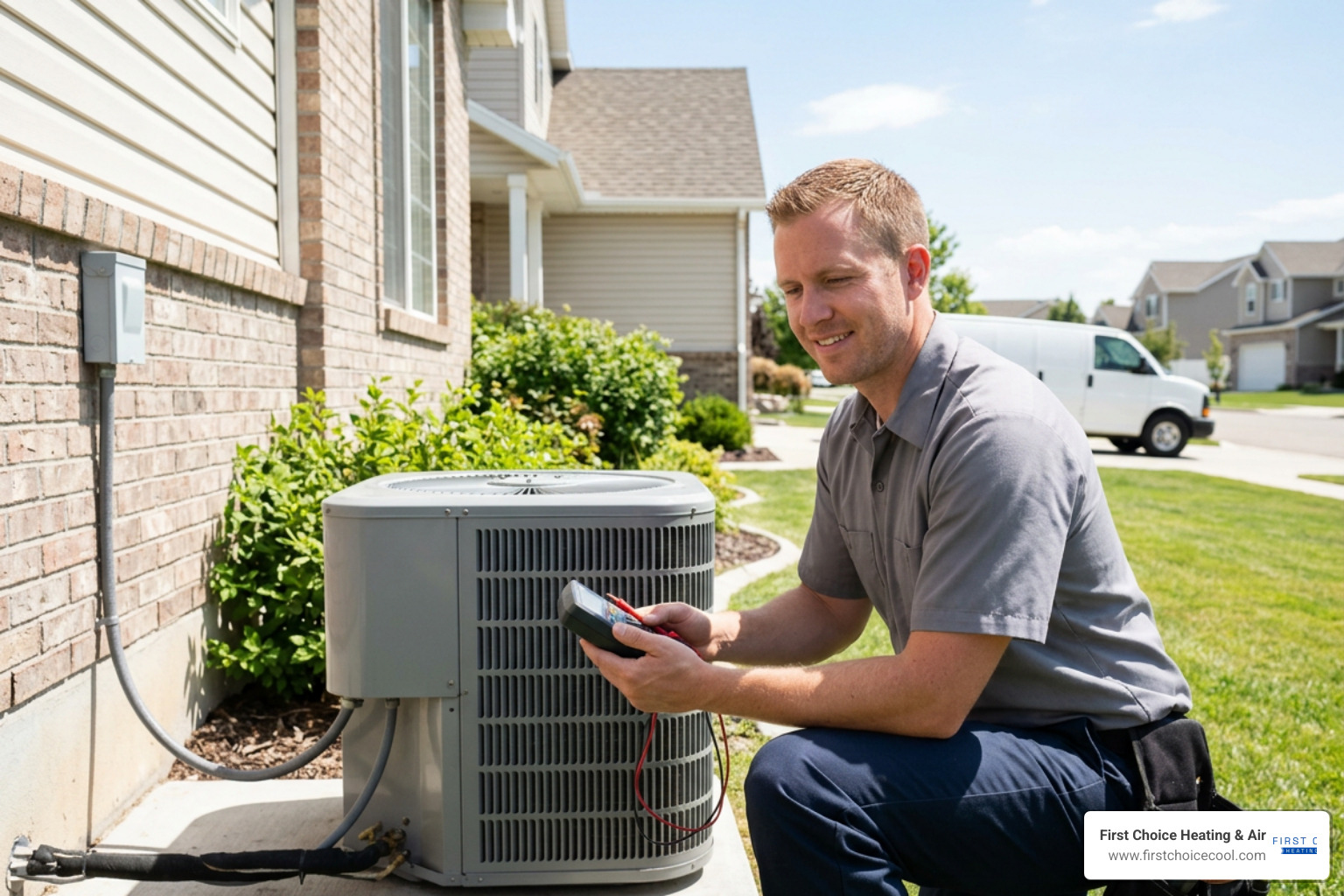
First, walk outside to your outdoor condenser unit and look at the copper lines connecting the outdoor unit to your home. There are typically two copper lines: a smaller, warm liquid line and a larger, insulated suction line.
If you see physical ice or frost forming on the exposed brass valves of the outdoor unit or along the larger copper line, your system is struggling. When refrigerant levels drop, the pressure inside the evaporator coil plummets. This pressure drop causes the coil’s temperature to fall below freezing, turning the moisture in Utah’s air into solid ice on contact.
While you are inspecting the copper lines, look closely at the joints and connections for any oily residue. Refrigerant circulates through your system alongside a specialized lubricating oil. If there is a pinhole leak in the copper tubing or aluminum coils, the escaping gas carries this oil with it, leaving a greasy, dust-attracting spot.
In Utah homes, these leaks are often caused by formicary corrosion—a chemical reaction between household pollutants, moisture, and copper that creates microscopic, tunnel-like holes in your evaporator coil.
Auditory and Temperature Signs: How to Check If AC Refrigerant Is Low Before Calling a Technician in Utah
You can also use your ears and a basic thermometer to diagnose a low refrigerant level. Walk near your indoor air handler and your outdoor condenser unit and listen closely.
Do you hear a distinct hissing or bubbling noise?
- A hissing sound typically indicates that refrigerant is escaping as a high-pressure gas.
- A bubbling noise suggests a leak in a section of the line where the refrigerant is still in a liquid state.
Next, you can perform a simple “temperature split” test (also known as Delta T) using a standard digital thermometer:
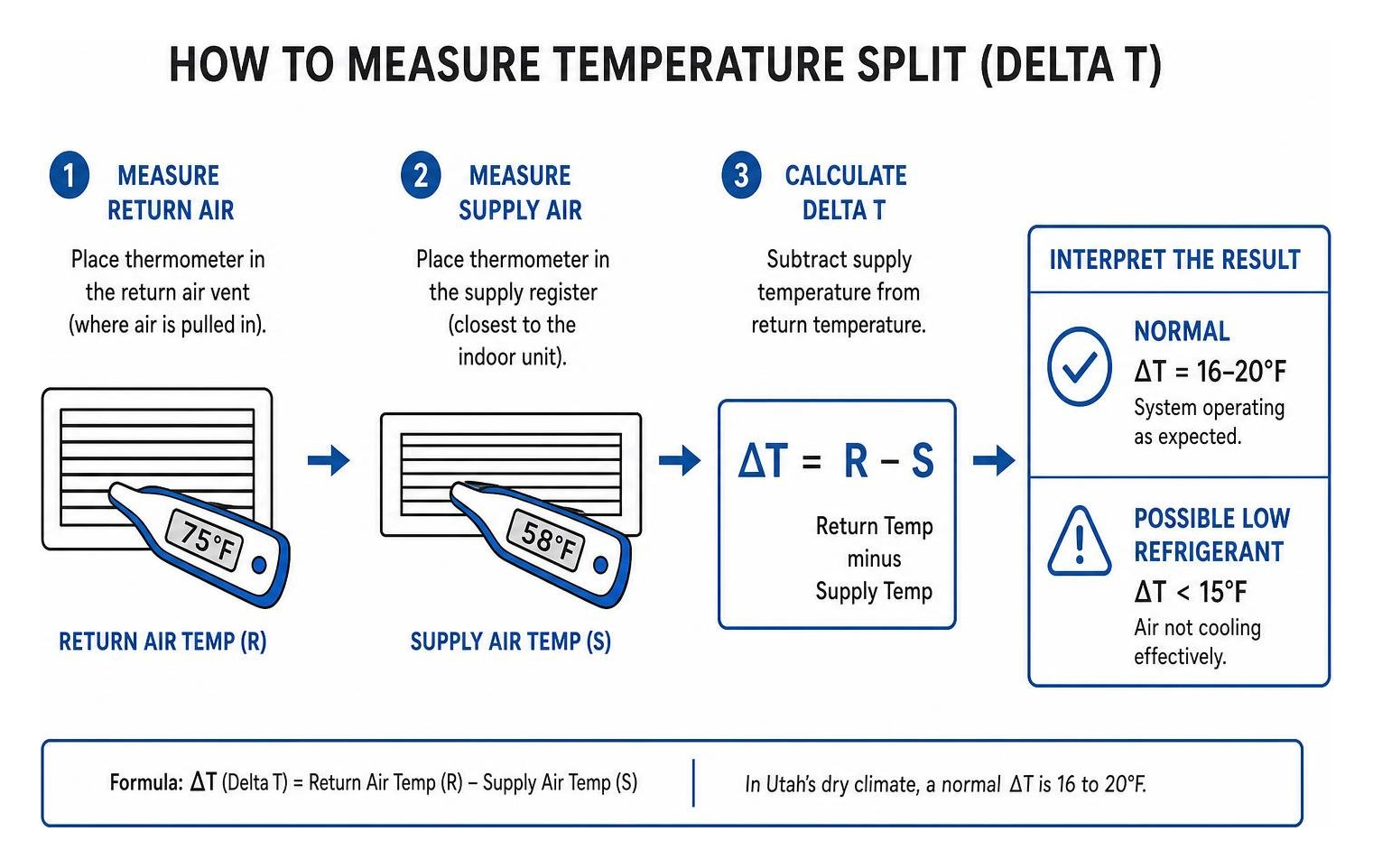
- Place the thermometer in the return air vent (where your system pulls air in).
- Place the thermometer in a supply register closest to the indoor unit (where cool air blows out).
- Subtract the supply temperature from the return temperature.
In Utah’s dry climate, a properly functioning AC system should maintain a temperature split of 16 to 20 degrees Fahrenheit. If your temperature split is significantly lower than 15 degrees—meaning the air coming out of your vents is only slightly cooler than the air going in—your system’s heat-absorbing capacity is compromised, which strongly points to low refrigerant.
The Risks of Running Your AC with Low Refrigerant in Utah’s Climate
If you suspect your system is low on refrigerant, you might be tempted to keep running it anyway, hoping it will slowly cool the house down. However, running a system with a low charge in Utah’s hot summer weather is highly risky.
When refrigerant is low, the system has to work much harder to absorb heat from your home, causing it to run constantly. This continuous operation forces your energy bills to spike dramatically, as a system low on refrigerant often operates at only 60% to 70% of its normal efficiency. You can read more about why this happens in our article on why is my ac running but not cooling.
Even worse, running your AC under these conditions can destroy the compressor—the heart of your cooling system. The compressor relies on the returning cool refrigerant gas to keep its motor cool and lubricated. Without enough refrigerant, the compressor will overheat and fail.
Additionally, low refrigerant can cause “liquid slugging.” This happens when liquid refrigerant flows back into the compressor instead of gas. Because liquids cannot be compressed, this creates extreme hydraulic pressure that can bend connecting rods, break internal valves, and ruin the compressor entirely. For more warning signs that your system is in danger of a major breakdown, review the common signs your ac needs repair.
Frequently Asked Questions About AC Troubleshooting
We hear many of the same questions from homeowners throughout Salt Lake County and Utah County who are trying to figure out why their home comfort is suffering. Here are the answers to the most common questions we receive.
How do differentiate between low refrigerant and a frozen evaporator coil?
Actually, a frozen evaporator coil is often a direct symptom of low refrigerant, but it can also be caused by severe airflow restrictions. If your blower motor fails or your air filter is completely clogged, the lack of warm air passing over the coil causes the remaining moisture on the coil to freeze.
To differentiate between the two, check your air filter first. If the filter is clean and your blower motor is blowing air out of the vents at normal strength, but the air is lukewarm and the coil is frozen, the culprit is likely low refrigerant. If you find yourself facing this issue, read our step-by-step guide on how to fix a frozen evaporator coil without damage to safely thaw your system before calling a technician.
What does a hissing or bubbling sound from the AC unit indicate?
A hissing or bubbling sound is a classic sign of an active refrigerant leak. Because the refrigerant lines operate under high pressure, any physical crack, loose joint, or corrosion hole will allow the refrigerant to escape.
If the leak is in a high-pressure vapor line, it will make a sharp hissing sound. If it is in a liquid line, it will sound like bubbling or gurgling. If you hear these sounds, turn your system off immediately to prevent further damage and avoid other common ac problems.
Can I check or add refrigerant levels myself?
No. Legally and practically, checking or adding refrigerant is not a DIY project. Under EPA Section 608 regulations, only certified HVAC professionals are permitted to purchase, handle, recover, or recharge chemical refrigerants.
Furthermore, checking actual refrigerant levels requires specialized manifold gauges and temperature probes to calculate precise “subcooling” and “superheat” measurements. Adding the wrong type of refrigerant or overcharging the system can instantly destroy your compressor. For more answers to common home comfort questions, browse through our extensive hvac faqs.
Conclusion
Taking a few minutes to check your air filter, inspect your copper lines for ice, and measure your temperature split can tell you a lot about your system’s health. If you complete these steps and find visual ice, oily residue, or hear hissing sounds, you can confidently tell your technician that you suspect a refrigerant leak.
At First Choice Heating & Air, we provide honest, professional leak detection and repair services to homeowners in Bluffdale, West Jordan, Salt Lake City, and throughout Salt Lake and Utah Counties. We focus on finding and permanently repairing the root cause of your leak rather than just applying a temporary “top-off” band-aid, ensuring your system runs efficiently all summer long.
If your air conditioner is struggling to keep your family cool, do not wait for the compressor to overheat. Visit First Choice Heating & Air today to schedule a professional, worry-free diagnostic visit with our friendly local team!