
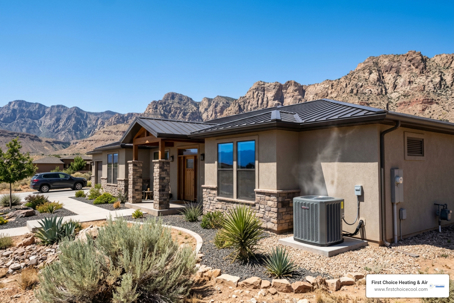
Why Dry Desert Heat in Utah Makes Your AC Work Harder Than You Think
How dry desert heat in Utah makes your AC work harder than humid climates comes down to one core difference: in Utah, your system fights almost nothing but raw temperature — and it fights it constantly, in thin air, through clouds of abrasive dust, under intense UV, with almost no moisture to soften the blow.
Here is a quick breakdown of why Utah’s desert climate is so demanding on AC equipment:
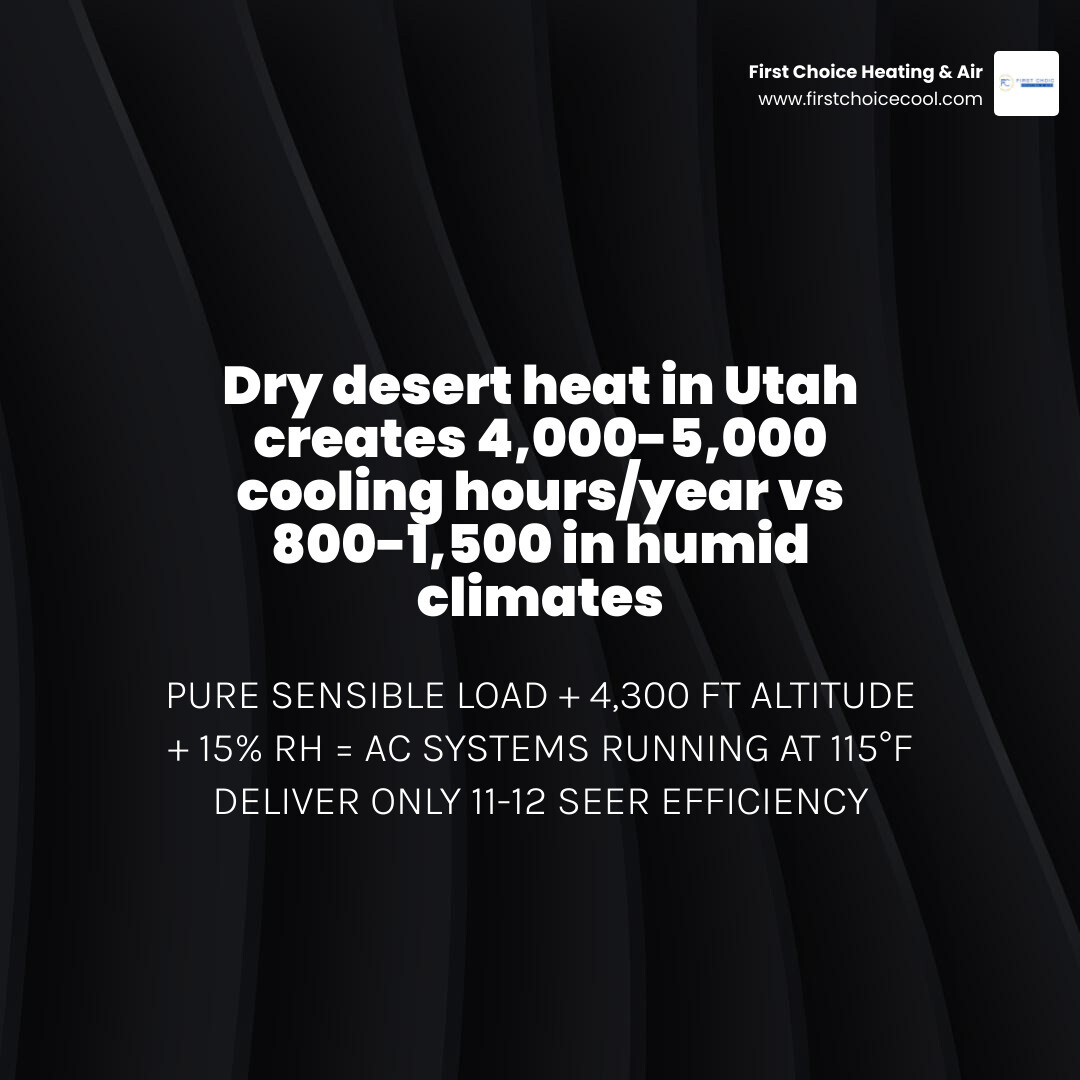
- Pure sensible heat load – Utah’s relative humidity regularly drops below 15% in summer. Your AC spends nearly 100% of its energy lowering temperature, not removing moisture. That sounds easier, but it means the system runs longer and harder to pull heat out of superheated air.
- Extreme outdoor temperatures – Salt Lake Valley regularly sees temperatures above 100°F. Most AC systems are engineered to a design temperature of 95°F, so anything above that pushes components beyond their rated range.
- Thinner air at 4,300 feet – Air at Salt Lake City’s elevation is about 86% as dense as sea level. Less air mass means less heat transfer, which forces your compressor and condenser fan to work harder for the same result.
- More cooling hours – Desert AC systems log 4,000 to 5,000 cooling hours per year, compared to just 800 to 1,500 hours in moderate climates. That is up to six times the wear in the same calendar year.
- Abrasive dust and UV degradation – Fine silica dust coats coils and clogs filters, while UV index levels of 10 to 11 degrade wiring insulation and plastic components faster than the manufacturer’s ratings assume.
- Dramatic temperature swings – Daily swings of 20 to 40°F cause metal components to expand and contract repeatedly, accelerating refrigerant micro-leaks and mechanical fatigue.
The result? AC systems in Salt Lake City typically last 12 to 15 years, compared to the national average of 15 to 20 years. And a 16 SEER unit running at 115°F may only deliver the real-world efficiency of an 11 to 12 SEER unit.
If you are a homeowner on the Wasatch Front wondering why your energy bills keep climbing or your system keeps struggling through July, the climate is not working in your favor — and your equipment is paying the price.
How Dry Desert Heat in Utah Makes Your AC Work Harder Than Humid Climates
To understand why our local climate is so brutal on cooling systems, we have to look at how relative humidity and thermodynamic loads interact.
In a humid climate, like coastal Florida, the air is heavy with water vapor. An air conditioner in that environment has to split its energy: it spends roughly 30% to 40% of its cooling capacity pulling moisture out of the air (latent cooling) and the remaining 60% to 70% actually dropping the temperature (sensible cooling).
In Utah, the story is entirely different. Because our summer relative humidity often plunges into the single digits, there is almost no moisture to remove. This means your air conditioner spends virtually 100% of its energy on sensible cooling.
While that sounds like a shortcut to comfort, it actually creates a massive thermodynamic load. Dry air has a lower heat capacity than moist air, but because the outdoor temperatures are so extremely high, the temperature difference (differential) between the hot outdoor air and your target indoor comfort zone is massive.
Furthermore, our system run times are highly extended. Instead of cycling on and off to manage humidity, Utah systems must run continuously for hours on end just to keep up with the relentless solar heat radiating through your roof and walls. This constant operation leads to rapid SEER2 degradation over the life of the system. In high desert environments, coil pitting and compressor wear can cause an air conditioner to lose 0.5 to 1.0 SEER points of efficiency every single year.
| AC Demand Factor | Utah Dry High Desert (e.g., Salt Lake Valley) | Humid Coastal Climate (e.g., Gulf Coast) |
|---|---|---|
| Primary Cooling Load | Sensible Heat (Raw Temperature) | Latent Heat (Moisture Removal) |
| Typical Summer Relative Humidity | 10% – 15% | 70% – 90% |
| Annual Cooling Run Hours | 4,000 – 5,000 hours | 1,500 – 2,500 hours |
| Average Equipment Lifespan | 12 – 15 years | 15 – 20 years |
| Key Environmental Threat | Fine Silica Dust & Thinner Air | High Humidity & Salt Corrosion |
| Peak Efficiency Performance | Drops significantly above 95°F | Stable but limited by high moisture load |
Sensible vs. Latent Load: How Dry Desert Heat in Utah Makes Your AC Work Harder Than Humid Climates
When we talk about how dry desert heat in Utah makes your AC work harder than humid climates, we are talking about the physics of sensible versus latent heat.
Sensible heat is the warmth you can directly measure with a standard thermometer. Latent heat is the “hidden” energy stored in water vapor. In a humid climate, when the AC condenses water on the indoor evaporator coil, it releases latent heat, which the system then pumps outdoors.
Because Utah has very low humidity, your indoor evaporator coil stays largely dry. Without moisture condensing on the coil, the heat transfer process relies entirely on direct air-to-metal contact. This lack of condensation can actually cause evaporator coils to freeze up if airflow is even slightly restricted, because there is no moisture to help transfer heat smoothly across the aluminum fins.
Additionally, standard HVAC sizing formulas use a baseline humidity level. When we calculate cooling loads for homes in Bluffdale or West Jordan, we have to adjust the BTU requirements to account for the lack of latent load, while simultaneously compensating for the extreme sensible heat radiating off sun-baked stucco and concrete.
Extreme Temperature Differentials and Heat Rejection
Air conditioners do not actually “create” cold; they collect heat from inside your home and reject it outdoors. This heat rejection happens at the outdoor condenser unit.
The ease of this process depends on the temperature difference between the hot refrigerant inside the condenser coils and the outdoor air. If it is 75°F outside, dumping heat is easy. But when Utah summers spike past 100°F, the outdoor air is already superheated.
To dump heat into 100°F+ air, the compressor has to compress the refrigerant gas to a much higher pressure and temperature—often exceeding 225°F internally. This extreme pressure puts immense mechanical strain on the compressor motor.
Additionally, the sudden drops in temperature when the sun goes down—sometimes falling 40 degrees in a matter of hours—cause rapid thermal cycling. The metal coils, copper lines, and aluminum fins expand during the heat of the day and contract rapidly at night. Over time, this constant physical movement leads to metal fatigue, resulting in micro-leaks in your refrigerant lines.
Environmental Stressors Unique to the Wasatch Front
Living along the Wasatch Front means our homes are subjected to a highly unique set of environmental conditions. From high altitudes to seasonal weather extremes, our HVAC systems face challenges that coastal or flatland systems never encounter.
The Sandpaper Effect of Desert Dust and Inversion Grime
If you have ever left your car outside during a Utah windstorm, you know how much fine, powdery dust settles over everything. This dust is largely made of abrasive silica. When sucked into your outdoor condenser unit, it acts like sandpaper on the fan motor bearings and coats the delicate aluminum fins of your condenser coils.
Once a layer of dust coats these coils, it acts as an insulator. Instead of the copper and aluminum releasing heat into the air, the dust traps the heat inside the system.
Furthermore, our unique winter inversion season in Salt Lake County and Utah County traps fine particulate matter (PM2.5) close to the valley floor. Even though your AC is dormant during the winter, this sticky, chemical-laden grime settles deep inside your outdoor unit. When summer arrives, this leftover winter pollution combines with summer dust to form a thick, muddy sludge on the coils, choking off vital airflow and forcing the fan motor to draw more electrical current to keep spinning.
High Altitude and Thinner Air Challenges
Our altitude along the Wasatch Front is another hidden efficiency killer. Salt Lake City sits at roughly 4,300 feet above sea level, and many surrounding areas in Salt Lake County and Utah County are even higher.
At 4,300 feet, the air is approximately 14% to 16% thinner than it is at sea level. Because air density is lower, there are fewer air molecules inside your home to absorb heat and carry it across the indoor evaporator coil.
To move the same physical mass of air as a sea-level system, your indoor blower fan has to work significantly harder. The lower air density also reduces the heat transfer efficiency of your outdoor condenser coil. Standard air conditioners are rated at sea level, which means a system installed right out of the box in Utah will automatically lose a portion of its real-world cooling capacity simply due to the elevation.
Sizing and System Selection for Arid Climates
Because of these unique local factors, choosing and sizing an air conditioner in Utah is not as simple as looking at a square footage chart. Standard calculations often leave homeowners with systems that struggle on the hottest days. To keep your home comfortable without wearing out your equipment, specialized sizing is required. You can learn more about general home comfort strategies on our Home Maintenance page.
Sizing and Derating: How Dry Desert Heat in Utah Makes Your AC Work Harder Than Humid Climates
To combat the effects of elevation and dry air, professional HVAC technicians use ACCA Manual J (for load calculation) and Manual S (for equipment selection) protocols. In Utah, we must apply an “altitude derating” factor.
As a general rule of thumb, an air conditioner loses about 3% of its cooling capacity for every 1,000 feet of elevation.
- At sea level, a 3-ton AC unit delivers 36,000 BTUs of cooling.
- At 4,300 feet in the Salt Lake Valley, that same unit experiences a capacity loss of roughly 13%, dropping its effective output to around 31,300 BTUs.
- If you live higher up in the foothills, the loss is even greater.
If an installer fails to account for this altitude derating and sizes your system based on sea-level specifications, your AC will be permanently undersized. It will run continuously on hot afternoons, overworking the compressor, overheating the electrical components, and driving your utility bills through the roof without ever reaching your thermostat’s set point.
Variable-Speed and High-Efficiency Systems
To handle the dramatic temperature swings and thin air of Utah, variable-speed technology is highly recommended.
Traditional single-stage air conditioners are either 100% on or 100% off. When they kick on, they draw a massive amount of startup amperage—up to six times their running current. In our hot, dry summers, this constant cycling on and off causes severe wear.
Variable-speed systems (often called inverter systems) can modulate their output in tiny 1% increments. Instead of shutting off, they ramp down to run at 25% or 30% capacity for hours at a time. This keeps the temperature inside your home perfectly stable (within 0.5 degrees) and uses up to 75% less electricity than a single-stage system running at full blast.
When looking at high-efficiency systems for desert climates, pay close attention to the EER2 (Energy Efficiency Ratio) rating rather than just the SEER2 (Seasonal Energy Efficiency Ratio) rating. While SEER2 measures seasonal average performance, EER2 measures how efficiently the system runs at a steady 95°F outdoor temperature. For Utah’s brutal July and August afternoons, a high EER2 rating is the true indicator of a system built to survive desert heat.
Additionally, look for modern systems utilizing R-32 refrigerant, which offers superior heat-transfer properties in extreme temperatures compared to older refrigerants, and pair your system with a smart thermostat to manage pre-cooling strategies during cheaper early-morning hours.
Maintenance Strategies to Combat Desert Wear and Tear
Because our climate actively accelerates mechanical wear, proactive maintenance is the only way to protect your investment and avoid premature system failure. If your system is already showing signs of aging, you can read our comprehensive AZ Guide to AC Repair vs Replace to determine your best next steps.
Monthly Filter Care and Airflow Optimization
Your air filter is the first line of defense for your entire HVAC system. In a dusty desert environment, standard fiberglass filters simply do not cut it. We recommend using high-quality pleated filters with a MERV 8 to MERV 11 rating.
However, because the air is thinner at our elevation, you must be careful not to restrict airflow too much. A MERV 13 or higher filter can be too restrictive for older blower motors in thin air, causing them to overheat.
During the peak dusty summer months, or during active wildfire seasons, you should check your air filter every 30 days. If you have pets, live near a construction zone in a growing area like Bluffdale, or experience heavy windstorms, expect to replace your filter monthly to keep air flowing freely.
Professional Tune-Ups and Component Protection
While homeowners can handle filter changes and gently rinse down their outdoor coils with a garden hose (never use a pressure washer, which can bend the delicate aluminum fins), professional maintenance is critical for protecting sensitive electrical parts.
During a professional tune-up, a technician will test your system’s capacitors. Capacitors act like temporary batteries that help your compressor and fan motors start up and run. They are typically rated for a maximum temperature of 131°F. On a 100°F day, the temperature inside your sun-baked metal condenser cabinet can easily soar past 140°F, causing capacitors to degrade, swell, and fail.
Professional maintenance also ensures your refrigerant charge is precise. Because of our extreme temperature swings and subsequent metal expansion, small leaks can develop over time. A system that is even slightly low on refrigerant will run hotter, use more energy, and eventually suffer compressor failure.
Frequently Asked Questions About Utah Desert AC Strain
Why does my AC run constantly during a Utah summer?
When outdoor temperatures exceed 95°F, your home absorbs heat faster than a standard air conditioner can pump it out. Because our relative humidity is so low, your AC is dealing entirely with sensible heat. To maintain a comfortable indoor temperature of 72°F on a 100°F afternoon, your system may need to run continuously for several hours. This is normal behavior for extremely hot days, but if your system runs constantly without ever reaching your thermostat setting, it may be low on refrigerant, choked by a dirty filter, or undersized for our altitude.
How often should I change my AC filter in Utah?
In Utah’s dry, dusty climate, we recommend checking your filter every 30 days. During peak cooling season, high-wind periods, or when wildfire smoke and winter inversion residue are present, filters clog much faster than the standard manufacturer-recommended three months. Replacing your filter every 30 to 60 days ensures optimal airflow, protects your blower motor, and keeps your indoor air clean.
Does high altitude affect my air conditioner’s lifespan?
Yes. Because the air is thinner at 4,300+ feet, your system has to work harder to transfer heat both indoors and outdoors. This added workload, combined with abrasive silica dust and long cooling seasons, reduces the average lifespan of a Utah AC system to 12 to 15 years, compared to the national average of 15 to 20 years. Regular professional maintenance is essential to combat these altitude-related stressors.
Conclusion
The unique combination of dry desert heat, high altitude, and abrasive dust along the Wasatch Front means your air conditioner is fighting a daily battle of attrition. Understanding how dry desert heat in Utah makes your AC work harder than humid climates is the first step in protecting your home’s comfort and your financial investment.
At First Choice Heating & Air, we are proud to serve our local communities in Bluffdale, Salt Lake City, West Jordan, and throughout Salt Lake and Utah Counties. As a community-focused team, we specialize in helping Utah homeowners navigate these specific climate challenges with competitive financing, comprehensive maintenance plans, and industry-leading warranties on high-efficiency, desert-optimized cooling systems.
Do not wait for the heat of July to find out if your system is up to the task. Schedule your high-efficiency AC service with First Choice Heating & Air today and make sure your home stays cool, efficient, and comfortable all summer long.