
Why Wildfire Smoke Is a Serious Indoor Air Threat in the Salt Lake Valley
How wildfire smoke affects indoor air quality in the Salt Lake Valley is something every local homeowner needs to understand — especially as Utah’s fire seasons grow longer and more intense. If you think closing your windows keeps you safe, the research says otherwise.
Here is a quick summary of what happens to your indoor air during a wildfire smoke event:
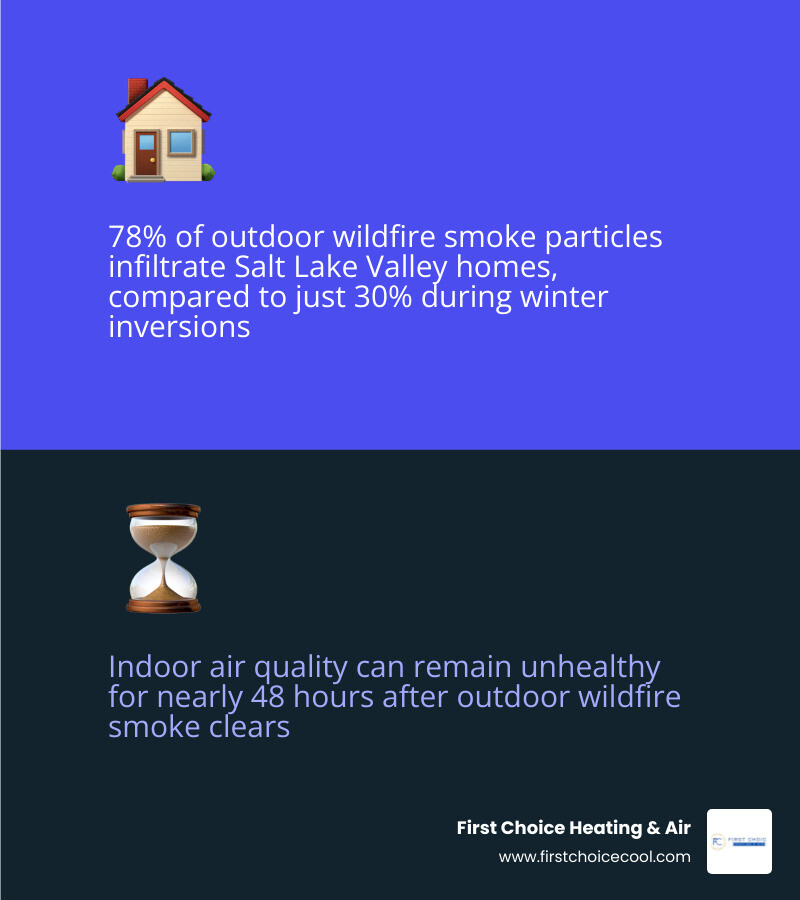
- 78% of outdoor smoke particles infiltrate indoors — compared to just 30% during winter inversions
- Wildfire smoke particles are chemically stable and travel straight through standard HVAC systems
- Indoor air quality can remain at unhealthy levels for nearly 48 hours after outdoor air clears
- Standard MERV 1–4 filters (found in most Utah homes) provide almost no protection against smoke-sized particles
- Emergency room visits for asthma and COPD surge 30% to 110% after heavy smoke days — even among people who stayed indoors
- In 2025, Utah recorded 693 wildfires burning 114,000 acres — 72% of them human-caused, meaning smoke arrives faster and with less warning
The Salt Lake Valley’s bowl-shaped geography makes this worse. The same Wasatch Front topography that traps winter inversion pollution also concentrates wildfire smoke, pushing it down into neighborhoods and through building gaps, HVAC intakes, and every crack in between.
The Science Behind How Wildfire Smoke Affects Indoor Air Quality in the Salt Lake Valley
To understand why wildfire smoke is such a sneaky intruder, we have to look at what it is made of. Unlike clean wood smoke from a campfire, wildland fires consume entire ecosystems, structures, and synthetic materials. This creates a complex, toxic cocktail of air pollutants.
The primary culprit is PM2.5—fine particulate matter that measures 2.5 micrometers or smaller in diameter. To put that in perspective, a single human hair is about 70 micrometers wide, making these smoke particles roughly 30 times smaller than the thinnest hair on your head.
Alongside PM2.5, wildfire smoke carries:
- Volatile Organic Compounds (VOCs): Benzene, formaldehyde, and acrolein, which off-gas from burning vegetation and synthetic materials.
- Carbon Monoxide (CO): An odorless, colorless gas that reduces oxygen delivery to the body’s organs.
- Polycyclic Aromatic Hydrocarbons (PAHs): Highly toxic compounds known to be carcinogenic.
Our unique geography along the Wasatch Front acts like a giant, high-altitude trap. The Salt Lake Valley is nestled in a bowl-shaped depression, flanked by the steep Wasatch Mountains to the east and the Oquirrh Mountains to the west.
When smoke drifts into the valley from regional fires—or ignites locally within Salt Lake or Utah County—atmospheric conditions like high-pressure systems and temperature inversions clamp down on the valley. This prevents vertical air mixing, compressing the smoke into our neighborhoods.
Furthermore, our high elevation (ranging from 4,000 to over 6,000 feet) naturally reduces HVAC system performance by 10% to 15% due to thinner air. This makes it even harder for standard residential blowers to push air through dense, high-efficiency filters when the valley is choked with smoke.
Why Wildfire Smoke Infiltrates Homes Differently Than Winter Inversions
Many Salt Lake Valley residents assume that if their homes feel relatively safe during our notorious winter inversions, they will be equally protected from summer wildfire smoke. However, groundbreaking research from the University of Utah reveals a starkly different reality.
During a typical wintertime inversion, indoor air pollution levels hover around 30% of outdoor levels. While the outdoor Air Quality Index (AQI) might climb into the orange or red ranges, indoor spaces remain relatively shielded, usually staying in the moderate yellow zone.
But during wildfire smoke events, indoor air pollution climbs to an alarming 78% of outdoor levels.
Why such a massive difference? It comes down to particle stability.
During winter inversions, about 60% of the valley’s particulate pollution is made of secondary particulates, primarily ammonium nitrate. These particles are chemically unstable. When they are drawn inside a warm, dry home, the change in temperature and relative humidity causes them to undergo a gas phase transition—they literally dissociate (vaporize) and disappear as solid particles.
Wildfire smoke, on the other hand, consists of highly stable primary particulates. These carbonaceous cores coated in organic compounds do not care about your thermostat settings. They do not break down, evaporate, or vaporize when they cross your threshold. They remain solid, stable, and airborne, traveling straight through your home’s building envelope and standard ventilation systems.
| Pollution Type | Indoor Infiltration Rate | Particle Chemical Behavior Indoors | Primary Components |
|---|---|---|---|
| Wildfire Smoke | 78% | Highly stable; remains solid and suspended in air | PM2.5, VOCs, Carbon Monoxide, PAHs |
| Winter Inversion | 30% | Unstable; undergoes gas phase transition (dissociates) | Ammonium nitrate, secondary aerosols |
| July 4th Fireworks | 30% | Moderately stable; spikes rapidly but settles quickly | Heavy metals, sulfur dioxide, fine soot |
How Long Smoke Pollutants Linger Indoors After Outdoor Air Clears
Another critical finding from local air quality monitoring is the “hangover effect” of indoor smoke. When a strong canyon breeze finally blows through the Salt Lake Valley and clears the outdoor air, residents naturally assume they can breathe easy.
Unfortunately, indoor air quality remains elevated and problematic for nearly 48 hours after the outdoor air has cleared.
Because PM2.5 particles are incredibly light, they can remain suspended in stagnant indoor air for days. Those that do settle land on carpets, upholstery, bedding, and countertops. The moment you walk across the room, sit on the couch, or turn on a ceiling fan, you kick these particles back into your breathing zone. This secondary exposure continues to irritate your respiratory tract long after the blue skies return to the Wasatch Front.
Health Risks of Wildfire Smoke PM2.5 Indoors
Because we spend up to 80% of our lives indoors, the high infiltration rate of wildfire smoke poses severe health risks. PM2.5 particles are so tiny that they easily bypass your respiratory system’s natural filtration defenses, such as nose hairs and mucus.
Once inhaled, these particles travel deep into your lungs, settling in the alveoli (the tiny air sacs where oxygen exchange occurs). From there, they can cross directly into your bloodstream, causing systemic inflammation, blood vessel constriction, and oxidative stress. This can lead to:
- Persistent coughing, throat irritation, and wheezing
- Red, burning eyes and sinus congestion
- Reduced lung function and chest tightness
- Increased risk of heart attacks, strokes, and irregular heartbeats in compromised individuals
Understanding the Impact of PM2.5 on Vulnerable Salt Lake Valley Residents
While healthy adults will certainly feel the scratchy throat and fatigue associated with smoky indoor air, certain populations in Salt Lake and Utah counties face severe, immediate dangers.
Vulnerable groups include:
- Asthmatics and COPD Patients: Smoke immediately triggers bronchospasms, making breathing incredibly difficult.
- Children: Kids breathe more air per pound of body weight than adults, and their lungs are still developing.
- The Elderly: Pre-existing cardiovascular or respiratory decline makes older adults highly susceptible to sudden cardiac events during smoke episodes.
The real-world consequences of poor indoor filtration are clear. Across the Wasatch Front, emergency department visits for asthma, COPD, and acute cough surge 30% to 110% following extreme smoke days.
Crucially, this surge includes many residents who followed public health advice and stayed entirely indoors. Staying inside only works if the air inside your home is actually being filtered.
How HVAC Systems and Building Filtration Control Smoke Infiltration
Your home’s heating, ventilation, and air conditioning (HVAC) system is your primary line of defense against outdoor pollution. However, without the right settings and filtration, it can also act as a highway for smoke.
Air enters your home in three ways:
- Natural Ventilation: Open windows and doors.
- Infiltration: Air leaking through microscopic cracks around windows, doors, plumbing penetrations, and attic vents.
- Mechanical Ventilation: HVAC fresh air intakes, bath fans, and kitchen hoods.
Modern homes built under recent Utah energy codes are highly sealed to save energy (often testing under 5 air changes per hour). However, this tight seal can create negative pressure inside the home when exhaust fans run, pulling smoky outdoor air through any tiny structural gap.
In homes with central air conditioning, the system recirculates indoor air. If your filter is clean and highly rated, it will scrub the air. If it is a basic filter, it simply circulates the smoke.
Upgrading to MERV 13 Filters to Block Wildfire Smoke
The single most effective upgrade you can make to your HVAC system is installing a MERV 13 air filter.
MERV stands for Minimum Efficiency Reporting Value, rated on a scale from 1 to 16.
- MERV 1 to 4: These are the cheap, fiberglass filters found in most Salt Lake homes. They are designed solely to keep large dust bunnies and pet hair from damaging the furnace blower motor. They have zero ability to capture sub-2.5-micron smoke particles.
- MERV 13: This is the gold standard recommended by the EPA for wildfire smoke. A MERV 13 filter captures 85% to 95% of PM2.5 particles, including the tiny soot and ash components of wildfire smoke.
During the intense 2025 Utah wildfire season, local homeowners who upgraded to MERV 13 filters reported a shocking phenomenon: their pristine, factory-white filters turned near-black in less than 14 days. This rapid discoloration is visual proof of massive PM2.5 accumulation.
Without that high-efficiency filter, those black carbon particles would have ended up in the lungs of the home’s occupants.
Warning: Before sliding a MERV 13 filter into your system, ensure your HVAC system can handle the static pressure. High-efficiency filters are denser, meaning your blower motor has to work harder. If your system is older or poorly maintained, a dense filter can restrict airflow, causing your AC coils to freeze or your blower motor to burn out. If you are unsure, it is always wise to consult an HVAC professional.
Best Practices for Running Your HVAC System During a Smoke Event
To maximize your home’s air filtration during a smoke storm, you must operate your thermostat and HVAC system correctly.
- Switch Thermostat Fan to “ON” (Not “AUTO”): On the “Auto” setting, your system only filters air when it is actively heating or cooling. If the outdoor temperature is mild, your system might sit idle for hours while smoke leaks inside. Setting the fan to “On” ensures continuous, 24/7 air filtration.
- Set HVAC to Recirculate: If your system has a fresh air intake damper, make sure it is closed. You want to recirculate and scrub the air already inside, rather than pulling in smoky air from outside.
- Close Fresh Air Flaps: Many modern homes in West Jordan and Bluffdale feature fresh air ventilation ducts that dump outdoor air directly into the return plenum. Locate this damper (often labeled “Fresh Air”) and close it during heavy smoke events.
Practical Steps and FAQs for Salt Lake Valley Residents
When smoke blankets the Wasatch Front, managing your indoor environment requires a mix of mechanical filtration, behavioral changes, and structural sealing.
Here are the immediate steps you should take:
- Seal the Envelope: Keep all windows and doors closed. Use temporary painter’s tape or weatherstripping to seal drafty window frames.
- Minimize Exhaust Fan Use: Avoid running bath fans and kitchen range hoods for extended periods. These fans vent indoor air outside, creating a vacuum that pulls smoky air inside through wall cavities and floorboards.
- Avoid Particle-Generating Activities:
- Do not burn candles or incense.
- Avoid gas stove cooking or frying food (which releases massive amounts of indoor PM2.5).
- Avoid vacuuming unless your vacuum has a sealed HEPA filter; standard vacuums simply blow fine dust and settled smoke particles back into the air.
- Create a “Clean Room”: If you cannot afford to upgrade your entire home’s filtration, dedicate one room (like a bedroom) as a clean air sanctuary. Seal it off, run a portable air purifier on high, and avoid opening its door.
Utilizing Portable Air Purifiers and DIY Air Cleaners
Portable air purifiers equipped with true HEPA filters are fantastic tools for supplementing your HVAC system. They are designed to clean individual rooms and can reduce indoor particulate levels by up to 45%.
If commercial air purifiers are sold out or out of your budget, you can easily build a highly effective DIY Air Cleaner, often called a Corsi-Rosenthal Box.
To build one, you will need:
- A standard 20-inch box fan (use a newer model, 2012 or later, which features safety fuses to prevent overheating)
- Four MERV 13 furnace filters (20″ x 20″)
- A cardboard bottom panel
- Duct tape
Tape the four filters into a square box with the arrows pointing inward toward the center. Tape the cardboard panel to the bottom, and tape the box fan securely to the top, blowing air upward.
This simple setup moves a massive volume of air (up to 600 cubic feet per minute) and performs just as well as commercial purifiers costing hundreds of dollars.
How Wildfire Smoke Affects Indoor Air Quality in the Salt Lake Valley Compared to Winter Inversions
As established by local university research, how wildfire smoke affects indoor air quality in the Salt Lake Valley is significantly more severe than winter inversions.
During winter inversions, the chemical compounds (primarily ammonium nitrate) are highly sensitive to temperature and humidity. When they enter your warm home, they dissolve into a gas phase, reducing the indoor PM2.5 concentration to about 30% of outdoor levels.
Wildfire smoke particles are incredibly stable primary carbon pollutants. They do not break down or evaporate when entering a home, resulting in an indoor infiltration rate of 78%. This means indoor air during a smoke event is nearly as toxic as the air outside unless active filtration is running.
What is the Best HVAC Filter to Prevent How Wildfire Smoke Affects Indoor Air Quality in the Salt Lake Valley?
The best HVAC filter for combating wildfire smoke is a pleated MERV 13 filter.
MERV 13 filters are specifically engineered to capture 85% to 95% of particles down to 0.3 microns, which covers the entire spectrum of PM2.5 smoke.
Avoid cheap fiberglass filters (MERV 1–4), which only protect your equipment from large dust particles. If your HVAC system’s blower motor can handle the static pressure, upgrading to a MERV 13 is the single most important action you can take to protect your family’s lungs.
How Often Should I Replace My Air Filter During Utah’s Wildfire Season?
While the standard recommendation is to change your HVAC filter every 90 days, you must throw that rule out during wildfire season.
During active smoke events, you should inspect your filter weekly. The massive volume of PM2.5 particles can clog a high-efficiency filter in as little as 2 to 3 weeks.
To check your filter, hold it up to a bright light source. If the light cannot penetrate the pleats, or if the filter has turned a gray or charcoal-black color, it is fully loaded and needs immediate replacement. Running a clogged filter restricts airflow, which can damage your air conditioner’s compressor and blower motor.
Conclusion
Protecting your home from the invisible, creeping threat of wildfire smoke requires proactive preparation. Simply heading indoors is not enough when stable, toxic PM2.5 particles can easily infiltrate your living space at a 78% rate. By upgrading to a MERV 13 filter, running your HVAC fan continuously on recirculate, and utilizing portable air purifiers, you can turn your home into a true sanctuary of clean air.
At First Choice Heating & Air, we are committed to helping our neighbors in Bluffdale, Salt Lake City, West Jordan, and across Salt Lake and Utah counties breathe easier. Whether you need an indoor air quality assessment, a high-efficiency filter upgrade, or a comprehensive system tune-up to ensure your blower motor can handle a MERV 13 filter, our team is here to help.
Don’t wait for the next plume of smoke to drift over the Wasatch Front. Protect your home’s air quality with professional HVAC services and ensure your family breathes clean, safe air all summer long.