
When Is AC Repair in Utah Costing You More Than a New System Would?
Knowing how much AC repair is too much before replacing your unit in Utah can save you hundreds — or even thousands — of dollars in wasted repair costs. Here’s a quick answer before we go deeper:
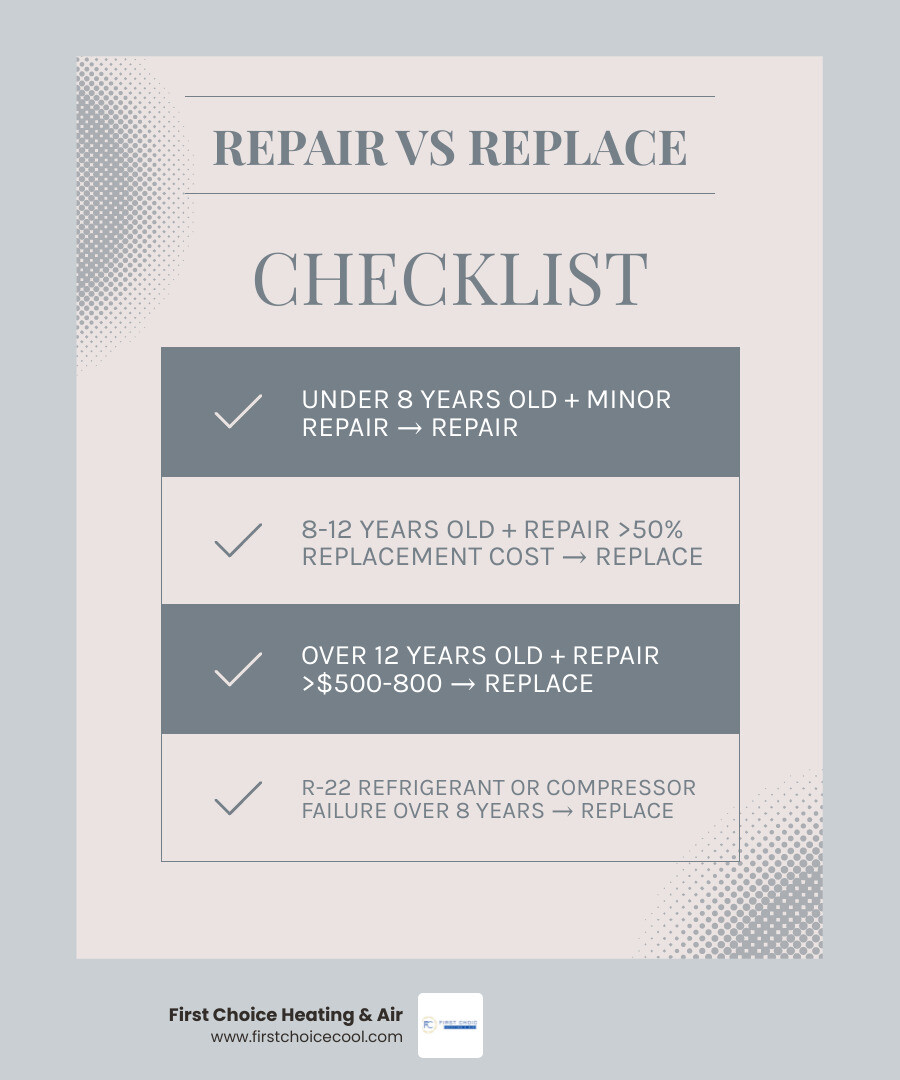
Quick Decision Guide: Repair or Replace Your Utah AC?
| Situation | Recommendation |
|---|---|
| Unit is under 8 years old, minor repair | Repair |
| Unit is 8-12 years old, repair under 50% of replacement cost | Likely repair |
| Unit is 8-12 years old, repair over 50% of replacement cost | Lean toward replace |
| Unit is over 12 years old, repair over $500-$800 | Replace |
| Unit is over 15 years old, any repair | Replace |
| Compressor failed, unit over 8 years old | Replace |
| Two or more repairs in a single season | Replace |
| Unit uses R-22 refrigerant | Replace |
| Age × repair cost exceeds $5,000 | Replace |
Picture this: it’s a 98-degree July afternoon in Salt Lake City, your AC just quit, and a technician hands you a repair quote on a system that’s already 12 years old. Do you pay it — or finally pull the trigger on a new unit? That moment is exactly where most Utah homeowners get stuck. The heat is on, the pressure is real, and making the wrong call can mean throwing good money after bad. This guide cuts through that stress with clear, practical rules so you can make a confident decision.
The 50% Rule and the $5,000 Rule: Mathematical Frameworks for Utah Homeowners
When your air conditioner breaks down, it is easy to let emotion guide your decision. No one wants to spend a hot summer afternoon in West Jordan sweating through a cooling emergency. However, taking a step back and applying objective mathematical frameworks can remove the guesswork and protect your household budget.
Two of the most reliable industry benchmarks are the 50% Rule and the $5,000 Rule. Both methods help you calculate whether continuing to patch up your current system is a smart financial move or a classic case of the “sunk cost fallacy.”
| Decision Framework | How It Works | Best Used For |
|---|---|---|
| The 50% Rule | If the cost of a single repair exceeds 50% of the cost of a brand-new replacement system, replace the unit. | Mid-life systems (8 to 12 years old) facing major component failures. |
| The $5,000 Rule | Multiply the age of your air conditioner by the estimated cost of the repair. If the result is over $5,000, replace the unit. | Systems of any age where you want to balance age against repair costs. |
Applying the 50% Rule
The 50% Rule is straightforward. When you receive a repair estimate, compare that quote directly to the total investment required for a brand-new, fully installed system. If the fix costs more than half of what a new, high-efficiency unit would cost, investing in the repair is rarely a wise long-term decision.
With a new system, you gain a fresh manufacturer’s warranty, modern efficiency, and years of reliable operation. Spending a significant portion of that replacement value on an aging machine that could break down again next month simply delays the inevitable. For a deeper dive into how these financial crossroads play out, check out our AZ Guide to AC Repair vs Replace.
Applying the $5,000 Rule
The $5,000 Rule adds a helpful mathematical weight to the age of your equipment. To use it, take the age of your system in years and multiply it by the repair quote you received.
- Example A: You have an 8-year-old system in West Jordan that needs a repair. If the repair quote is relatively low, multiplying 8 by that amount will likely keep you well under the $5,000 threshold. In this scenario, proceeding with the repair makes perfect financial sense.
- Example B: You have a 12-year-old system in Bluffdale facing a major component failure. If the repair quote is substantial, multiplying 12 by that estimate will easily push you past $5,000. This is a clear mathematical signal that your money is better spent on a replacement.
How Much AC Repair Is Too Much Before Replacing Your Unit in Utah?
Every air conditioner will need a minor fix now and then. A worn-out capacitor here or a clogged condensate drain line there is just part of standard home ownership. But at what point do these individual service calls transition from routine maintenance into a “repair spiral”?
Determining how much ac repair is too much before replacing your unit in Utah requires looking at the frequency of your breakdowns. If you are calling for emergency service once every few years, your system is likely in decent health. However, if you find yourself on a first-name basis with your HVAC technician, it is time to look at the warning flags:
- Yellow Flags (Proceed with Caution): Your system has required one repair per season for the last two years, or your energy bills are creeping up despite regular maintenance.
- Red Flags (Stop and Replace): You are facing two or more repairs in a single cooling season. If you fix a fan motor in June only to have the contactor fail in July and the refrigerant leak in August, you are throwing money into a sinking ship.
When cumulative repair costs over a rolling 12-to-24-month period start approaching the cost of a new system, continuing to repair the unit is no longer economical.
Evaluating System Age: Under 8, 8-12, and Over 12 Years
The age of your equipment is the single greatest predictor of future breakdowns. As mechanical parts age, they experience unavoidable wear and tear, thermal stress, and electrical degradation.
- Under 8 Years: If your air conditioner is under eight years old, it is generally in the prime of its life. Major components may still be protected under the original manufacturer’s parts warranty. Unless you are dealing with a catastrophic failure caused by severe neglect, repairing the unit is almost always the correct choice.
- 8 to 12 Years: This is the critical transition phase. Components are out of warranty, and efficiency is naturally declining. This is where you must strictly apply the 50% and $5,000 rules. Keep a close eye on how often the system breaks down.
- Over 12 Years: In Utah’s demanding climate, central air conditioners over 12 years old are entering their twilight years. At this stage, even minor repairs should be scrutinized. If a repair costs more than a few hundred dollars, or if the system struggles to keep up with summer heatwaves along the Wasatch Front, planning a proactive replacement is the smartest financial move. To keep your home running smoothly year-round, consult our comprehensive guide on Home Maintenance.
When a Failed Compressor Signals It’s Time to Replace
The compressor is the undisputed heart of your air conditioning system. It is responsible for pumping refrigerant through the cooling cycle, pressurized at high temperatures to facilitate heat transfer.
Because the compressor operates under extreme pressure and heat, replacing it is one of the most labor-intensive and expensive repairs in the HVAC industry. If your compressor fails and your system is over eight years old, the diagnosis is almost always a clear signal to replace the entire outdoor unit.
Furthermore, a compressor rarely fails in a vacuum. It often burns out due to underlying issues like acid buildup in the refrigerant lines, chronic liquid slugging, or severe system restriction. Installing a brand-new compressor into an old, contaminated system often leads to premature failure of the new part, making a full system replacement the much safer and wiser long-term investment.
Utah-Specific Environmental Factors Affecting Your AC Decision
Utah is famous for its breathtaking landscapes, but our unique geography and climate present distinct challenges for mechanical equipment. When deciding whether to repair or replace your system, national averages do not tell the whole story. You must consider the local environmental factors that impact homes across Salt Lake and Utah Counties.
How Much AC Repair Is Too Much Before Replacing Your Unit in Utah at High Altitude?
The elevation along the Wasatch Front — ranging from roughly 4,200 feet in Salt Lake City to over 4,500 feet in Bluffdale and West Jordan — has a direct physical impact on air conditioning performance.
At higher altitudes, the air is thinner and less dense. Because air conditioning relies on moving a specific mass of air across the indoor evaporator coil and the outdoor condenser coil to transfer heat, thin air reduces the overall heat transfer efficiency of your system.
In fact, standard air conditioning systems experience a capacity derating at high altitudes. Your system has to work harder and run longer to achieve the same level of cooling as an identical unit installed at sea level. This elevated workload accelerates mechanical wear and tear. If your system is already struggling, the thin mountain air will exacerbate its inefficiencies, pushing an older, repaired unit to its breaking point much faster than normal.
The R-22 Refrigerant Phase-Out and Modern SEER2 Standards
If your air conditioner was installed before 2010, there is a very high probability that it utilizes R-22 refrigerant (commonly known as Freon). Due to environmental regulations targeting ozone depletion, the U.S. EPA completely banned the production and import of R-22.
Today, the remaining supply of R-22 is extremely scarce and exceptionally expensive. If an older system develops a refrigerant leak, the cost to locate the leak, repair the copper lines, and recharge the system with R-22 is often prohibitively high. Patching up an R-22 system is a temporary fix; once the refrigerant leaks out again, that investment is completely gone.
Additionally, modern energy regulations now mandate strict efficiency minimums known as SEER2 (Seasonal Energy Efficiency Ratio 2). Older systems typically operate at SEER ratings between 10 and 13. Modern baseline systems start much higher, meaning a replacement instantly slashes your summer electricity consumption.
Recognizing Efficiency Loss: Rising Energy Bills and Declining Performance
Sometimes, an air conditioner does not experience a sudden, dramatic breakdown. Instead, it undergoes a slow, quiet decline in performance. This gradual loss of efficiency can be just as costly as a major repair, slowly draining your monthly budget through inflated utility bills.
As an AC unit ages, its internal components degrade. Coils corrode, fan motors draw more electrical current, and compressors lose their compression ratio. You might notice that your system runs constantly during a hot afternoon but never quite cools the house down to your thermostat’s setpoint. If your monthly electricity bills are spiking compared to the same months in previous years — despite similar weather and usage habits — your system is sending a clear signal that its operating efficiency has plummeted.
Modern variable-speed technology avoids this constant cycling. Rather than running at 100% capacity and shutting off repeatedly, variable-speed systems adjust their output precisely to match your home’s cooling demand, providing incredibly consistent comfort and whisper-quiet operation.
How Much AC Repair Is Too Much Before Replacing Your Unit in Utah with Low SEER Ratings?
If you are faced with a moderate repair bill on a system with a low SEER rating (such as an old 10 or 12 SEER unit), you must factor the “cost of inefficiency” into your decision.
Upgrading to a modern, high-efficiency system can reduce your cooling energy consumption by up to 20% to 40%. Over the course of our hot Utah summers, those monthly savings add up quickly. When you combine those utility savings with available manufacturer promotions, local utility rebates, and federal energy tax credits, the long-term return on investment (ROI) of a new system often far outweighs the cost of keeping an inefficient unit on life support.
Frequently Asked Questions About AC Repair vs. Replace
How long do central air conditioners typically last in Utah’s climate?
In Utah’s semi-arid climate, a well-maintained central air conditioner typically lasts between 12 and 15 years. While our low humidity is generally gentler on outdoor metal components compared to humid coastal regions, our extreme temperature swings, high summer heat, and airborne dust can accelerate wear on moving parts. Regular professional maintenance is the single most important factor in helping your system reach the upper end of its lifespan.
Is it better to replace both the furnace and the AC at the same time?
In most cases, yes. Your furnace and air conditioner share the same indoor blower motor and ductwork system. When you replace them together, you ensure that both components are perfectly matched in terms of airflow and efficiency.
Installing a modern, high-efficiency AC condenser outside while leaving an old, inefficient furnace blower inside can prevent the new air conditioner from reaching its rated efficiency. Plus, replacing both systems simultaneously saves you money on labor costs, as our team only needs to modify your plenum and electrical connections once.
What rebates or tax credits can help offset the transition to a new system?
There are several excellent financial incentives available for Utah homeowners upgrading to energy-efficient equipment. Depending on the system you select, you may qualify for utility rebates through Rocky Mountain Power’s Wattsmart program or gas rebates through Enbridge Gas’s ThermWise program.
Additionally, federal energy tax credits can provide significant savings for qualifying high-efficiency systems and electric heat pumps. Our team can help you navigate these programs to maximize your savings.
Conclusion
Deciding whether to repair or replace your air conditioner does not have to be a stressful guessing game. By applying objective mathematical frameworks like the 50% and $5,000 rules, and taking Utah’s unique climate and altitude into account, you can make a smart, financially sound choice for your home.
If you are still on the fence about whether to repair your current system or invest in an upgrade, let the professionals help. At First Choice Heating & Air, we provide honest, transparent assessments to homeowners in Bluffdale, West Jordan, Salt Lake City, and across Salt Lake and Utah Counties. We will never push you into an unnecessary replacement if a simple, reliable repair is the better option for your budget.
To learn more about our community-focused services, competitive financing, and robust maintenance plans, read our Hello World post or visit First Choice Heating & Air today to schedule a professional assessment or request a free estimate on a new system!