


Why Utah Homeowners Are Switching to Ductless Mini Splits This Summer
Understanding what are the benefits of a ductless mini split in a hot dry utah climate can make a real difference in your home’s comfort and your monthly energy bills. If you’ve been dealing with hot rooms that won’t cool down, skyrocketing utility costs, or an HVAC system that just can’t keep up with Utah’s brutal summer heat, you’re not alone.
Here’s a quick answer:
Top benefits of a ductless mini split in Utah’s hot, dry climate:
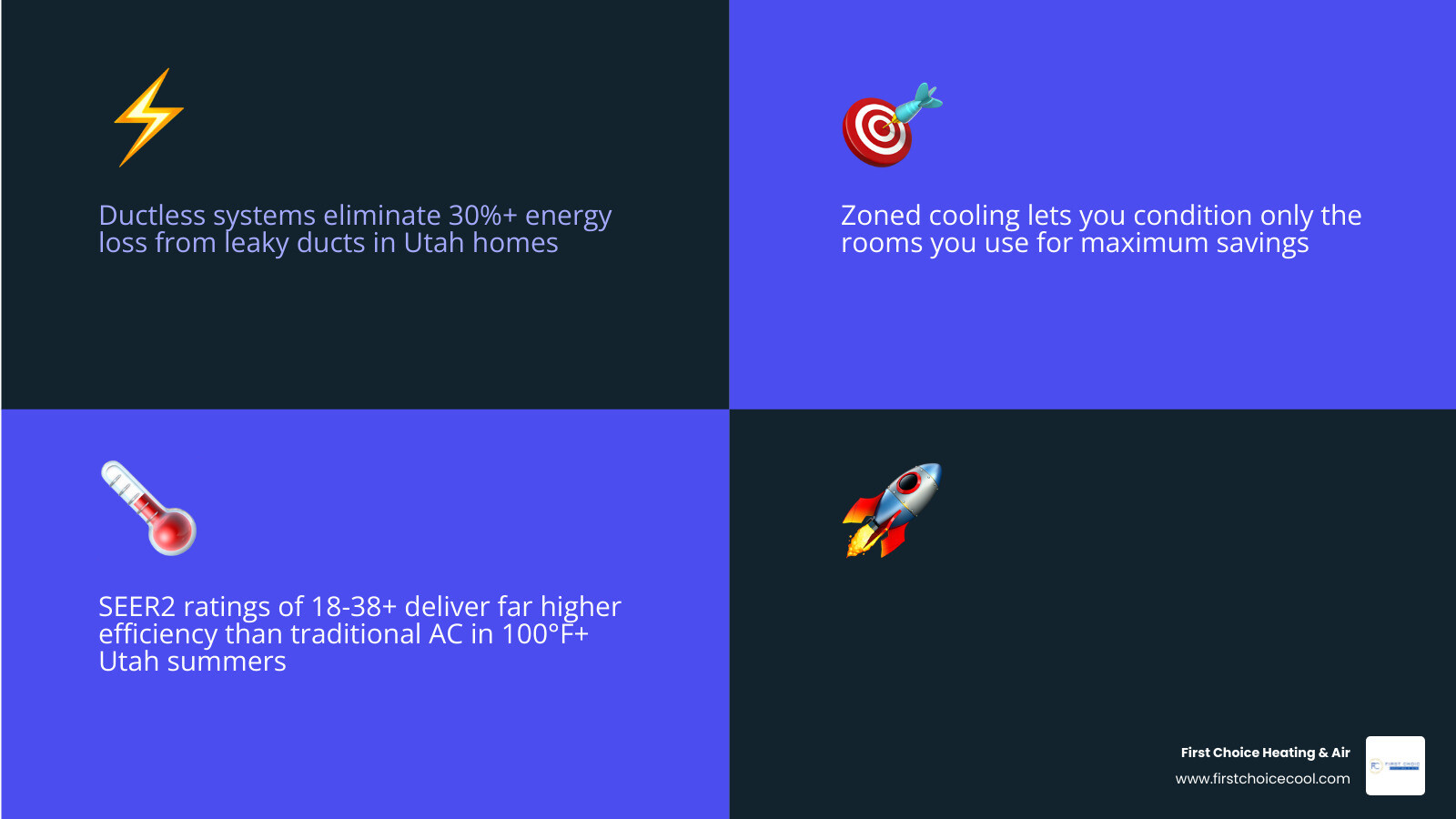
- No duct energy loss – Eliminates the 30%+ cooling energy wasted through leaky ductwork
- Zoned comfort – Cool only the rooms you use, room by room
- High efficiency – SEER2 ratings of 18-38+, far above traditional central AC
- Year-round use – Works as a heat pump in winter, cooling system in summer
- Handles temperature swings – Inverter technology adjusts output as Utah temps shift dramatically day to night
- Better air filtration – Multi-stage filters catch dust and allergens common in dry, arid conditions
- Whisper-quiet operation – Indoor units run as quietly as 19 decibels
- Long lifespan – Lasts 15-20 years with proper maintenance in Utah’s climate
Utah’s summers are no joke. Temperatures routinely exceed 100°F across the Salt Lake and Utah County areas, humidity drops as low as 20-30%, and homes — especially older ones without well-sealed ductwork — struggle to stay comfortable. A ductless system addresses these problems directly, without the inefficiencies baked into traditional forced-air setups.
What Are the Benefits of a Ductless Mini Split in a Hot Dry Utah Climate?
When June 2026 arrived, Utah homeowners faced the classic summer dilemma: how to keep the house cool without running up a massive electric bill. In our high-desert climate, traditional heating and air conditioning systems often fall short. That is where ductless mini-split systems step in to completely change how we think about home comfort.
At its core, a ductless mini-split consists of an outdoor compressor unit connected to one or more indoor air handlers by a small conduit. This conduit houses the power cable, refrigerant tubing, and a condensate drain line. Because they deliver conditioned air directly into individual rooms, they bypass the need for invasive, dusty, and inefficient ductwork.
But what are the benefits of a ductless mini split in a hot dry utah climate specifically?
The answer lies in how these systems handle extreme heat and dry air. Traditional air conditioners operate on an “all-or-nothing” cycle. They turn on at 100% capacity, blast cold air until the thermostat is satisfied, and then shut off. This constant on-and-off cycling is highly inefficient.
Mini-splits, however, utilize advanced inverter technology. Think of a traditional AC as a standard light switch (on or off) and a mini-split as a dimmer switch. The variable-speed compressor automatically adjusts its speed to match the precise cooling needs of the room. In Utah’s dry climate, this means the system can run continuously at a low, ultra-efficient speed, maintaining a perfectly steady temperature without those annoying drafts or sudden blasts of cold air.

Zoning and Efficiency: What Are the Benefits of a Ductless Mini Split in a Hot Dry Utah Climate?
One of the greatest advantages of a ductless system along the Wasatch Front is zoned cooling. In a typical Salt Lake County or Utah County home, different areas of the house have wildly different cooling needs. The upstairs bedrooms might bake under the summer sun while the finished basement feels like an icebox.
With a multi-zone mini-split system, you can connect up to eight indoor air handlers to a single outdoor compressor. Each indoor unit is controlled by its own thermostat. This means you can keep your home office crisp and cool during the day, turn off the cooling in unoccupied guest rooms, and lower the temperature in the bedrooms at night.
By only cooling the spaces you are actively using, you can achieve massive energy savings. Standard central AC systems lose a massive amount of energy simply by pushing air through empty rooms. Furthermore, because there is no ductwork, you completely avoid the “duct tax”—the energy lost through leaks, cracks, and poor insulation in your attic or crawlspace. Regular Home Maintenance of your HVAC system is crucial, but eliminating ductwork entirely is the single most effective way to protect your wallet from wasted energy.
Combatting Arid Heat: What Are the Benefits of a Ductless Mini Split in a Hot Dry Utah Climate?
Utah’s dry air presents unique challenges for home comfort. While high humidity makes the air feel heavy, extremely low humidity (often dropping below 20% during July and August) can dry out your nasal passages, skin, and wood furniture.
Traditional central AC systems are designed to remove large amounts of moisture from the air because they were engineered for humid climates. In an already arid environment like West Jordan or Salt Lake City, over-dehumidification can make your indoor air feel uncomfortably dry and dusty.
Ductless mini-splits offer superior comfort control in dry climates because their variable-speed fans maintain a highly consistent, gentle airflow. Instead of dumping a massive volume of dry, cold air into your home all at once, the mini-split circulates air steadily. This continuous, low-speed circulation prevents dust from settling and helps maintain a more comfortable, natural indoor environment.
Additionally, during our late-summer monsoon season when humidity levels briefly spike, mini-splits can easily transition to a dedicated dehumidification mode to keep your home from feeling sticky.
Ductless Mini Splits vs. Central Air in Utah’s Arid Climate
To truly appreciate the value of a ductless system, it helps to see how it stacks up directly against traditional central air conditioning. Below is a comparison of how these two popular options perform under typical Utah conditions.
| Feature | Ductless Mini-Split Systems | Traditional Central AC |
|---|---|---|
| Cooling Efficiency | Up to 35+ SEER2 | Typically 14 to 16 SEER2 (rarely exceeding 21) |
| Heating Efficiency | Up to 30 HSPF2 | Dependent on furnace (typically lower overall efficiency) |
| Energy Loss | 0% (Ductless delivery) | 30%+ lost through leaky ductwork |
| Zoning Capabilities | Standard (Room-by-room control) | Requires expensive, complex damper systems |
| Noise Level | Whisper-quiet (19-30 dB indoor) | Moderate to loud (whoosh of vents and clunk of units) |
| Lifespan | 15 to 20 years with proper care | 10 to 15 years on average |
| Installation Disruption | Minimal (requires a simple 3-inch wall hole) | High (requires extensive drywall cutting if adding ducts) |
When deciding how to upgrade your home’s comfort, it is highly recommended to read through our AZ Guide to AC Repair vs Replace to determine whether retrofitting your current system or making the jump to a modern ductless setup is the smartest long-term investment.
Energy Efficiency and the Duct Tax
According to the U.S. Department of Energy, ductwork in typical central air systems can lose more than 30% of cooling energy through leaks, poor insulation, and unsealed joints. In Utah, where many duct systems run through baking-hot attics that can reach temperatures of 130°F or higher, this “duct tax” is even more severe.
When your central AC pushes cold air through a hot attic, the air warms up before it ever reaches your living spaces. Your system has to run longer and work harder just to compensate for this thermal loss.
Ductless mini-splits completely bypass this issue. By delivering conditioned air directly from the indoor unit into your room, 100% of the energy you pay for goes directly toward cooling your living space. When you upgrade from an older, low-efficiency system to a high-efficiency mini-split, you can reduce your cooling energy consumption by up to 60%.
Year-Round Performance and Winter Heating
While we focus heavily on summer cooling, we can’t forget that Utah winters are notoriously cold and snowy. Fortunately, modern mini-splits are not just air conditioners—they are bidirectional heat pumps.
During the winter, the system reverses its operation. Instead of releasing heat from your home to the outdoors, it extracts ambient heat from the cold outdoor air and transfers it inside. Even when the temperature drops well below freezing, advanced cold-climate mini-splits can operate efficiently at temperatures down to -13°F or even -22°F.
Because they transfer heat rather than generate it through electrical resistance or fossil fuel combustion, mini-splits can heat your home at two to three times the efficiency of electric baseboard heaters. This dual heating and cooling functionality makes them an incredibly practical year-round solution for the Wasatch Front.
Handling Utah’s Extreme Temperature Swings and Elevation
Utah’s geography and high-desert climate create unique environmental challenges that standard HVAC calculations often fail to account for. Our communities sit at high elevations, and we frequently experience dramatic temperature swings of 30°F or more within a single 24-hour period.
The Altitude Factor on HVAC Capacity
Did you know that altitude directly affects how your heating and cooling systems perform? In places like Salt Lake City, West Jordan, and Bluffdale, our elevation ranges from 4,200 to over 4,800 feet above sea level.
At these elevations, the air is thinner and less dense. Because thin air carries less heat than dense air, HVAC systems experience what is known as “altitude derating.” At 5,000 feet, a cooling system can experience a capacity loss of approximately 17% compared to its sea-level rating.
This is why generic, one-size-fits-all sizing guides do not work in Utah. When we design a comfort system for your home, we perform altitude-corrected Manual J load calculations. Because mini-splits utilize variable-speed inverter compressors, they are incredibly resilient to these elevation changes. The system can automatically adjust its operating parameters to compensate for thinner air, ensuring you get the exact cooling capacity your home requires.
Managing Rapid 24-Hour Temperature Changes
It is incredibly common in Utah to wake up to a crisp, chilly 55°F morning and watch the thermometer climb to a scorching 95°F by late afternoon. This rapid temperature swing forces traditional HVAC systems to work in fits and starts.
A central AC might sit idle all morning, allow the home to heat up, and then struggle to pull down the temperature during the hottest part of the day.
Ductless mini-splits handle these rapid transitions seamlessly. Because the indoor air handlers continuously monitor room temperatures, they make micro-adjustments in real-time. As the outdoor temperature climbs, the inverter slowly ramps up the compressor speed to match the rising cooling load.
When the sun goes down and the desert air cools off rapidly, the system gently winds down, preventing the over-cooling and temperature swings common with traditional central systems.
Indoor Air Quality and Dust Filtration in Dry Climates
Living in an arid climate means dealing with dust, pollen, and dry soil blowing off the desert. In recent years, Utah homeowners have also had to contend with seasonal wildfire smoke settling into the Salt Lake Valley. Maintaining clean, healthy indoor air has never been more important.
Filtering Dust and Allergens in Arid Regions
Because traditional central HVAC systems rely on a single, centralized return vent, they have to pull air from across the entire house, through dusty wall cavities, and back to a central filter. If your ductwork has leaks, it can actually pull dusty, unconditioned air from your attic or crawlspace directly into your breathing air.
Ductless mini-splits feature localized, multi-stage filtration built directly into each indoor unit. Air is pulled directly from the room, passed through high-efficiency filters, and immediately redistributed. This localized filtration process is incredibly effective at capturing airborne dust, pet dander, and pollen right where it originates.
Because there are no ducts to accumulate dust, mold, or pests, the air entering your rooms is significantly cleaner. For Utahns suffering from seasonal allergies or respiratory sensitivities, this localized air cleaning can provide massive relief.
Frequently Asked Questions About Utah Mini Splits
Do mini splits work during freezing Utah winters?
Yes, absolutely. Modern cold-climate ductless mini-splits are highly efficient heat pumps designed to extract heat from outdoor air even in extreme sub-zero temperatures. Many premium models can operate at full heating capacity down to -13°F and continue providing heat down to -22°F, which is well below the average winter lows along the Wasatch Front.
How do mini splits handle Utah’s dusty summer conditions?
Mini-splits are equipped with easily accessible, washable filters inside each indoor air handler. Because Utah’s dry climate and seasonal winds can create dusty conditions, we recommend popping the covers open and rinsing the filters under lukewarm water every 2 to 4 weeks. This simple task keeps air flowing freely and maintains peak operating efficiency.
Are mini splits quiet enough for bedrooms and home offices?
Yes, they are incredibly quiet. Because the noisy compressor and fan motor are located outside, the indoor air handlers run almost silently. Most indoor units operate between 19 and 26 decibels—which is quieter than a whisper or a library. They also feature dedicated “sleep modes” that lower fan speeds for undisturbed rest.
Conclusion
When it comes to keeping your home comfortable, understanding what are the benefits of a ductless mini split in a hot dry utah climate is the first step toward a more efficient, customizable, and cost-effective home. From eliminating the expensive “duct tax” to providing precision zoned comfort and whisper-quiet performance, ductless systems are uniquely suited to handle the extreme temperature swings and arid conditions of the Wasatch Front.
At First Choice Heating & Air, we are proud to be your local, community-focused HVAC experts in Bluffdale, Salt Lake City, West Jordan, and throughout Salt Lake and Utah Counties. We believe in providing honest advice, competitive financing options, robust maintenance plans, and strong warranties to ensure your peace of mind for years to come.
Ready to experience the ultimate in home comfort and start saving on your monthly utility bills? First Choice Cool is here to help. Contact us today to schedule your professional home comfort assessment and find out if a ductless mini-split is the perfect fit for your Utah home!