


What Happens When Your Heat Pump Defrosts During a Salt Lake Valley Cold Snap
Understanding how does heat pump defrost mode work during cold snaps in the salt lake valley is simpler than it sounds — and knowing the basics can save you from unnecessary worry or a call you don’t need to make.
Here’s the quick answer:
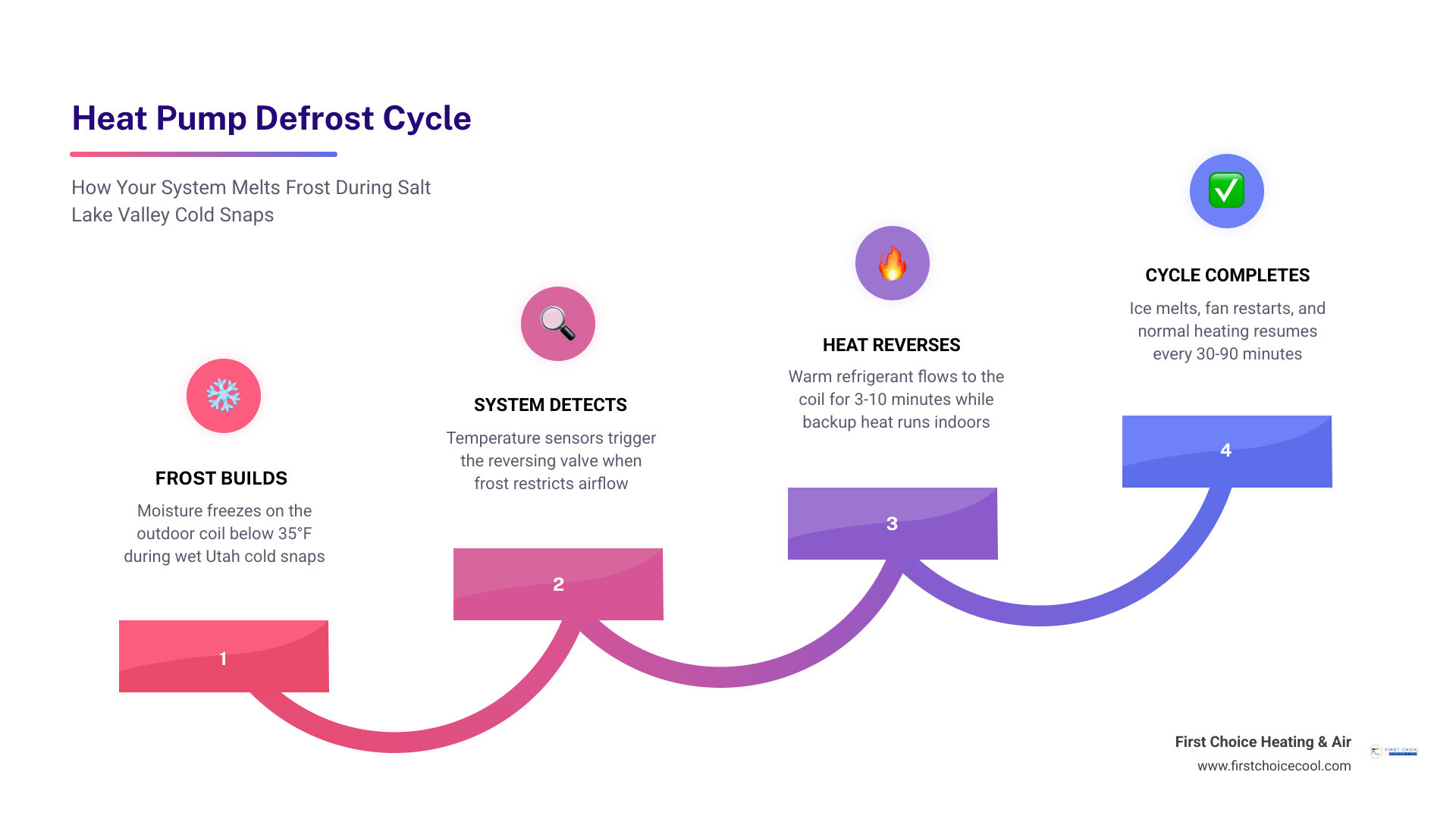
- Frost builds up on your heat pump’s outdoor coil when temperatures drop and moisture in the air freezes on the coil surface.
- The system detects the buildup using temperature or pressure sensors on the outdoor unit.
- The reversing valve switches refrigerant flow so the system temporarily runs like an air conditioner — sending warm refrigerant to the outdoor coil to melt the ice.
- The outdoor fan stops to maximize heat on the coil, and you may see steam rising from the unit.
- Backup heat kicks in indoors so you stay warm during the 3-10 minute cycle.
- The system switches back to normal heating mode once the frost is cleared.
This is completely normal operation — not a malfunction. During a typical Utah cold snap with wet, below-freezing conditions, your heat pump may run a defrost cycle every 30 to 90 minutes, each lasting just a few minutes before returning to full heating.
Salt Lake Valley winters create some specific conditions — inversions, valley fog, and humidity levels that fluctuate with elevation — that can trigger these cycles more often than homeowners expect. That first time you look outside and see steam billowing off your unit on a January morning, it can be alarming. But in most cases, it means your system is doing exactly what it was designed to do.
This guide walks you through the full picture: the mechanics, the local climate factors, what to watch for, and when something actually warrants a service call.
How Does Heat Pump Defrost Mode Work During Cold Snaps in the Salt Lake Valley?
To understand how a defrost cycle works, we first have to look at how your heat pump heats your home in the winter. Unlike a gas furnace, which generates heat by burning fuel, a heat pump moves heat from one place to another. Even when the air outside feels freezing to you, it still contains a significant amount of thermal energy.
To extract this heat, the heat pump circulates super-cold liquid refrigerant through its outdoor coil. Because the refrigerant is incredibly cold, the outdoor coil itself typically runs 10°F to 20°F colder than the ambient outdoor air. As the outdoor fan pulls winter air across this freezing coil, the refrigerant absorbs the air’s heat, vaporizes, and is compressed to raise its temperature even further before being sent indoors to warm your rooms.
However, this physics trick comes with a natural side effect: condensation.
When the moisture in our Utah air touches a metal coil that is below freezing, it instantly turns to frost. Over time, this frost layer thickens, acting as an insulating blanket that blocks airflow through the coil. If the air can’t pass through, the heat pump can’t extract heat, and its efficiency plummets.
This is where the defrost mode steps in as a built-in self-care routine. When the system’s control board detects that frost is choking the coil, it triggers a temporary operational pivot:
- The Reversing Valve Shifts: The four-way reversing valve—the mechanical heart of the heat pump—switches the flow of refrigerant. This instantly turns the heat pump into an air conditioner.
- The Cycle Reverses: Instead of pulling heat from the outside to send indoors, the system now takes warm refrigerant from the indoor compressor and pumps it directly into the frozen outdoor coil.
- The Outdoor Fan Shuts Off: The outdoor fan stops spinning. This keeps the cold winter air from blowing away the heat, allowing the hot refrigerant to quickly melt the ice off the coil.
- Heating Pauses (Briefly): Because the system is temporarily running in “cooling mode” to heat the outdoor unit, it would normally blow cold air into your home. To prevent this space heating interruption, your system automatically activates its auxiliary heating elements (usually electric resistance heat strips or your dual-fuel gas furnace) to keep indoor temperatures steady.
Once the sensors detect that the outdoor coil temperature has risen back to a safe level (usually around 50°F to 57°F, indicating all ice has melted), the reversing valve clicks back, the outdoor fan restarts, and normal heating resumes. For more on keeping your home’s comfort systems running efficiently year-round, check out our guide on Home Maintenance.
Environmental Triggers and Timing in Northern Utah
Our weather along the Wasatch Front is unique. Nestled between the Great Salt Lake and the Wasatch Range, the Salt Lake Valley experience winter conditions that are vastly different from the dry, high-desert winters of southern Utah.
During a cold snap, several local environmental factors work together to make your heat pump work harder—and defrost more frequently.
Local Weather Triggers: How Does Heat Pump Defrost Mode Work During Cold Snaps in the Salt Lake Valley
The most notorious trigger for frequent defrosting in Salt Lake County is our winter temperature inversions. During these periods, cold, stagnant air gets trapped on the valley floor under a layer of warmer air. Along with trapping pollutants, inversions often trap high levels of moisture, creating dense valley fog and high relative humidity at temperatures hovering right around freezing.
When we look at the physics of frost, the 20°F to 35°F range is the absolute peak danger zone.
Why? Because cold air can only hold so much moisture. At 0°F, the air is extremely dry, meaning there is very little water vapor available to freeze on your coil. But at 28°F with high humidity or fog, the air is packed with moisture. Because your outdoor coil runs 10°F to 20°F colder than the air, an outdoor temperature of 32°F means your coil is sitting at a freezing 12°F to 22°F.
This combination of high moisture and below-freezing coil temperatures creates the perfect storm for rapid condensation and thick frost layers.
Elevation also plays a major role. If you live up on the East Bench in Sandy, or high up in Herriman, you might experience dry, powdery snow that blows right through the unit without sticking. Meanwhile, a homeowner down on the valley floor in West Jordan might be dealing with heavy, wet valley fog that glazes the heat pump coil in a thick sheet of ice within minutes.
Typical Cycle Length and Frequency During Utah Cold Snaps
During a standard dry winter day in Utah, you might rarely notice your system defrosting. But when a wet cold snap hits, the frequency changes dramatically:
- Frequency: In damp, foggy, or snowy conditions between 20°F and 35°F, a typical heat pump will enter a defrost cycle every 30 to 90 minutes.
- Duration: A standard defrost cycle is quite brief, usually lasting between 3 to 10 minutes (and rarely exceeding 15 minutes).
- Capacity Derate: Because the heat pump has to stop heating your home to clear its coils, these cycles cause a temporary drop in overall heating output. In cold, humid climates, this can result in an 8% to 18% seasonal capacity derate. Fortunately, in Utah’s generally drier climate, the seasonal capacity loss is much lower—averaging just 4% to 8%.
What Homeowners See, Hear, and Feel During Defrost Mode
If you are new to owning a heat pump, the first time your system enters defrost mode can be a bit startling. It is incredibly common for homeowners to think their system is on fire or breaking down.
Knowing what to expect can prevent a middle-of-the-night panic.
Here is exactly what you might experience:
- The Steam Cloud: As the ice on the outdoor coil melts rapidly against the hot refrigerant, it turns into water and water vapor. This creates a visible cloud of steam rising from the outdoor unit. It looks exactly like smoke, but it is completely odorless and harmless.
- The “Swoosh” Sound: When the reversing valve shifts the direction of the refrigerant, it releases built-up pressure. This creates a loud, distinct whoosh or swoosh sound at the outdoor unit, followed by a change in the compressor’s pitch.
- The Stopped Fan: You will hear the outdoor fan motor shut off completely while the compressor continues to hum loudly.
- Water Runoff: You will see water actively dripping or running out from the bottom of the outdoor unit as the ice melts away.
Indoor Comfort and the Role of Auxiliary Heat
What happens inside your home during those 5 to 10 minutes?
Because the heat pump is technically running in cooling mode to heat the outdoor coil, the indoor coil would normally blow cold air into your living spaces. To keep you comfortable, your system’s control board automatically calls for auxiliary heat (often labeled as “AUX” or “Emergency Heat” on your thermostat).
In most Salt Lake Valley homes, this auxiliary heat comes in the form of electric resistance heat strips built into your indoor air handler, or a backup gas furnace in a dual-fuel setup. These backup systems kick in instantly, tempering the air so that you continue to feel warm, comfortable air coming out of your vents.
If your system is properly configured with auxiliary heat, 99% of homeowners won’t notice any temperature drop indoors during a defrost cycle. If you don’t have backup heat installed, you might feel a brief stream of cooler air for a few minutes, but the system will quickly return to delivering cozy warmth as soon as the cycle ends.
Demand Defrost vs. Timed Defrost Technology
Not all heat pumps handle frost the same way. The technology your system uses to initiate a defrost cycle has a massive impact on your monthly utility bills and the wear-and-tear on your equipment.
Timed Defrost Systems (Time-Temperature)
Older and entry-level heat pumps rely on a simple time-temperature method. These systems use a basic timer (usually set to 30, 60, or 90 minutes) paired with a simple temperature sensor on the outdoor coil.
If the coil sensor is below freezing when the timer runs out, the system automatically runs a defrost cycle—regardless of whether there is actual ice on the coil. This leads to highly inefficient “unnecessary cycles” on cold, dry days, wasting energy and unnecessarily wearing out your compressor and reversing valve.
Demand Defrost Systems
Modern high-efficiency heat pumps use demand defrost technology. Instead of relying on a clock, these intelligent systems use electronic sensors to monitor outdoor ambient temperature, coil temperature, and sometimes even the pressure differential across the coil.
By utilizing intelligent defrosting algorithms, a demand defrost system only initiates a cycle when it detects actual airflow restriction caused by physical ice. If the air is cold but bone-dry, the system will keep running in heating mode for hours without interrupting your comfort.
This smart approach reduces unnecessary cycles, shortens defrost runtimes to just 3 to 5 minutes, and saves a significant amount of electricity.
| Feature | Timed Defrost Systems | Demand Defrost Systems |
|---|---|---|
| Trigger Mechanism | Fixed clock interval (30/60/90 mins) + freezing temp | Real-time sensor data (temp, pressure, airflow) |
| Defrost Frequency | High (runs even if coil is completely clear) | Low (only runs when actual ice is present) |
| Average Cycle Length | 10 to 15 minutes | 3 to 10 minutes (often just 3-5 mins) |
| Energy Consumption | Higher due to unnecessary heating cycles | Lower (saves up to 10-12% on winter heating power) |
| Equipment Wear | Higher (frequent reversing valve shifting) | Lower (valve only shifts when absolutely necessary) |
Variable-Speed Inverters and Cold-Climate Heat Pumps
If you are looking for the gold standard in winter performance, cold-climate heat pumps equipped with variable-speed inverter compressors change the math entirely.
Unlike traditional single-stage systems that are either 100% on or 100% off, variable-speed inverters operate like a dimmer switch. They constantly adjust their output between 25% and 100% capacity to match your home’s exact heating needs.
Because they can run continuously at lower, highly efficient speeds, they maintain a more consistent coil temperature. This slower, steadier operation actually reduces the rate of frost accumulation, meaning fewer defrost cycles overall.
Furthermore, modern cold-climate heat pumps are designed with enhanced heat exchangers and built-in base pan heaters. These heated elements at the bottom of the outdoor unit prevent melted runoff water from refreezing and building up ice at the base of your system, maintaining a high integrated COP (Coefficient of Performance) even when temperatures drop to -15°F.
Why Defrost Efficiency Matters for Your Wallet
Every time your heat pump enters a defrost cycle, it uses extra energy to melt the ice and run your backup heat. Research shows that utilizing smart technology and proper installation practices can yield massive savings:
- Demand vs. Timed Savings: Demand-defrost units experience less than half the capacity loss of older timed systems, keeping your heating bills lower.
- Drainage Efficiency: Ensuring your system has excellent local drainage for melted frost can reduce energy consumption by approximately 18% during defrost cycles, as it prevents the system from having to melt refrozen ice pooling around the base.
- Sizing Headroom: When sizing a system, professional HVAC contractors don’t just look at standard ratings. They use databases like the NEEP (Northeast Energy Efficiency Partnerships) Cold Climate Database to apply a defrost derate factor, ensuring your heat pump is perfectly sized to handle our cold snaps without relying too heavily on expensive backup heat.
Homeowner Best Practices and Maintenance Tips
While your heat pump is designed to handle defrosting automatically, there are several simple actions you can take to support your system during a Salt Lake Valley winter. Proper care keeps your system running efficiently and extends its lifespan (which can last 15 to 20 years with regular maintenance!).
- Keep the Outdoor Unit Clear: After a heavy Wasatch snowstorm, gently clear snow away from the top and sides of your outdoor unit. Maintain at least a 2-foot clearance around the system to ensure unrestricted airflow.
- Never Chip Ice Manually: If you see thick ice on your unit, never use a screwdriver, shovel, or hammer to chip it off. The aluminum fins and copper refrigerant lines inside are incredibly delicate; one slip can puncture a line, leading to an expensive refrigerant leak. If you must melt ice quickly, gently pour warm water over the coils.
- Monitor Your Drainage: Ensure the outdoor unit is elevated on a riser (often called “snow feet”) at least 4 to 6 inches off the ground. This allows melted ice to drain away freely and prevents the unit from freezing into a solid block of ice at its base.
- Change Your Indoor Air Filter: A clogged, dirty air filter restricts indoor airflow. If air can’t flow properly across your indoor coil, the system can’t transfer heat efficiently during a defrost cycle, which can cause the system to fault or run abnormally long cycles.
- Schedule Bi-Annual Servicing: Having a professional technician inspect your system before the winter freeze ensures that your reversing valve, defrost sensors, control board, and auxiliary heat strips are all functioning perfectly. For a deeper look into whether it is time to tune up or upgrade your current setup, take a look at our AZ Guide to AC Repair vs Replace.
Frequently Asked Questions About Heat Pump Defrosting
When should I call a professional for heat pump icing issues?
You should call for professional HVAC service if you notice any of the following warning signs:
- The outdoor unit is completely encased in a thick, solid block of ice (often looking like a giant ice cube) that doesn’t melt after several hours.
- The system is constantly entering defrost mode (every 15-20 minutes) or stays in defrost mode for longer than 15 minutes at a time.
- You hear unusual grinding, clanking, or rattling noises coming from the outdoor unit.
- Your home feels cold, your auxiliary heat isn’t keeping up, or you suspect a refrigerant leak.
Is it normal for my heat pump to blow cool air during defrost?
If your system is equipped with properly sized auxiliary heat strips (electric backup) or is part of a dual-fuel setup, you should not feel cold air indoors. The backup heat should kick in automatically to keep the supply air warm. However, if you do not have backup heat, or if your backup heat strips are malfunctioning, you may feel cool air blowing from your vents for the 3 to 10 minutes the system is in defrost mode.
Why does my heat pump defrost when it is above freezing outside?
This is completely normal! Because the refrigerant running through your outdoor coil is typically 10°F to 20°F colder than the outdoor air, your coil will drop below freezing (32°F) even when the outdoor air temperature is in the low 40s. If there is high humidity or moisture in the air, frost will form on the coil, and the system will run a brief defrost cycle to clear it.
Conclusion
A heat pump’s defrost mode is a highly sophisticated, completely normal feature designed to protect your system’s efficiency and keep your home cozy during our coldest winter days. By understanding how this cycle works, you can rest easy knowing that the steam and sounds coming from your outdoor unit are simply signs of a healthy, hard-working system.
At First Choice Heating & Air, we are proud to serve our neighbors throughout Bluffdale, Salt Lake City, West Jordan, and the surrounding communities across Salt Lake and Utah Counties. Whether you need a seasonal winter tune-up, want to explore the benefits of a modern cold-climate heat pump, or need help troubleshooting an icing issue, our team is here to help.
Check out our Hello World post to learn more about our commitment to our community, or Schedule professional heat pump service with First Choice Heating & Air today to ensure your home stays perfectly comfortable all winter long!