

Why Utah Homeowners Are Leaving Thousands on the Table with HVAC Upgrades
Learning how to stack rocky mountain power and federal rebates for hvac in utah can cut the cost of a new heat pump or dual-fuel system dramatically — and most homeowners never do it because they only know about one program at a time.
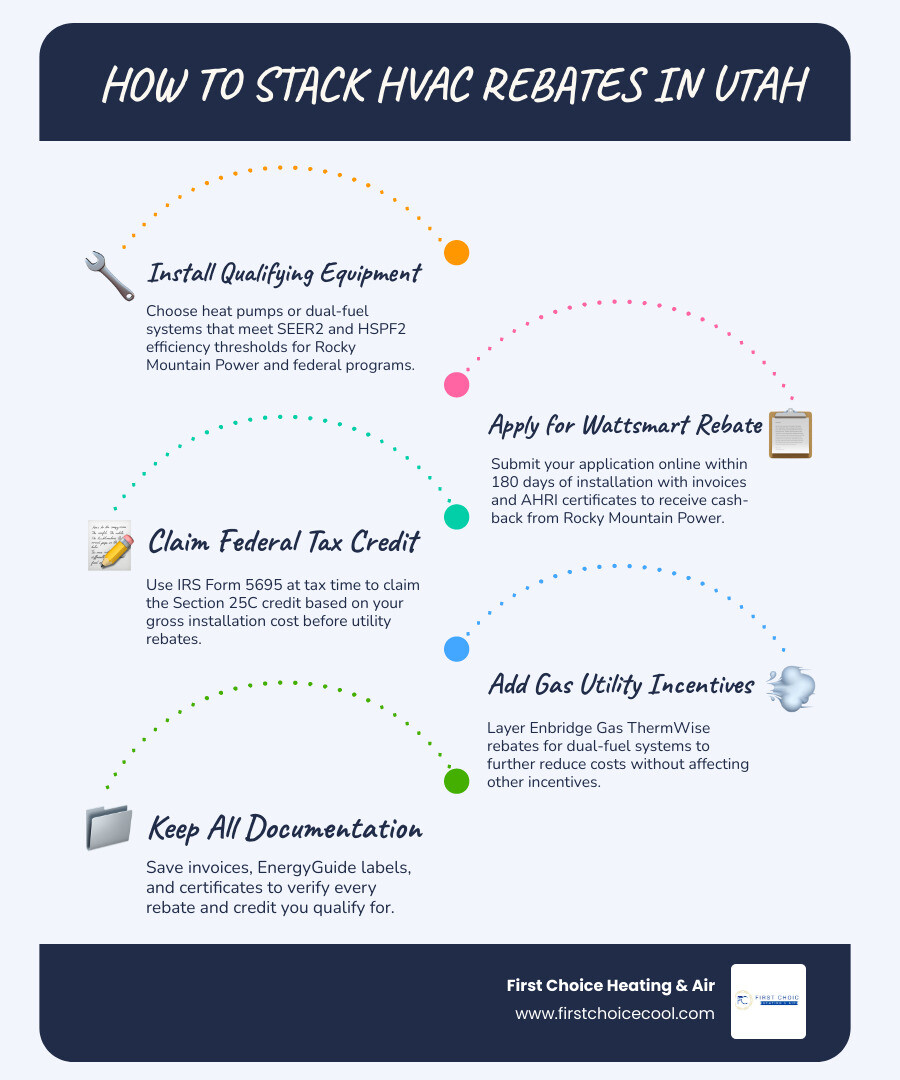
Here is a quick overview of how stacking works:
- Install qualifying HVAC equipment that meets efficiency thresholds (more on those below)
- Apply for your Rocky Mountain Power Wattsmart rebate within 180 days of installation
- Claim the federal Section 25C tax credit on IRS Form 5695 when you file your taxes
- Stack Enbridge Gas ThermWise rebates if you have a dual-fuel system and a gas account
- Keep all documentation — invoices, AHRI certificates, and EnergyGuide labels — for both applications
The key rule to remember: utility rebates and the federal tax credit are calculated independently. The IRS bases your Section 25C credit on your gross installation cost, not the amount left after rebates.
If you live in Salt Lake County or Utah County and you are tired of high energy bills and aging equipment, you are sitting on a real opportunity right now. Rocky Mountain Power’s Wattsmart program offers cash-back rebates on qualifying heat pumps and dual-fuel systems. The federal Section 25C Energy Efficient Home Improvement Credit adds another layer of savings on top. And if your home uses natural gas, Enbridge Gas ThermWise rebates can be combined with both.
Most homeowners only capture part of these savings — not because they don’t qualify, but because no one walked them through the full picture. This guide does exactly that.
Understanding the Core Incentives: Wattsmart and Section 25C

To maximize your savings, you first need to understand the two heavyweights of the energy efficiency incentive world in Utah: the local utility program and the federal tax code.
The Rocky Mountain Power Wattsmart Program
Rocky Mountain Power (RMP) offers the Wattsmart program to encourage residential customers in Utah to lower their electricity usage. Because heating and cooling make up the largest portion of a home’s energy consumption, RMP provides substantial cash-back rebates for installing high-efficiency heat pumps, dual-fuel systems, and smart thermostats.
These are direct cash rebates. Once your qualifying system is installed by an approved contractor and your paperwork is approved, RMP mails a check directly to you.
The Federal Section 25C Tax Credit
Under the federal Inflation Reduction Act, the Section 25C Energy Efficient Home Improvement Credit allows homeowners to claim a tax credit for 30% of the cost of qualifying energy efficiency upgrades.
Unlike a rebate, which is cash in hand, a tax credit reduces the total amount of federal income tax you owe at the end of the year. For qualifying heat pumps, this credit is capped at a generous $2,000 per year. For central air conditioners and high-efficiency gas furnaces, the cap is $600 per year. Because this is an annual cap, it resets every year, allowing you to plan multiple home upgrades over time.
How to Stack Rocky Mountain Power and Federal Rebates for HVAC in Utah
The magic happens when you combine these two programs on a single HVAC installation. Stacking allows you to offset a massive portion of your project’s total cost.
The most important regulatory detail to understand is how the IRS treats utility rebates under IRS Section 136. According to federal tax guidelines, energy conservation subsidies provided by public utilities are generally excluded from a taxpayer’s gross income.
What does this mean for your wallet? It means the IRS calculates your 30% Section 25C tax credit on the gross installation cost of your HVAC system, without requiring you to subtract your Rocky Mountain Power Wattsmart rebate first.
For example, if you install a qualifying cold-climate heat pump, you can claim a 30% tax credit up to the $2,000 federal cap when you file your taxes. At the same time, you can receive up to a $2,000 cash-back rebate check from Rocky Mountain Power. Because the programs run on parallel tracks, you can claim both for a combined total of up to $4,000 in incentives on a single installation.
Below is a breakdown of how these incentives compare across different equipment types:
| Equipment Type | Rocky Mountain Power Wattsmart Rebate | Federal Section 25C Tax Credit | Maximum Combined Incentive |
|---|---|---|---|
| Cold-Climate Heat Pump | Up to $2,000 | 30% of cost (up to $2,000) | Up to $4,000 |
| Standard Heat Pump | Up to $1,000 | 30% of cost (up to $2,000) | Up to $3,000 |
| Dual-Fuel Heat Pump | Up to $1,450 | 30% of cost (up to $2,000) | Up to $3,450 |
| Central Air Conditioner | Up to $350 | 30% of cost (up to $600) | Up to $950 |
| Smart Thermostat | Up to $100 | Not applicable | Up to $100 |
Qualifying Equipment and Efficiency Thresholds
Incentive programs do not hand out cash for basic, builder-grade equipment. To qualify for both local rebates and federal tax credits, your new HVAC system must meet strict efficiency thresholds.
These thresholds are measured using industry-standard ratings:
- SEER2 (Seasonal Energy Efficiency Ratio 2): Measures cooling efficiency.
- HSPF2 (Heating Seasonal Performance Factor 2): Measures heating efficiency.
- AFUE (Annual Fuel Utilization Efficiency): Measures the gas efficiency of furnaces.
Heat Pump Requirements
To qualify for the maximum $2,000 Rocky Mountain Power cold-climate bonus, your heat pump must meet an efficiency threshold of 8.5 HSPF2 and 17 SEER2 or better. Furthermore, the unit must be listed on the Northeast Energy Efficiency Partnerships (NEEP) Cold-Climate Air Source Heat Pump Product List. This ensures the system can reliably heat your home even when Utah temperatures drop below freezing.
For standard heat pumps, RMP offers up to a $1,000 rebate for systems meeting 7.5 HSPF2 and 15.2 SEER2. Both tiers can be stacked with the federal tax credit, provided the equipment is ENERGY STAR certified.
Dual-Fuel Systems
Dual-fuel systems combine an electric heat pump with a natural gas furnace backup. In Utah’s dry, high-altitude climate, dual-fuel systems are incredibly popular. They run on the highly efficient electric heat pump during mild spring and autumn days, and automatically switch to the gas furnace when winter temperatures plunge.
To qualify for RMP’s dual-fuel rebates of up to $1,450, the system must be AHRI-rated and paired with a furnace that has an AFUE of 80% or higher (for some tiers) or 90% or higher (for maximum rebates).
Keeping your system running efficiently year after year requires consistent care. For tips on keeping your new investment in peak shape, check out our guide to Home Maintenance.
Step-by-Step Guide to Claiming Your Combined Savings
If you want to ensure you don’t miss out on any of these savings, you must follow a structured process. A single missing document or missed deadline can disqualify your application.
Step 1: Hire a Program-Eligible Contractor
Rocky Mountain Power requires that all qualifying HVAC work be performed by a registered, program-eligible HVAC Trade Ally. If you hire an unlicensed contractor or a company that is not registered with the Wattsmart program, you will not receive a dime of the utility rebate.
Step 2: Choose the Right Equipment
Work with your contractor to select a system that matches the efficiency requirements for both RMP and the federal tax credit. Ensure your contractor provides you with the AHRI (Air-Conditioning, Heating, and Refrigeration Institute) certificate number and the manufacturer’s certification statement before the installation begins.
Step 3: Install the System and Keep the Paperwork
Once the system is installed, save every piece of documentation. You will need:
- An itemized invoice showing the model numbers, installation date, and labor costs.
- The AHRI certificate.
- The yellow EnergyGuide labels that come with the equipment.
If you are currently trying to decide whether to repair your old, struggling air conditioner or make the leap to a high-efficiency system, take a look at our AZ Guide to AC Repair vs Replace to see which path makes the most financial sense for your home.
Step 4: Submit Your Utility Rebate Applications
You must submit your Rocky Mountain Power rebate application online at wattsmarthomes.com within 180 days of the installation date. If you have a dual-fuel system, you must also submit your Enbridge Gas ThermWise application within the same timeframe at thermwise.com.
Step 5: Claim Your Federal Tax Credit
When tax season rolls around, give your tax preparer your itemized invoice and AHRI certificate. You will claim the Section 25C credit by completing IRS Form 5695 (Residential Energy Credits) and submitting it with your federal tax return.
Frequently Asked Questions about Utah HVAC Rebates
Do utility rebates reduce my federal tax credit under the rules for how to stack rocky mountain power and federal rebates for hvac in utah?
No. Under IRS Section 136, utility energy conservation subsidies are excluded from your gross income and do not reduce your cost basis for calculating the federal Section 25C tax credit. You can calculate your 30% tax credit based on the gross installation invoice.
Can I combine Enbridge Gas ThermWise incentives with my stacking strategy?
Yes! If you install a dual-fuel system, you can stack Rocky Mountain Power Wattsmart rebates with Enbridge Gas (formerly Dominion Energy) ThermWise rebates on the same project. This utility partnership has processed nearly 5,900 successful dual-fuel installations over a three-year period. Combining RMP and ThermWise rebates on a dual-fuel system can yield between $2,450 and $2,650 in total utility incentives, which can then be stacked with the $2,000 federal tax credit.
What is the timeline to receive my Wattsmart cash-back check when learning how to stack rocky mountain power and federal rebates for hvac in utah?
Once your online application is submitted and approved by Rocky Mountain Power, rebate checks are typically issued within 14 business days. Just remember that you must submit all documentation within the 180-day window following your system’s installation.
Conclusion
Upgrading your home’s heating and cooling system doesn’t have to be an overwhelming financial burden. By understanding how to stack rocky mountain power and federal rebates for hvac in utah, you can take advantage of the most generous energy efficiency incentives in Utah’s history.
At First Choice Heating & Air, we are proud to serve our neighbors throughout Bluffdale, Salt Lake City, West Jordan, and the surrounding communities in Salt Lake and Utah Counties. As a community-focused company, we don’t just install your system — we help you navigate the paperwork, select eligible equipment, and maximize every single rebate dollar you deserve. Plus, we back our work with competitive financing options, robust maintenance plans, and industry-leading warranties.
Ready to slash your utility bills and bring modern comfort to your home? Contact us today at First Choice Heating & Air to schedule a consultation and let us help you build your perfect, high-efficiency home comfort system.