


How Long Does a Heat Pump Last in the Hot Summers and Cold Winters of the Wasatch Front?
How long does a heat pump last in the hot summers and cold winters of the Wasatch Front is one of the most common questions Utah homeowners ask — and the honest answer is: it depends, but you can expect somewhere between 10 and 20 years depending on how well the system is maintained and installed.
Here is a quick breakdown by scenario:
| Scenario | Expected Lifespan |
|---|---|
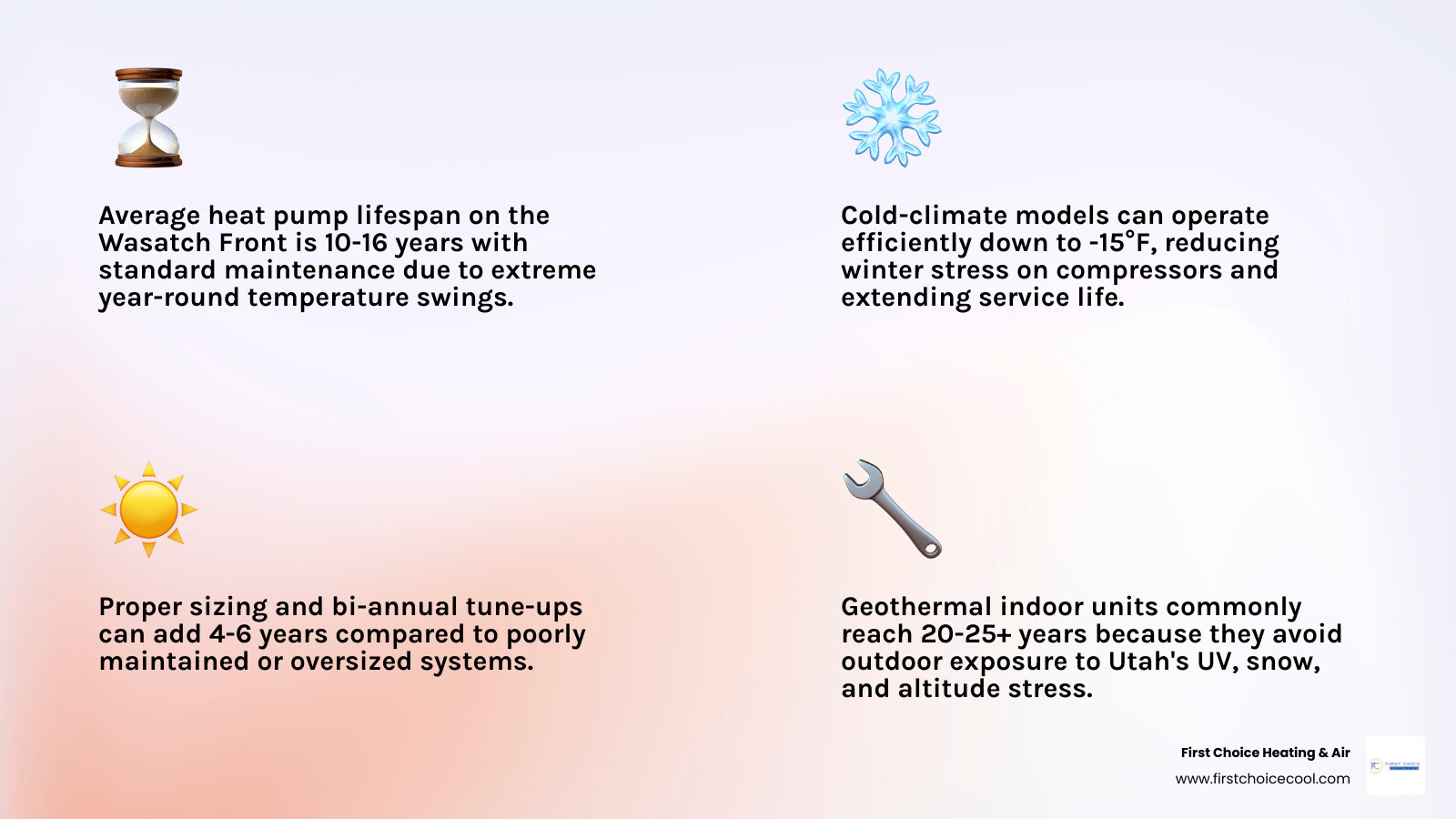
| Wasatch Front average (year-round operation, standard maintenance) | 10-16 years |
| Well-maintained modern air-source heat pump | 15-20 years |
| Poorly maintained or improperly sized system | 8-12 years |
| Ductless mini-split with regular service | 15-20 years |
| Geothermal system (indoor unit) | 20-25+ years |
Utah’s climate is genuinely harder on heat pumps than most places in the country. Your system runs in cooling mode through 100°F+ July days, then switches to heating mode through below-freezing January nights — often without much of a break in between. That year-round workload puts real stress on fan motors, compressors, and refrigerant lines in ways that milder coastal climates simply do not.
The good news is that the gap between a heat pump that fails at year 10 and one that reaches year 18 usually comes down to maintenance habits and proper installation — not luck.
How Long Does a Heat Pump Last in the Hot Summers and Cold Winters of the Wasatch Front?
When evaluating how long a heat pump remains viable along the Wasatch Front, we have to look closely at its operational cycle. Unlike a traditional furnace that rests all summer, or a central air conditioner that hibernates all winter, a heat pump is a year-round workhorse. It is constantly working to transfer heat—pushing it out of your home during the sweltering July heatwaves and pulling it in from the freezing winter air.
Because of this bidirectional operation, a heat pump naturally accumulates double the run-time hours of a single-season system. In cities like Salt Lake City, West Jordan, and Bluffdale, this heavy workload typically places the average lifespan of a standard air-source heat pump at 10 to 16 years.
However, modern engineering has steadily pushed these boundaries. Today’s high-efficiency systems, particularly those utilizing variable-speed inverter technology, can comfortably reach 15 to 20 years of service life if they receive consistent care.
Without proactive Home Maintenance, mechanical wear accelerates dramatically. The compressor—the very heart of your heat pump—has to work much harder to pump refrigerant through dirty coils or clogged filters. Over time, this extra friction and heat degrade the compressor’s internal valves and electrical windings, leading to premature failure long before the decade mark.
Environmental Factors Affecting Heat Pump Longevity in Utah
The Wasatch Front presents a highly unique set of environmental challenges that directly impact mechanical equipment. From our high elevation to winter weather patterns, your outdoor unit must brave elements that coastal or midwestern systems never encounter.

High Altitude, Intense UV Radiation, and Temperature Swings
At our elevation in the Salt Lake Valley, the atmosphere is thinner, which means we experience up to 17% more intense UV radiation than sea-level locations. This persistent UV exposure degrades plastic fan blades, wire insulation, and service valve covers on the outdoor cabinet.
Additionally, we regularly experience dramatic daily temperature swings of 40°F to 50°F, especially during the spring and autumn months. These rapid thermal shifts cause metal refrigerant lines and electrical connections to expand and contract repeatedly. Over several years, this physical stress can invite micro-leaks in copper joints or loosen electrical terminals.
Winter Inversions and Particulate Matter
During our notorious winter inversions, heavy, cold air becomes trapped along the valley floor, collecting high concentrations of particulate matter (PM 2.5). This airborne dust and soot settles directly onto the outdoor heat pump coils. When combined with winter moisture, it forms a grimy insulating barrier that severely restricts heat transfer. If left uncleaned, the system must run longer, warmer cycles to extract the same amount of heat, accelerating component wear.
How long does a heat pump last in the hot summers and cold winters of the wasatch front under high-altitude stress?
Operating at high altitudes changes the physics of air-source heating and cooling. Because the air is thinner along the Wasatch Front, it carries less density and mass. This has two direct consequences for your heat pump:
- Reduced Heat Dissipation: Air is the medium used to cool down the outdoor compressor and electrical control board. Thinner air is less effective at absorbing and carrying away this excess heat during a scorching 100°F summer afternoon.
- Increased Fan Workload: To move the necessary mass of air across the outdoor coils, the condenser fan motor must spin consistently, facing unique aerodynamic conditions that can lead to motor fatigue if the system is not specifically engineered for high-altitude performance.
This elevation-induced stress means that a heat pump operating in Bluffdale or West Jordan experiences higher internal operating temperatures than an identical unit running in a sea-level, moderate climate. Left unchecked, this heat buildup degrades lubricating oils within the compressor, shortening its overall lifespan.
How long does a heat pump last in the hot summers and cold winters of the wasatch front without proper snow clearance?
Winter along the Wasatch Front brings heavy, wet snow. If your outdoor unit is allowed to become buried or restricted by snowdrifts, its lifespan will suffer a major hit.
An air-source heat pump must have clear, unobstructed airflow to perform its defrost cycle. During freezing weather, moisture naturally condenses and freezes on the outdoor coils. The heat pump periodically reverses itself into a temporary cooling mode to warm up the outdoor coils and melt this ice.
If snow accumulates around the base of the unit or blocks the top fan discharge:
- Ice Buildup: Melted water cannot drain away properly. It pools at the base of the unit and refreezes into a solid block of ice, which can bend coil fins, damage fan blades, and rupture refrigerant tubing.
- Defrost Failure: The system may get stuck in continuous defrost loops, forcing the auxiliary heating elements to run constantly. This drastically spikes your utility bills and places immense thermal stress on the indoor air handler.
To maximize your system’s life, we recommend elevating the outdoor unit 12 to 18 inches on a sturdy snow stand and keeping a clear perimeter of at least two feet around all sides.
Maximizing Lifespan Through Proper Sizing and Installation
The single most influential day in a heat pump’s life is the day it is installed. No amount of maintenance can save a system that was improperly sized or poorly put together.
Many older systems were installed using “rules of thumb” based strictly on square footage. Today, we know that a precise Manual J load calculation is non-negotiable. This calculation accounts for your home’s local elevation, insulation values, window orientations, and local climate extremes.
| Sizing Status | Compressor Behavior | Impact on Lifespan | Efficiency Performance |
|---|---|---|---|
| Oversized Unit | Short cycles (turns on and off rapidly) | Low (8-12 Years): Extreme wear on start capacitors and compressor windings | Poor; fails to dehumidify in summer and wastes energy |
| Undersized Unit | Runs continuously without stopping | Low (8-12 Years): Mechanical fatigue from constant friction and lack of rest | Poor; struggles to maintain set temperatures on extreme days |
| Correctly Sized (Variable-Speed) | Runs in long, low-capacity steady cycles | High (15-20 Years): Minimal wear; gentle “soft starts” prevent electrical spikes | Excellent; maximizes SEER2 and HSPF2 ratings |
Modern variable-speed inverter systems act like a dimmer switch rather than a simple on/off light switch. By running at 30% or 50% capacity for longer stretches, they avoid the harsh electrical and mechanical starting spikes that wear out traditional single-stage compressors.
When to Repair vs. Replace Your Wasatch Front Heat Pump
As your heat pump blows past its tenth birthday, you will eventually face a fork in the road: do you patch up the existing unit, or invest in a modern replacement?
To remove the guesswork, we recommend applying the $5,000 Rule (also known as the age-times-repair-cost index).
$$\text{Age of System (Years)} \times \text{Cost of Repair} = \text{Decision Index}$$
If your calculation yields a number greater than 5,000, replacement is almost always the more financially sound decision. For example:
- A 13-year-old system requiring a $450 valve repair scores 5,850. Because this exceeds the threshold, and the unit is nearing the end of its typical Wasatch Front lifespan, upgrading to a high-efficiency SEER2 model is the wiser move.
- Conversely, an 8-year-old system needing a $300 fan motor replacement scores 2,400, making a professional repair the clear choice.
For a deeper dive into making this decision for your home, check out our AZ Guide to AC Repair vs Replace.
The R-22 Refrigerant Factor
If your heat pump was installed before 2010, it likely relies on R-22 (Freon) refrigerant. Because R-22 was completely phased out of production and importation, sourcing it for repairs has become incredibly difficult and costly. If an aging R-22 system develops a refrigerant leak or compressor failure, replacing the system is the only practical and environmentally responsible solution. Upgrading to a modern system utilizing eco-friendly refrigerants will immediately slash your heating and cooling energy use by up to 40% to 50%.
Frequently Asked Questions about Utah Heat Pump Lifespans
Do heat pumps really work in Utah’s freezing winters?
Yes, absolutely! While older heat pumps struggled when temperatures dipped below freezing, modern cold-climate heat pumps are specifically engineered to extract heat from outdoor air down to -15°F. They utilize variable-speed scroll compressors and advanced electronic expansion valves to maintain high efficiency even on our coldest January nights. For added peace of mind, we often configure these systems with auxiliary electric heat strips or pair them with a high-efficiency gas furnace in a hybrid “dual-fuel” setup.
How often should I schedule professional maintenance for my heat pump?
Because heat pumps operate year-round, they require professional maintenance twice a year—once in the spring to prep for the intense summer cooling demands, and once in the fall to ensure heating reliability. During these visits, we thoroughly clean the coils, verify precise refrigerant charges, inspect electrical connections, clear condensate drains, and test the defrost cycle calibration. This proactive care can easily add 3 to 5 years of reliable service to your system’s life.
Can a heat pump replace both my furnace and air conditioner in Salt Lake City?
Yes, a heat pump is designed to handle both heating and cooling duties, completely simplifying your home’s mechanical systems. By consolidating your comfort into a single, high-efficiency system, you reduce your long-term maintenance overhead and eliminate the need to manage two completely separate appliances.
Conclusion
Navigating the extreme seasonal shifts of the Wasatch Front requires a home comfort system that is tough, efficient, and expertly installed. While our hot summers and freezing winters place a heavy workload on any heat pump, proper sizing, professional installation, and consistent maintenance will ensure your system delivers reliable comfort for up to 15 to 20 years.
At First Choice Heating & Air, we are proud to provide community-focused, expert HVAC services across Bluffdale, Salt Lake City, West Jordan, and the surrounding Salt Lake and Utah counties. Whether you need to establish a preventative maintenance plan to protect your current system or want to explore competitive financing options on a new, high-efficiency heat pump backed by strong warranties, our team is here to help.
Schedule your professional heat pump service with First Choice Heating & Air today and let us give your home the year-round comfort and peace of mind you deserve!