


When Your AC Can’t Keep Up: Undersized AC Unit Signs and Problems in a Hot Dry Wasatch Front Climate
The undersized ac unit signs and problems in a hot dry wasatch front climate are something thousands of Utah homeowners run into every summer — often without realizing the root cause. If your home never quite reaches the temperature on your thermostat, your AC runs for hours without a break, or your energy bills keep climbing despite nothing changing, your system may simply be too small for the job it’s being asked to do.
Here are the most common signs your AC is undersized for a Wasatch Front home:
- AC runs nonstop without ever reaching the thermostat setpoint, especially between 2 PM and 7 PM
- Indoor temperature stays 5°F or more above what you have the thermostat set to on hot days
- Energy bills are unusually high compared to neighbors with similar-sized homes
- Uneven cooling — some rooms feel comfortable while others stay hot
- The system has always struggled, even when it was relatively new
- Humidity feels higher than expected indoors, even in Utah’s dry climate
- Frequent breakdowns and repairs that keep recurring season after season
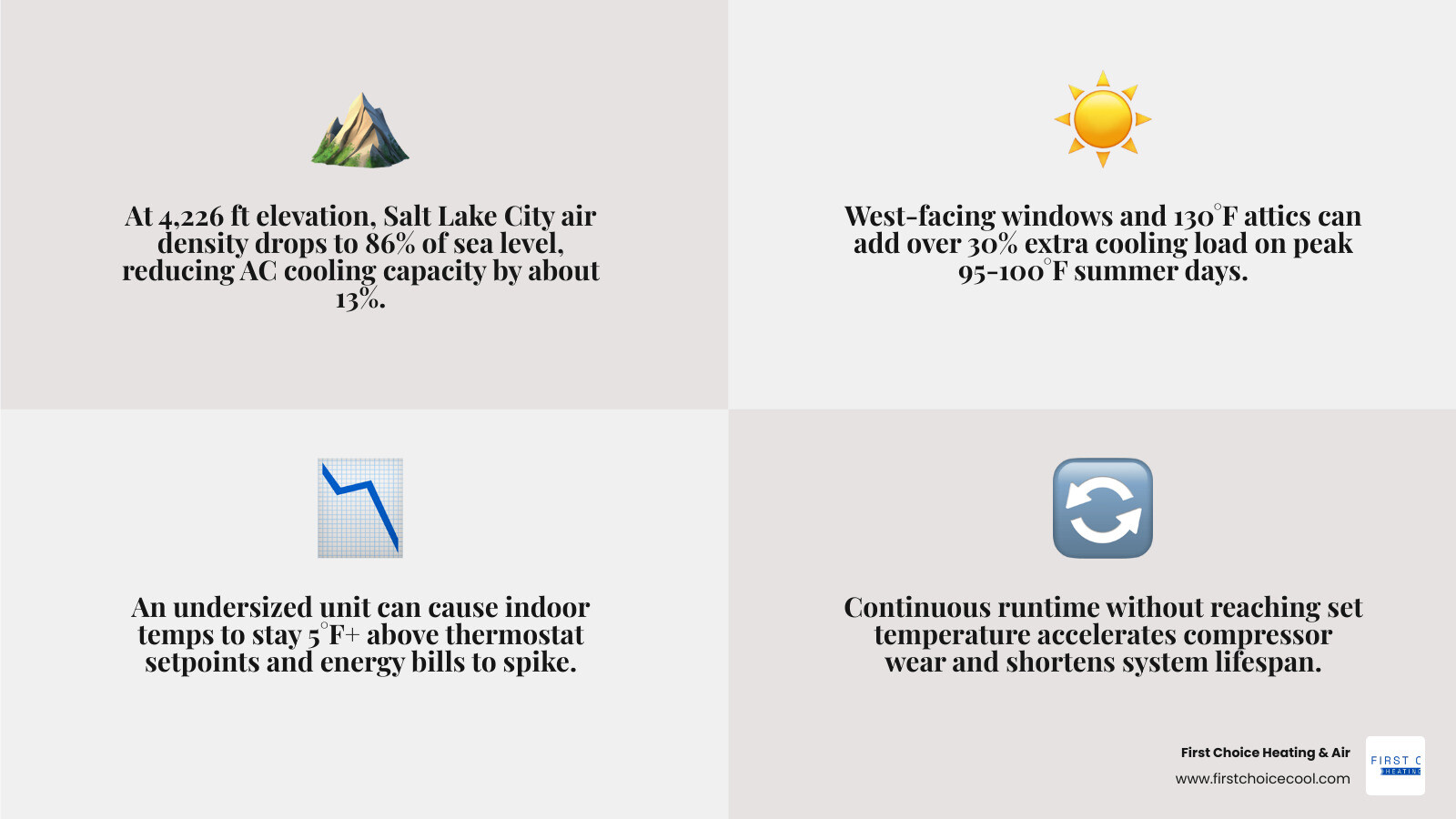
What makes this problem especially tricky on the Wasatch Front is that Utah’s high altitude and dry desert heat create conditions that shrink your AC’s real-world cooling capacity well below what the nameplate rating suggests. A unit that looks right on paper can be significantly underpowered by the time you account for Salt Lake City’s elevation of 4,226 feet — where air is only about 86% as dense as at sea level, cutting cooling capacity by roughly 13%.
Add in summer days that regularly push past 95°F (and sometimes 100°F), attic temperatures that can exceed 130°F, and the relentless sun beating through west-facing windows, and even a properly sized system works at its absolute limit. An undersized one never has a chance.
Undersized ac unit signs and problems in a hot dry wasatch front climate terms to remember:
- ac running constantly in utah summer heat
- how dry desert heat in utah makes your ac work harder than humid climates
The Double Threat: How Utah’s Altitude and Dry Climate Impact AC Sizing
When HVAC systems are engineered, their performance ratings are calculated under laboratory conditions at sea level. However, living along the Wasatch Front means dealing with two powerful environmental factors that completely change the rules of thermodynamics: high altitude and extremely low humidity.
These factors combined make our region one of the most demanding environments for residential cooling. If you want to understand why your system struggles, it is helpful to look at Why the Salt Lake Valley Is One of the Most Demanding HVAC Climates in the West and learn All About Dry Desert Heat in Utah and AC Strain.
Why Altitude Derating Matters for Utah Homes
Air density decreases as elevation rises. Because air is thinner at higher elevations, there are fewer air molecules available per cubic foot to absorb and carry heat away from your home. In the HVAC industry, adjusting a system’s capacity to account for this thin air is called “altitude derating.”
As a general rule, an air conditioner loses about 3% of its cooling capacity for every 1,000 feet of elevation gain. In Salt Lake City, which sits at an average elevation of 4,226 feet, the air density is only about 86% of what it is at sea level. This results in a direct 13% loss in cooling capacity.
Consider what this means for a typical home:
- A 3-ton air conditioner is rated to deliver 36,000 BTUs (British Thermal Units) of cooling per hour at sea level.
- At 4,226 feet along the Wasatch Front, that exact same 3-ton system only delivers about 31,300 BTUs of actual cooling.
- If your home climbs higher into the foothills of Draper, Sandy, or up toward Park City, the capacity loss becomes even more severe.
If an installer calculates your home’s cooling needs using standard sea-level charts without applying altitude derating, they will install a system that is fundamentally undersized from day one.
How Dry Desert Air Masks and Multiplies Sizing Issues
Utah’s dry desert air plays a deceptive role in how we perceive our air conditioner’s performance. In humid climates, an AC unit must spend a massive amount of its energy removing moisture from the air (known as the latent cooling load) before it can effectively lower the indoor temperature (known as the sensible cooling load).
Because our relative summer humidity along the Wasatch Front regularly drops below 15%, your air conditioner has a very low latent load. Almost 100% of its cooling capacity goes directly toward lowering the air temperature. This dry air initially masks a slightly undersized system during the mild spring months of May and early June.
However, once July and August arrive, bringing sustained afternoon temperatures of 95°F to 100°F, the lack of humidity can no longer compensate for a lack of raw cooling capacity. The dry air causes moisture in any outdoor dirt or dust on your condenser coils to bake into a hard, insulating crust, further choking the system’s ability to reject heat. When the outdoor temperature rises, the undersized system runs out of thermal headroom and completely fails to keep up.
Undersized AC Unit Signs and Problems in a Hot Dry Wasatch Front Climate

When your air conditioner lacks the physical capacity to handle the heat load of your home, it expresses this limitation through a very specific set of operational behaviors. Recognizing these patterns can help you determine if you need a system replacement or if you are dealing with a standard maintenance issue. If you are experiencing these problems, it is worth exploring Why Is My AC Running But Not Cooling? to rule out other common culprits.
Recognizing Undersized AC Unit Signs and Problems in a Hot Dry Wasatch Front Climate
The most obvious sign of an undersized system is a persistent thermostat mismatch during peak afternoon hours. Most residential air conditioning systems are engineered to handle a maximum temperature difference (known as Delta T) of about 15 to 20 degrees Fahrenheit between the outdoor air and the indoor air.
If it is 98°F in West Jordan, a properly sized and functioning system should be able to maintain an indoor temperature of 72°F to 75°F. However, an undersized unit will hit a hard ceiling. It may keep the house at 78°F or 80°F, running continuously for hours without ever dropping the temperature to your setpoint.
An undersized unit can run up to 80% longer than a properly sized system during peak Utah summer heat. Instead of cycling on and off 2 to 3 times per hour for 15 to 20 minutes at a time, an undersized compressor will start running at 10 AM and won’t shut off until 2 AM the following morning. This constant runtime places an immense burden on your utility bills. Given that air conditioning accounts for roughly 70% of residential electricity use in Utah during the summer months, a system running nearly 24/7 will cause your power bills to skyrocket.
Long-Term Mechanical Failures Caused by Undersized AC Unit Signs and Problems in a Hot Dry Wasatch Front Climate
Running an air conditioner continuously does more than just drain your wallet; it rapidly accelerates the wear and tear on the system’s critical mechanical components. Air conditioners are mechanical systems with parts designed for specific duty cycles. When forced to run without a break in triple-digit heat, several key components are pushed to their breaking points:
- Compressor Overheating: The compressor is the heart of your AC system. It relies on the cool refrigerant gas returning from your indoor evaporator coil to keep its internal motor cool. In an undersized system, the refrigerant returning to the compressor is often too warm, causing the compressor to run at elevated temperatures. This breaks down the lubricating oil inside, leading to mechanical friction, electrical shorts, and eventual compressor failure.
- Fan Motor and Capacitor Failure: The outdoor condenser fan motor and its run capacitor are subjected to extreme, sustained heat inside the unit’s electrical cabinet, where temperatures can easily exceed 150°F on a hot afternoon. Sustained operation under these conditions causes capacitors to bulge and lose their charge, leaving the fan motor unable to start or run.
- Severely Shortened Lifespan: While a well-maintained, properly sized air conditioner in Utah typically lasts 12 to 15 years, an undersized unit that runs constantly during the summer will often experience catastrophic failure between years 8 and 10.
If you find yourself calling for technicians to address recurrent electrical or mechanical issues every summer, you are likely dealing with the downstream effects of an undersized system. For a closer look at these issues, read about the Common AC Repairs in Hot Dry Wasatch Front Climates.
Is It Undersized or Just Broken? How to Tell the Difference
Before assuming your air conditioner is undersized, it is vital to rule out common mechanical faults that produce similar symptoms. A system that is low on refrigerant, choked by a dirty air filter, or insulated by dirty condenser coils will also run constantly and struggle to cool your home.
To help you diagnose the root cause of your cooling troubles, review Five Reasons Why Your AC Isn’t Cooling Your House and see What Causes My AC to Blow Hot Air?.
The table below outlines the key differences between an undersized system and common mechanical failures:
| Symptom / Behavior | Undersized AC Unit | Low Refrigerant Charge | Dirty Condenser Coils / Clogged Filter |
|---|---|---|---|
| History of Performance | Has struggled on hot days since the day it was installed. | Used to cool the home perfectly, but performance has degraded over time. | Cooling performance dropped suddenly or gradually over a single season. |
| Airflow Temperature | Air coming out of the vents is cool and consistent (typically 15-20°F below return air), but there isn’t enough volume or capacity to lower the whole house. | Air coming out of the vents feels lukewarm or warm. | Airflow is noticeably weak or restricted; air may feel cool but cannot circulate. |
| Evaporator Coil Icing | Coils rarely freeze unless there is a secondary airflow issue. | Indoor evaporator coil frequently freezes over, turning into a block of ice. | Coils may freeze due to restricted airflow over the dusty, choked metal fins. |
| Energy Consumption Impact | Increases energy bills due to extremely long runtimes, but operates at normal electrical draw. | Low refrigerant levels can increase energy consumption by 20% to 30% because the system cannot absorb heat efficiently. | A clogged air filter can reduce system efficiency by up to 15%, forcing longer run times. |
| Outdoor Unit Behavior | Runs quietly and consistently, just for hours on end without stopping. | Compressor may make a clicking sound or shut down on thermal overload. | Outdoor unit may run hot to the touch and sound louder as it struggles to reject heat. |
If your system cooled your home perfectly in previous summers but is suddenly struggling in 2026, you are likely dealing with a mechanical issue rather than an undersized unit. If your home has never been comfortable on a hot July afternoon, the system was likely miscalculated during installation.
The Path to Comfort: Sizing and Solutions for Wasatch Front Homeowners
If you suspect your air conditioner is undersized, the solution is not as simple as just buying a “bigger” unit. Installing an oversized system can lead to short cycling, where the unit turns on and off rapidly, failing to run long enough to properly dehumidify the home or distribute air evenly. This results in hot and cold spots, high indoor humidity, and up to 600% more wear and tear on electrical components.
The only correct way to size an air conditioner for a Utah home is by performing a comprehensive load calculation. Professional HVAC contractors use industry-standard protocols established by the Air Conditioning Contractors of America (ACCA):
- Manual J Load Calculation: This calculation determines the exact amount of heating and cooling your home actually needs. It takes into account your home’s total square footage, ceiling heights, insulation levels (R-values) in the attic and walls, the type and orientation of your windows (especially west-facing glass), local climate design temperatures, and our specific altitude of 4,226+ feet.
- Manual S Equipment Selection: Once the Manual J load is known, Manual S is used to select equipment that matches those exact requirements, applying the necessary altitude derating factors so the system performs as expected in our thin air.
For homeowners dealing with an undersized system, there are several pathways to restore comfort:
- Full System Replacement: Replacing the undersized unit with a correctly sized system is the most comprehensive solution. Modern systems using variable-speed compressors are highly recommended for the Wasatch Front, as they can scale their output up during a 100°F heatwave and scale down during milder 85°F days, maximizing energy efficiency. You can learn more about making this choice in Choosing the Right Air Conditioner for Your Home and check out these Tips Choosing the Right AC System.
- Ductless Mini-Split Additions: If your main system is in good condition but struggles to cool specific areas — such as a newly finished basement, a converted attic, or a master bedroom with heavy solar gain — installing a ductless mini-split to supplement your central AC is an excellent, cost-effective solution.
- Zoning Systems: For multi-level homes in Salt Lake or Utah County, adding dampers and a zoning panel can help redirect cooling capacity to the upper levels during the hottest parts of the day, maximizing the effectiveness of your existing equipment.
Frequently Asked Questions About AC Sizing in Utah
How long should my AC run on a 95-degree day in Utah?
On a 95-degree afternoon along the Wasatch Front, it is completely normal for a properly sized, single-stage air conditioner to run for 30 to 45 minutes per hour. During the hottest part of the day (typically between 2 PM and 7 PM), it may run continuously without stopping. This is by design.
Air conditioners are sized based on “design temperatures” that are only exceeded about 1% of the year. In Salt Lake City, that design temperature is 95°F. When temperatures hit or exceed this threshold, your system is working at its maximum capacity, and continuous runtime is expected. However, once the sun goes down and outdoor temperatures drop into the 70s, a properly sized system should easily catch up and begin cycling on and off normally.
Can a dirty air filter cause my AC to run continuously?
Yes, absolutely. A dirty air filter restricts the volume of air flowing through your system. Because less warm indoor air is passing over the cold evaporator coils, the system takes much longer to extract heat from your home, forcing the unit to run hours longer than normal.
In our dusty, dry high-desert climate, fine alkaline dust and windblown soil clog filters much faster than the standard 90-day manufacturer recommendations. During peak summer, we highly recommend checking your filter every 3 to 4 weeks and replacing it every 30 to 45 days to maintain proper airflow and prevent system strain. If your system is struggling, check if Is Your Air Conditioner in Need of a Repair? to avoid unnecessary wear.
When should I replace vs. repair a struggling AC system?
Deciding whether to repair or replace a struggling system comes down to age, repair history, and the underlying cause of the issue. If your air conditioner is under 10 years old and the repair is a simple component failure (like a capacitor or contactor), repairing the system is almost always the best choice.
However, if your system is over 12 years old, uses the phased-out R-22 refrigerant, and requires frequent, expensive repairs, replacement is usually the smarter long-term investment. This is especially true if the system is fundamentally undersized; no amount of repairs or maintenance can change the physical capacity of a system that is too small for your home.
For a detailed breakdown of this decision, read When to Replace vs Repair Aging AC System and explore our guide All About Deciding AC Repair vs Replace in Utah.
Conclusion
Dealing with an undersized air conditioner in the middle of a scorching Utah summer is incredibly frustrating. The combination of high altitude, low humidity, and intense afternoon heat means that any shortcut taken during the initial system sizing will make itself known when you need cooling the most.
If your air conditioner is running constantly, driving up your power bills, and failing to keep your family comfortable, it is time to stop guessing and get a professional assessment. At First Choice Heating & Air, we are proud to serve our neighbors throughout Bluffdale, West Jordan, Salt Lake City, and across Salt Lake and Utah Counties. We don’t rely on rule-of-thumb guesses; we perform precise Manual J load calculations to ensure your home gets the exact cooling capacity it needs to handle the unique demands of our high-altitude climate.
Whether you need a comprehensive system evaluation, a strategic ductless mini-split installation, or a complete, high-efficiency AC upgrade, our team is here to help you find the perfect solution for your home and budget. Contact us today at First Choice Heating & Air to schedule your professional comfort assessment and keep your home cool all summer long!