


Is a 12 to 15 Year Old AC Worth Fixing in a Hot Dry Utah Climate? Here’s the Short Answer
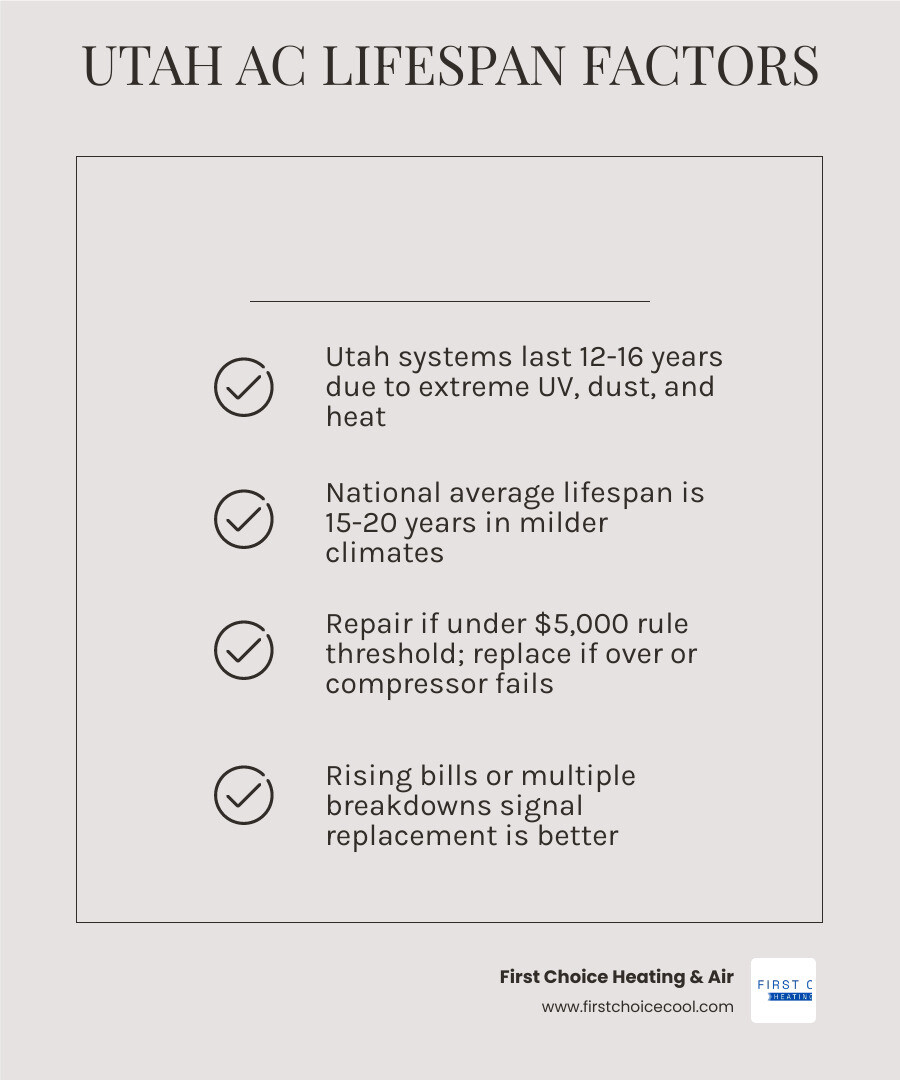
Is a 12 to 15 year old AC worth fixing in a hot dry Utah climate? In most cases, the answer depends on what needs to be repaired — but the odds are not in the system’s favor. Utah’s extreme heat, intense UV radiation, and winter inversion dust put central AC units under stress that most other states simply don’t. Nationally, a central AC might last 15 to 20 years. In the Salt Lake Valley and along the Wasatch Front, that same system typically reaches the end of its useful life somewhere between 12 and 16 years.
If your system is already in that window and something goes wrong, you’re likely staring down one of the most common — and stressful — decisions a homeowner faces: do you pay for the repair, or is it time to replace the whole thing?
Here’s a quick-reference answer based on the most common scenarios:
Quick Answer: Should You Repair or Replace?
| Situation | Likely Recommendation |
|---|---|
| Minor repair (capacitor, contactor) on a 12-year-old unit | Repair may be worthwhile — apply the $5,000 Rule first |
| Compressor failure on a 12-15 year old unit | Replace — repair cost approaches 40-60% of full replacement |
| System uses R-22 refrigerant and has a refrigerant leak | Replace — R-22 is no longer manufactured and costs are high |
| Multiple repairs needed in a single season | Replace — signals widespread component wear |
| Rising utility bills without a usage change | Evaluate — likely efficiency loss from age; replacement may pay for itself |
| System age × repair cost exceeds $5,000 | Replace — the $5,000 Rule points toward a new system |
The sections below walk through exactly why Utah’s climate accelerates AC aging, how to run the numbers on any repair estimate, and what warning signs mean your system is past the tipping point.
Is a 12 to 15 year old ac worth fixing in a hot dry utah climate vocab explained:
- ac repair vs replace — decision guide
- how much ac repair is too much before replacing your unit in utah
Why Utah’s Harsh Climate Shortens Central AC Lifespan
When manufacturers calculate the average lifespan of a central air conditioner, they often base their numbers on moderate climates with average humidity, mild winters, and standard elevations. Unfortunately, the Wasatch Front is anything but average.
The unique geography of the Salt Lake Valley, spanning from West Jordan up to Salt Lake City and down through Utah County, creates a highly demanding environment for mechanical equipment. To understand why your cooling system might be struggling at 12 years old, we have to look at the unique atmospheric and weather patterns of our region. For a deeper dive into these localized challenges, you can read about Why the Salt Lake Valley is One of the Most Demanding HVAC Climates in the West and learn All About Dry Desert Heat in Utah and AC Strain.
In Utah, our summers are characterized by sustained triple-digit heat and exceptionally low relative humidity, often dipping below 15%. While dry air means your air conditioner doesn’t have to work as hard to remove moisture from the air compared to humid climates, it forces the system to run for much longer, continuous cycles to drop the indoor temperature to a comfortable level. These long runtimes translate directly to physical wear and tear on the compressor, fan motors, and electrical contactors.
How Elevation and UV Radiation Accelerate Wear
Our high elevation is another silent contributor to premature equipment aging. At an average altitude of over 4,300 feet along the Wasatch Front, the atmosphere is thinner, which has two direct consequences for your outdoor condenser unit:
- Increased UV Exposure: Solar radiation is roughly 17% more intense at our elevation than it is at sea level. This relentless ultraviolet light bakes the outdoor unit, causing plastic electrical covers, wire insulation, and rubber seals to become brittle, crack, and fail years ahead of schedule.
- Reduced Heat Transfer Efficiency: Thinner air carries less heat. Because the air is less dense, your outdoor fan must work harder to push heat off the condenser coils and into the surrounding atmosphere. This places an elevated thermal load on the compressor, leading to internal metal fatigue.
Over time, this combination of high UV and altitude-induced strain shortens the operational horizon of major components. To see how these factors stack up over the years, check out our Ultimate Checklist for Average Lifespan of Central Air Conditioner in Hot Dry Utah Climate.
The Impact of Winter Inversion Dust on Dormant Systems
Utah’s climate challenges aren’t restricted to the summer. Our notorious winter inversion season plays a major role in degrading air conditioning equipment while it sits dormant. During an inversion, cold air is trapped on the valley floor, pooling fine particulate matter, road salt dust, and industrial emissions close to the ground.
Because your outdoor condenser unit sits uncovered throughout the winter, these microscopic, corrosive particles settle deep into the aluminum fins and copper tubing of the condenser coil. When spring arrives, this accumulated grime forms a baked-on barrier that restricts airflow and insulates the coils. If not meticulously cleaned during an annual tune-up, this winter residue forces the system to run hotter and consume more energy during the subsequent cooling season, accelerating the transition of your 12-to-15-year-old system from “aging” to “failed.”
Is a 12 to 15 Year Old AC Worth Fixing in a Hot Dry Utah Climate?
When your air conditioner crosses the decade mark, it officially enters its late-life stage. In a climate as demanding as ours, a 12-year-old system has already spent over a decade fighting intense UV rays, dust storms, and winter inversions. At this point, the system is operating at roughly 65% to 75% of its maximum realistic lifespan.
Before you approve an expensive repair on a unit in this age bracket, you must weigh the upfront cost of the fix against the high likelihood of subsequent component failures. To help guide this process, we recommend reading All About Deciding AC Repair vs. Replace in Utah as well as our guide on When to Replace vs. Repair Aging AC System.
Warning Signs Your 12-15 Year Old AC is Nearing End of Life
An air conditioner rarely fails completely without dropping a few hints first. If you notice any of the following warning signs, your aging system is likely telling you that its internal components are in terminal decline:
- Diminishing Airflow and Rising Indoor Temperatures: If your registers are blowing lukewarm or weak air, and the system runs constantly without ever reaching your thermostat’s set point on a hot afternoon, the compressor or blower motor is likely failing.
- Frequent Component Breakdowns: If you had to call an HVAC technician last summer for a bad capacitor, and now the fan motor is squealing, your system is entering a “repair spiral.”
- Short Cycling: If the AC turns on and off rapidly every few minutes, it is experiencing electrical or pressure issues that place immense strain on the compressor.
- Unusually High Utility Bills: As mechanical parts wear down, they require more electrical current to perform the same amount of work, resulting in spiked monthly energy bills.
To learn more about these indicators, read our breakdown of the Signs Your Home Needs New AC System.
The R-22 Refrigerant Dilemma for Older Utah Units
If your air conditioner was installed before 2010, there is a very high probability that it utilizes R-22 refrigerant (commonly known as Freon). Due to environmental regulations, the EPA fully banned the production and import of R-22.
Today, the only R-22 available is reclaimed or recycled stock, which has driven the cost of this refrigerant to astronomical heights. If your 12-to-15-year-old unit develops a refrigerant leak and uses R-22, attempting a repair is almost always a poor financial decision. Finding and patching a leak in an old copper coil is incredibly labor-intensive, and recharging the system with scarce R-22 can cost nearly as much as a down payment on a modern, highly efficient replacement system.
Mathematical Frameworks for the Repair-vs-Replace Decision
When emotions run high during a summer breakdown, having an objective, mathematical framework can take the stress out of making a decision. Instead of guessing whether a repair is worth it, you can apply industry-standard financial formulas to determine the most logical path forward. For a deeper look at this logic, see our article on Is Repairing Your Air Conditioner Necessary?.
To help you visualize where your system stands, consider this comparison table of key indicators:
| Decision Factor | Strongly Favors Repair | Strongly Favors Replacement |
|---|---|---|
| System Age | Under 8-10 years old | 12 to 15+ years old |
| Refrigerant Type | R-410A (widely available) | R-22 (phased out, highly expensive) |
| Repair History | First major issue in several years | Multiple service calls over the last 24 months |
| Component Health | Failed capacitor, contactor, or minor switch | Cracked heat exchanger, failed compressor, or leaking coil |
| Energy Efficiency | Utility bills remain consistent with previous years | Monthly bills are steadily climbing despite normal usage |
Applying the $5,000 Rule to Your System
The $5,000 Rule is a simple, time-tested mathematical formula used by HVAC professionals and homeowners alike to remove emotion from the repair-versus-replace equation.
To use this rule, you simply multiply the age of your air conditioning unit by the exact written estimate for the repair:
System Age (Years) × Repair Cost = Decision Score
- If the resulting score is under $5,000, making the repair is generally considered a reasonable financial investment.
- If the score is over $5,000, you should strongly consider putting that money toward a modern, high-efficiency replacement system.
For example, if you have a 12-year-old system that requires a moderate repair of several hundred dollars, multiplying 12 by that repair cost will easily push your score past the $5,000 threshold. In this scenario, the math suggests that continuing to patch the old unit is likely throwing good money after bad.
Understanding the 50% Rule for Major Component Failures
Another highly reliable framework is the 50% Rule. This rule states that if the cost of a single repair exceeds 50% of the total value of a brand-new, comparable air conditioning system, you should always opt for replacement.
Major components like the compressor or the evaporator coil are incredibly labor-intensive to replace. Because these parts represent the “heart” of the system, their failure on a unit that is 12 to 15 years old is a strong indicator that the rest of the system is on the verge of breakdown. To explore how this rule applies to your specific home setup, check out our guide on When to Replace Your Air Conditioner.
Frequently Asked Questions About Aging AC Units
Is a 12 to 15 year old ac worth fixing in a hot dry utah climate if it only needs a minor repair?
Yes, in many cases, minor repairs are still worth making on an older unit, provided the system has a clean service history and hasn’t shown signs of systemic failure. Minor parts like capacitors, contactors, or simple fan relays are relatively inexpensive to replace and can keep your system running through the end of the season.
However, before authorizing even a minor fix, you should still run the $5,000 Rule and consult with a professional to ensure that the minor issue isn’t a symptom of a larger, underlying electrical problem. If your system is constantly blowing fuses or failing to start, read our helpful article: Is Your Air Conditioner in Need of a Repair?.
Is a 12 to 15 year old ac worth fixing in a hot dry utah climate when the compressor fails?
Almost never. The compressor is the most expensive and vital component in your air conditioner. Replacing a compressor on a 12-to-15-year-old system is highly discouraged because the new compressor will have to work alongside aging, worn-out components like the fan motor, condenser coils, and electrical wiring.
Additionally, a compressor failure often contaminates the refrigerant lines with acid and metal debris. Flushing this debris out is difficult, and if any residue remains, it can quickly destroy the newly installed compressor. Putting a brand-new compressor into a system that is already past its prime is rarely a sound long-term investment.
How does consistent maintenance affect the lifespan of a Utah AC?
Consistent, professional maintenance is the single most important factor in extending the lifespan of your cooling system in Utah’s harsh climate. Annual spring tune-ups allow technicians to clean away corrosive winter inversion dust, check refrigerant levels, tighten electrical connections, and catch minor component wear before it turns into a catastrophic summer breakdown.
Without regular coil cleanings, a layer of dirt as thin as a dime can reduce your system’s heat-exchange efficiency by up to 30%, forcing the compressor to run hotter, draw more electricity, and fail years ahead of schedule.
Conclusion
Deciding whether to repair or replace a 12-to-15-year-old air conditioner in Utah is ultimately a balance of mathematical reality and your personal comfort goals. While a minor, inexpensive fix might buy you another season of cool air, investing in a major repair on a system of this age is often a temporary patch on an inevitable problem.
Upgrading to a modern, high-efficiency system not only provides reliable peace of mind during our blistering July and August heatwaves, but it can also dramatically lower your monthly energy consumption, often reducing cooling costs by 20% to 40% compared to older, low-SEER units.
At First Choice Heating & Air, we are proud to serve our neighbors throughout Bluffdale, Salt Lake City, West Jordan, and the surrounding Salt Lake and Utah Counties. As a community-focused HVAC provider, we pride ourselves on delivering honest, pressure-free assessments to help you make the smartest choice for your home and budget. We offer competitive financing options, robust maintenance plans, and industry-leading warranties to ensure your home remains a sanctuary of comfort all year long.
If your aging air conditioner is struggling to keep up with the summer heat, don’t wait for a total system failure on the hottest day of the year. Schedule an expert consultation with First Choice Heating & Air today, and let our experienced team help you find the perfect, energy-efficient solution for your home.