


Why 50 Years of Combined HVAC Experience Benefits Utah Homeowners
Understanding how 50 years of combined HVAC experience benefits Utah homeowners comes down to one simple idea: when your heating or cooling system fails during a January blizzard or a July heat wave, you want a team that has seen it all before — and knows exactly what to do.
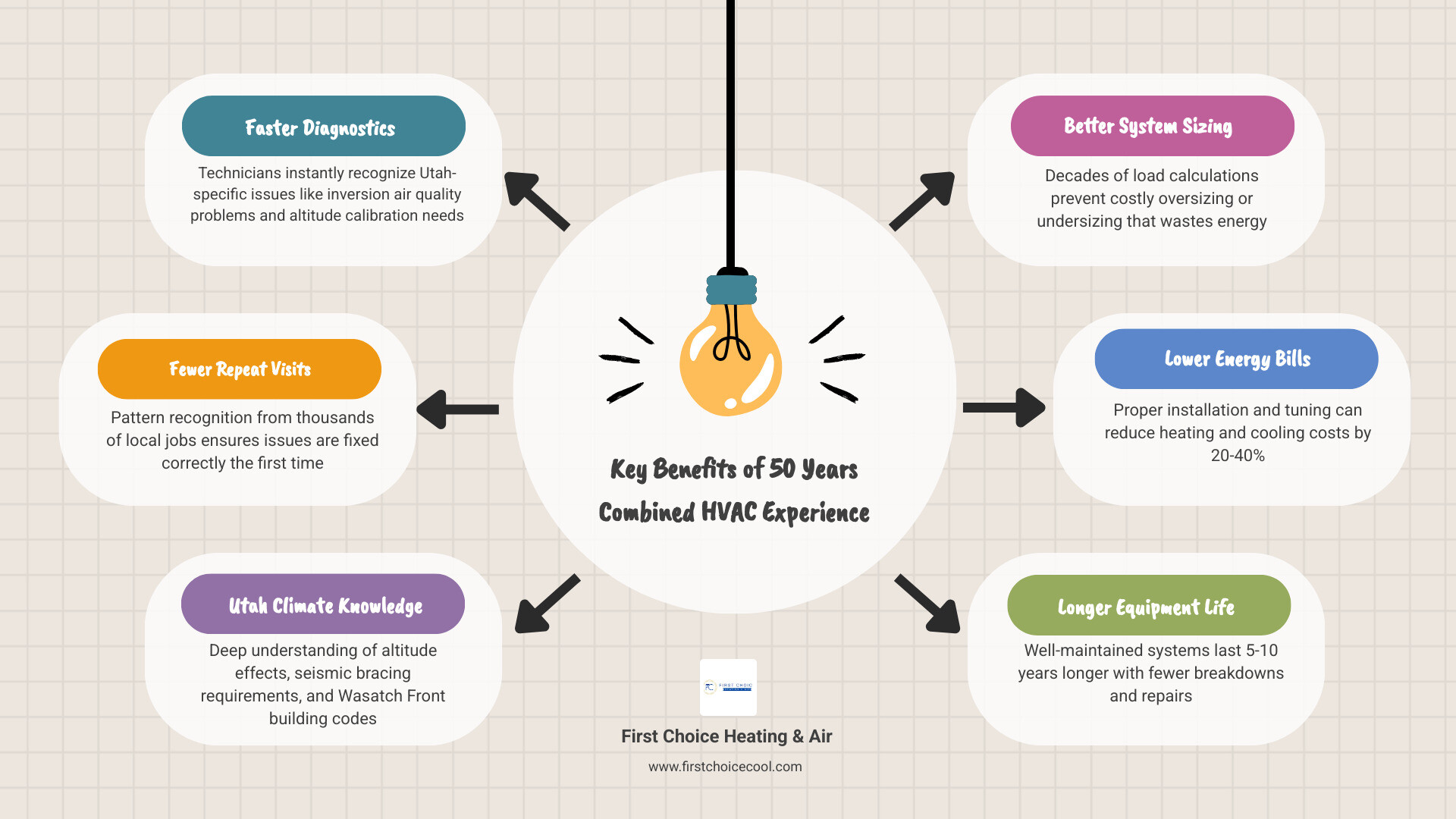
Here is a quick summary of the key benefits:
- Faster diagnostics – Experienced technicians recognize common Utah problems immediately, reducing time without heat or cooling
- Fewer repeat visits – Pattern recognition from thousands of jobs means issues get fixed right the first time
- Utah-specific knowledge – Local teams understand altitude calibration, inversion air quality, seismic bracing, and Wasatch Front building codes
- Better system sizing – Decades of load calculations prevent costly oversizing or undersizing mistakes
- Lower energy bills – Proper installation and tuning can reduce cooling and heating costs by 20–40%
- Longer equipment life – Well-maintained systems last 5–10 years longer than neglected ones
- Regulatory confidence – Local experience means permits, codes, and inspections are handled correctly the first time
- Community accountability – A long-standing local company’s reputation depends on every single job
Heating and cooling costs make up 30–50% of the average Utah homeowner’s energy bills. Getting HVAC service wrong — oversized equipment, leaky ducts, improper altitude calibration — can make those costs significantly worse. A team with deep collective experience removes the guesswork that newer or out-of-area providers simply cannot.
In this guide, First Choice Heating & Air walks you through exactly what that experience means for your home, your comfort, and your wallet.
How 50 Years of Combined HVAC Experience Benefits Utah Homeowners
When we talk about “50 years of combined HVAC experience,” we are referring to the collective knowledge network of our entire team. In the HVAC industry, a single technician working alone only has access to their own past jobs. But when you hire a team with half a century of combined experience, you are tapping into a shared library of problem-solving.
If a technician encounters a rare, complex wiring issue on an older system in Salt Lake City or a unique airflow bottleneck in a newer West Jordan home, they do not have to guess. They have immediate access to a brain trust of senior specialists who have resolved that exact issue dozens of times. This team synergy directly translates to faster diagnostic times and a dramatic reduction in errors.
This level of experience relies heavily on pattern recognition. Experienced technicians can often diagnose a failing capacitor or a restricted expansion valve simply by the pitch of the system’s hum or the specific timing of its startup cycle. Because they recognize these patterns instantly, they do not waste time replacing parts you do not need. They pinpoint the root cause of the problem on the first visit, saving you from the frustration of repeat service calls.
Furthermore, this deep background shapes how we approach routine Home Maintenance. Experienced teams do not just run through a generic checklist; they know exactly where systems fail under local conditions. They inspect high-wear components proactively, catching minor electrical faults or small heat exchanger cracks before they turn into midnight emergencies.
Navigating Utah’s Unique Climate and Environmental Challenges
Utah’s environment is notoriously tough on heating and cooling systems. The Wasatch Front experiences dramatic seasonal temperature swings, ranging from winter lows in the teens to scorching summer days that climb past 100°F. This extreme variation puts incredible stress on mechanical systems, forcing them to transition from heavy heating to intense cooling in a matter of weeks.
In addition to temperature swings, Utah is the second-driest state in the nation. While our low relative humidity actually helps air conditioners run slightly more efficiently because they do not have to remove as much moisture from the air, it presents severe indoor comfort challenges during the winter. Dry indoor air can dry out nasal passages, increase static electricity, and damage wooden flooring or furniture. Our decades of experience help us design and integrate whole-home humidification systems that maintain an optimal 30% to 60% relative humidity throughout the dry winter months.
These extreme weather shifts also make the decision to service or replace your equipment highly critical. When you are trying to determine the best path forward for an aging system, consulting our AZ Guide to AC Repair vs Replace can help you weigh the longevity of your unit against the long-term energy savings of a modern upgrade.
Solving Altitude and Inversion Issues: How 50 Years of Combined HVAC Experience Benefits Utah Homeowners
Living above 4,000 feet along the Wasatch Front changes the physics of heating and cooling. Thinner air contains less oxygen, which directly impacts the fuel-to-oxygen combustion ratio in gas furnaces. If a furnace is installed straight out of the box without altitude calibration, it will burn fuel inefficiently, soot up the heat exchanger, and wear out prematurely. Experienced technicians know how to derate heating equipment and adjust gas pressure specifically for Utah’s altitude to ensure clean, safe, and efficient combustion.
Thinner air also carries less heat, meaning blower motors and air conditioning condensers have to work harder to transfer heat out of your home. A team with 50 years of combined experience understands how to adjust fan speeds and verify airflow rates so your equipment does not overheat or short-cycle.
Additionally, Utah’s geography creates winter inversions that trap cold air, moisture, and fine particulate matter (PM2.5) in our valleys. During these periods, indoor air quality (IAQ) can plummet. Experienced local professionals know that standard fiberglass filters are not enough to protect your family. We specialize in implementing advanced indoor air quality solutions, such as:
- HEPA and high-MERV filtration to capture microscopic particles during peak inversion days.
- UV air purifiers to eliminate biological contaminants and keep system coils clean.
- Whole-home ventilators to safely exchange stale indoor air with filtered outdoor air.
Mitigating Seismic and Soil Risks: How 50 Years of Combined HVAC Experience Benefits Utah Homeowners
The Wasatch Front sits directly on an active fault zone, which introduces unique structural requirements for HVAC systems. During an earthquake, unsecured water heaters, heavy furnaces, and outdoor condensers can shift, rupture gas lines, break electrical connections, or even become dangerous projectiles.
Our deep local experience ensures that we install heavy equipment with proper seismic bracing and flexible gas connectors. These flexible lines allow for ground movement without cracking, significantly reducing the risk of fire or gas leaks following a tremor.
Furthermore, soil conditions near the Great Salt Lake and across low-lying areas of Salt Lake County are prone to liquefaction during seismic events. When the ground behaves like a liquid, rigid underground piping and outdoor equipment pads can sink or tilt. We understand these local soil profiles and ensure that outdoor units are set on stable, reinforced pads, and that all line sets have enough slack to absorb minor ground settling without losing refrigerant.
Maximizing Energy Efficiency and System Longevity along the Wasatch Front
Heating and cooling make up the largest portion of your home’s energy consumption. If your system is poorly designed, improperly sized, or neglected, your utility bills will skyrocket. For instance, dirty systems have to work twice as hard to circulate air, which can increase your monthly energy costs by 15% to 30%. Simply keeping your system clean and replacing filters regularly can reduce your electricity use by 15% to 25%.
Another common culprit for high energy bills is leaky ductwork. In many Utah homes, particularly those with finished basements, ductwork leaks can cause a 20% to 30% loss of conditioned air into unconditioned spaces like attics or crawlspaces. Experienced technicians do not just look at the furnace and air conditioner; they evaluate the entire duct network, performing professional sealing to ensure the air you pay to heat or cool actually reaches your living spaces.
When it is time to upgrade, choosing a team with decades of experience prevents the common mistake of oversizing your new system. Many inexperienced contractors install larger units than necessary, believing “bigger is better.” However, oversized systems cool the home too quickly without running long enough to remove humidity, leading to rapid starting and stopping (short-cycling) that ruins the compressor and wastes energy.
| Installation Factor | Experienced Installation | Inexperienced Installation |
|---|---|---|
| System Sizing | Precise Manual J load calculation based on insulation, window efficiency, and local climate. | Guesswork based solely on square footage, leading to oversized units. |
| Ductwork Evaluation | Thorough inspection for leaks, balance, and airflow restrictions before installation. | Connecting new equipment to old, leaky, or undersized ducts. |
| Altitude Calibration | Gas pressure and airflow adjusted specifically for 4,000+ feet elevation. | Factory default settings left unchanged, causing incomplete combustion. |
| Seismic Protection | Heavy equipment anchored securely with flexible utility connections. | Standard rigid connections that can rupture during ground tremors. |
| Long-Term Efficiency | Optimizes system to achieve full rated SEER2 and AFUE energy savings. | Improper airflow and refrigerant charge reduce efficiency by up to 30%. |
By combining a properly sized, high-efficiency system (such as an ENERGY STAR-qualified unit with a high SEER2 rating) with professional duct sealing, Utah homeowners can save 20% to 50% on their heating and cooling costs. To protect this investment and maximize your equipment’s lifespan, regular Home Maintenance plans are essential. A well-maintained air conditioner or furnace can easily last 15 to 20 years, adding an extra 5 to 10 years of reliable service compared to neglected systems.
Regulatory Compliance, Safety, and Community Accountability
Hiring an experienced, licensed local contractor ensures that your installation complies with all municipal building codes and safety standards. Every city along the Wasatch Front, from Bluffdale to West Jordan, has specific permitting processes and code requirements regarding electrical loads, gas venting, and structural safety.
A team with 50 years of combined experience knows these local codes inside and out. We pull the correct permits, coordinate municipal inspections seamlessly, and ensure that every installation meets or exceeds safety standards. This prevents future headaches, such as code violations that can delay a home sale or void your homeowner’s insurance policy in the event of an accident.
Safety is our absolute highest priority. Working with high-voltage electricity, pressurized natural gas, and chemical refrigerants carries inherent risks. Our experienced technicians follow strict safety protocols to protect your home and family. We verify that gas lines are pressure-tested, electrical connections are tight and properly grounded, and carbon monoxide detectors are functioning correctly.
Furthermore, our deep roots in the community mean we stand behind our work. We do not disappear after the job is done. Because we live and work in the same neighborhoods we serve, our business relies on long-term trust, word-of-mouth referrals, and honest customer service. This community accountability is backed by strong, long-term warranties and dedicated maintenance plans, giving you complete peace of mind that your home comfort is secure for years to come.
Frequently Asked Questions about Experienced HVAC Services
Why is local Wasatch Front experience better than a national provider?
National corporate providers often use generic, one-size-fits-all installation practices designed for sea-level climates. They do not understand the specific nuances of Utah’s weather, high altitude, or seismic risks. A local provider with deep Wasatch Front experience knows how to calibrate systems specifically for our environment, responds faster during winter blizzards, and is directly accountable to the local community.
How does high altitude affect my heating and cooling systems?
Because the air is thinner at higher elevations, furnaces require specific gas pressure adjustments and burner calibrations to ensure safe, complete combustion. Without this altitude derating, your furnace will burn fuel inefficiently and wear out much faster. Additionally, thinner air carries less heat, which requires precise blower motor adjustments to maintain proper airflow and prevent the system from overheating.
When should I repair or replace my aging HVAC system?
Generally, if your air conditioner or furnace is over 15 years old and experiencing frequent breakdowns, replacing it is usually the more cost-effective choice. Older systems run on outdated, less efficient technology and can struggle to keep up with Utah’s extreme temperatures. Upgrading to a modern, energy-efficient system can lower your utility bills by 20% to 40% and eliminate the stress of constant, costly repairs.
Conclusion
When it comes to maintaining a safe, comfortable, and energy-efficient home along the Wasatch Front, experience is irreplaceable. From navigating extreme temperature swings and winter inversions to calibrating systems for high altitude and securing them against seismic risks, the benefits of hiring a highly experienced team are clear.
At First Choice Heating & Air, we are proud to bring our collective decades of expertise to every home we service. Based in Bluffdale, UT, we serve families across Salt Lake County and Utah County with honest, community-focused heating, cooling, ductless, and zoning services. We back our work with strong warranties, flexible financing, and preventative maintenance plans designed to keep your systems running perfectly for years to come.
Do not leave your family’s comfort to guesswork. Contact First Choice Heating & Air today to schedule your next service or system consultation with a team you can truly trust.