
How Long Does a Central Air Conditioner Last in Utah’s Hot, Dry Climate?
The average lifespan of a central air conditioner in a hot dry utah climate is shorter than most homeowners expect. While national averages suggest 15 to 20 years, Utah’s unique combination of high-desert dust, intense UV radiation, extreme daily temperature swings, and long cooling seasons pushes most systems toward the 12 to 16 year range — and even less without regular maintenance.
Quick Answer: Central AC Lifespan in Utah
| Condition | Expected Lifespan |
|---|---|
| National average (mild climate) | 15-20 years |
| Utah average (with regular maintenance) | 12-16 years |
| Utah average (without regular maintenance) | 8-12 years |
| Utah average (poor installation or oversized/undersized unit) | 8-12 years |
Here is what drives that shorter lifespan in Utah specifically:
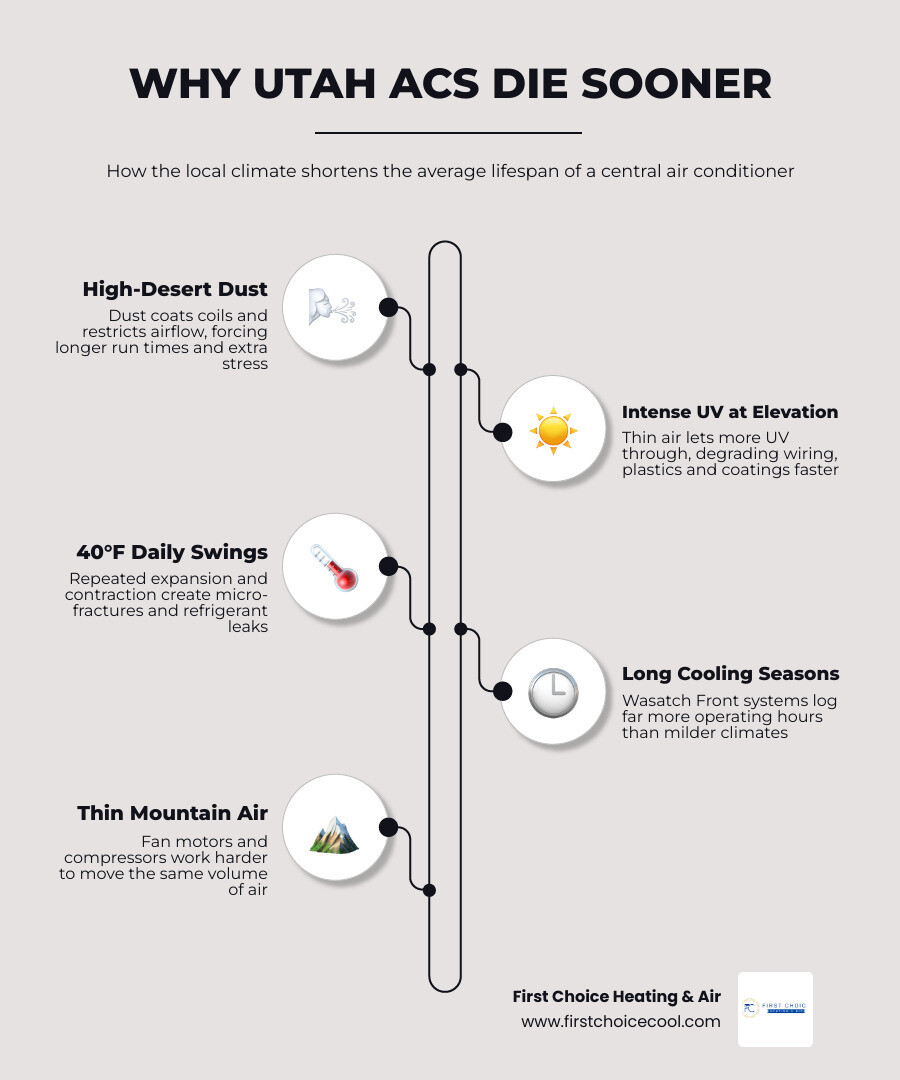
- High-desert dust coats condenser coils and restricts airflow, forcing the system to run longer and work harder
- Intense UV radiation at Utah’s elevation degrades wiring insulation, plastic components, and exterior coatings faster than in lower-altitude states
- Daily temperature swings of 20 to 40°F cause repeated expansion and contraction in metal parts, leading to micro-fractures and refrigerant leaks over time
- Long cooling seasons on the Wasatch Front mean your system logs significantly more operating hours per year than systems in milder climates
- Thin mountain air at higher elevations forces fan motors and compressors to work harder to move the same volume of air
Most systems don’t announce when they’re about to fail. They just stop working on the hottest day of the year, when you need them most. Understanding what shortens AC life in Utah — and what you can do about it — is the difference between a system that reaches 16 years and one that quits at 10.
What is the Average Lifespan of a Central Air Conditioner in a Hot Dry Utah Climate?
When we talk about how long an air conditioner lasts, we have to look past the optimistic estimates printed in manufacturer brochures. Under perfect laboratory conditions, a central air conditioning system might hum along happily for two decades. But here along the Wasatch Front—from Salt Lake City down through West Jordan and deep into Utah County—our systems live a much more demanding life.
In our high-desert environment, the average lifespan of a central air conditioner in a hot dry utah climate typically lands between 12 and 16 years, provided it receives consistent, professional care. Without regular maintenance, that timeline quickly shrinks to a mere 8 to 12 years.
System degradation in Utah is non-linear. During the first 8 to 10 years, a quality unit operates at peak efficiency with only minor hiccups. However, between years 10 and 15, the cumulative physical toll of our climate begins to show. Annual SEER (Seasonal Energy Efficiency Ratio) degradation in aging central air systems is estimated at 5% to 9% per decade. This means an older system has to run significantly longer just to deliver the same amount of cooling, which accelerates mechanical wear.
The ultimate end-of-life mechanism for most Utah air conditioners is compressor failure. The compressor is the heart of your AC system, responsible for pumping refrigerant through the indoor and outdoor coils. Because our hot, dry summers force the compressor to operate under high-ambient stress for extended periods, the compressor oil can eventually break down or turn acidic. When the compressor fails on an older system, it is rarely practical to replace it, signaling that the entire system has reached the end of its useful life.
Environmental Stressors: How Utah’s Climate Impacts Your AC
To understand why our local air conditioners retire earlier than their coastal counterparts, we have to look at the specific environmental stressors unique to Utah.
High Altitude and UV Exposure Effects on Outdoor Units
The Salt Lake Valley sits at an average elevation of over 4,300 feet. While we love our mountain views, this altitude presents two distinct challenges for outdoor HVAC equipment:
- Thinner Air: Because the air is less dense at higher elevations, it is physically harder for your outdoor condenser fan to shed heat. The fan motor has to spin with greater resistance and run longer to achieve the same cooling effect as a unit operating at sea level.
- Elevated UV Radiation: UV intensity along the Wasatch Front is approximately 17% higher than at sea level. This relentless solar bombardment acts like slow-motion acid on your outdoor unit. Over a decade or more, intense UV rays degrade electrical wiring insulation, make plastic fan blades brittle, and break down the protective finishes on the outer cabinet, leaving vital components vulnerable to rust and electrical shorts.
The Sandpaper Effect: How Desert Dust and Low Humidity Reduce the Average Lifespan of a Central Air Conditioner in a Hot Dry Utah Climate
Our low humidity is great for keeping summers feeling comfortable, but dry air means dry soil. Wind blowing off the West Desert carries fine, alkaline silt directly into our residential neighborhoods.
When your air conditioner runs, the outdoor unit acts like a giant vacuum cleaner, pulling hundreds of cubic feet of air through the condenser coils every minute. This airborne dust acts like microscopic sandpaper, slowly eroding the delicate aluminum fins on your coils.
Furthermore, this dust accumulates inside the unit, coating the coils in a thick, insulating thermal blanket. A fouled condenser coil can reduce system airflow by 30% to 40%, forcing the compressor to run at dangerously high internal temperatures and pressures. Over time, this constant strain leads to premature mechanical fatigue.
Thermal Cycling and Extreme Temperature Swings
Utah is famous for its dramatic daily temperature swings. It is not uncommon for a mid-summer day in West Jordan or Bluffdale to start in the crisp 60s at dawn and skyrocket to over 100°F by late afternoon.
This rapid 30-to-40-degree temperature swing causes constant thermal cycling. The metal copper tubing and aluminum fins in your AC system expand when hot and contract when cold. This continuous physical movement creates a “paperclip effect”—bending the metal back and forth on a microscopic scale. Eventually, this thermal stress leads to metal fatigue, which manifests as micro-fractures in solder joints and copper bends, resulting in hard-to-find refrigerant leaks.
Maximizing Longevity: The Ultimate AC Maintenance Checklist
While we cannot change Utah’s weather, we can change how we protect our equipment from it. Implementing a proactive approach to Home Maintenance is the single most effective way to add three to five years to the life of your air conditioner.
Professional Tune-Ups to Protect the Average Lifespan of a Central Air Conditioner in a Hot Dry Utah Climate
Annual professional maintenance is not a luxury; in our climate, it is a survival requirement for your HVAC system. A professional spring tune-up keeps your system running efficiently and prevents minor component failures from cascading into catastrophic system damage.
During a professional tune-up, we focus on the critical areas most vulnerable to desert wear:
- Electrical Diagnostic: We test the run capacitor and contactor. In extreme heat, capacitors are often the first things to fail. Catching a weak capacitor in May prevents a blown compressor motor in July.
- Deep Coil Cleaning: We wash away the accumulated West Desert silt from the outdoor condenser coils using specialized techniques that protect the delicate aluminum fins.
- Refrigerant Charge Verification: We check for proper refrigerant levels. Operating a system even slightly low on refrigerant causes the compressor to overheat, drastically shortening its life.
- System Calibration: We check airflow rates and calibrate the system to account for our high elevation, ensuring optimal heat transfer.
Studies show that keeping up with annual professional maintenance can save up to 15% on your monthly energy bills while significantly delaying the need for a costly system replacement.
DIY Maintenance Steps for Utah Homeowners
Between professional visits, there are several simple steps you can take to keep your system happy:
- Check Filters Every 30 Days: During our dusty summer months, standard air filters clog quickly. Check your filter monthly and replace it as soon as it looks grey. We recommend using filters rated between MERV 8 and MERV 11; filters with a MERV rating of 13 or higher can actually restrict airflow too much in our thin mountain air, overworking your blower motor.
- Maintain a 2-Foot Clearance Zone: Keep plants, shrubs, weeds, and patio furniture at least two feet away from your outdoor unit. Your AC needs to breathe to dump heat efficiently.
- Gently Rinse the Outdoor Unit: After a windstorm or a period of high dust, turn off your AC at the thermostat and use a gentle spray from your garden hose to rinse loose dirt off the outdoor coils. Never use a pressure washer, as the high pressure will instantly flatten the soft aluminum fins and permanently block airflow.
- Optimize Thermostat Settings: Avoid setting your thermostat to extremely low temperatures (such as 68°F when it is 100°F outside). This forces the system to run continuously without a break, accelerating wear. Instead, aim for a comfortable 74°F to 78°F, and consider upgrading to a smart thermostat to manage cooling cycles efficiently.
The Tipping Point: When to Repair vs. Replace Your Utah AC
Every homeowner eventually faces the ultimate question: Do I patch up my aging air conditioner one more time, or is it time to invest in a modern replacement?
To help make this decision easier, we recommend consulting our detailed AZ Guide to AC Repair vs Replace, but you can also use these key indicators to evaluate your system’s current status:
1. The Age-Times-Repair-Cost Rule (The $5,000 Rule)
This is a reliable industry formula to determine if a repair is a wise investment or a waste of money.
- The Formula: Multiply the age of your system (in years) by the cost of the proposed repair.
- The Decision: If the result is less than 5,000, repairing the unit is usually a sensible choice. If the result exceeds 5,000, that money is better spent toward a new, high-efficiency system.
For example, if you have a 12-year-old system facing a repair, the math looks like this:
- A minor electrical repair: 12 years × minor repair cost = well under the 5,000 threshold (Go with the repair!).
- A major compressor or coil repair: 12 years × major repair cost = well over the 5,000 threshold (It’s time to replace).
2. The Refrigerant Type (The R-22 Rule)
If your air conditioner was installed before 2010, there is a very high chance it uses R-22 refrigerant (often called Freon). The production and import of R-22 was completely phased out in the United States. Today, only scarce, reclaimed supplies exist, making any repairs involving refrigerant leaks on these older systems incredibly expensive. If your R-22 system has a leak or a failed compressor, replacing the unit is almost always the best financial decision.
3. The SEER2 Efficiency Gap
Modern air conditioning systems must meet strict SEER2 energy efficiency standards. Upgrading an old, inefficient system (which may have degraded to an effective SEER of 8 or 10 over the years) to a modern, high-efficiency system with a SEER2 rating of 16 or higher can reduce your summer cooling energy usage by 20% to 40%.
Additionally, modern systems utilizing variable-speed technology run at lower, quieter speeds for longer periods. This eliminates the harsh “on/off” mechanical shock of older single-stage systems, drastically reducing wear and tear while keeping your home at a perfectly consistent temperature.
Frequently Asked Questions about Utah AC Lifespan
How often should I change my AC filter during Utah’s dusty summer months?
In the high-desert climate of the Wasatch Front, you should check your air filter every 30 days during the peak cooling season. If you have pets, live near active construction zones (common in rapidly growing areas of Utah County and Salt Lake County), or experience high winds, you will likely need to replace your filter every single month. Keeping a clean filter ensures unrestricted airflow, which is critical for preventing your indoor evaporator coil from freezing up and overworking your compressor.
Does shading my outdoor AC unit help it last longer?
Yes, but only if it is done correctly. Providing shade can lower the ambient temperature immediately surrounding your outdoor unit, reducing its thermal load and slightly improving operating efficiency. However, you must maintain at least 24 inches of clear space around the sides and several feet of open space above the unit. Never construct tight, fully enclosed boxes or structures over your AC, as this traps hot air and chokes the system, causing it to overheat and fail prematurely.
Is a 15-year-old air conditioner considered old in Utah in 2026?
Yes. In June 2026, a 15-year-old air conditioner (installed around 2011) is considered a “senior citizen” by industry standards. At this age, the unit is likely using outdated refrigerant, operating at a fraction of its original efficiency due to natural coil and compressor degradation, and approaching the statistical end of its useful life in our harsh climate. If your 15-year-old system requires frequent service visits or struggles to keep your home comfortable on 95°F+ days, it is highly beneficial to begin planning for its replacement before a total breakdown occurs.
Conclusion
Navigating the hot, dry summers of the Wasatch Front requires a home cooling system that is up to the challenge. While the average lifespan of a central air conditioner in a hot dry utah climate presents real challenges, proper installation, mindful DIY habits, and consistent professional maintenance can help you get the absolute most out of your investment.
At First Choice Heating & Air, based right here in Bluffdale, UT, we are committed to keeping our neighbors comfortable across Salt Lake City, West Jordan, and the surrounding Salt Lake and Utah Counties. We pride ourselves on providing community-focused service backed by competitive financing options, comprehensive maintenance plans, and strong equipment warranties to give you total peace of mind.
Whether you need a seasonal tune-up to extend the life of your current system or honest guidance on selecting a new, energy-efficient replacement, we are here to help.
Ready to make sure your air conditioner is prepared to handle the summer heat? First Choice Heating & Air is just a call or click away. Reach out to our friendly team today to schedule your system check-up!