
Why the Salt Lake Valley Is One of the Most Demanding HVAC Climates in the West
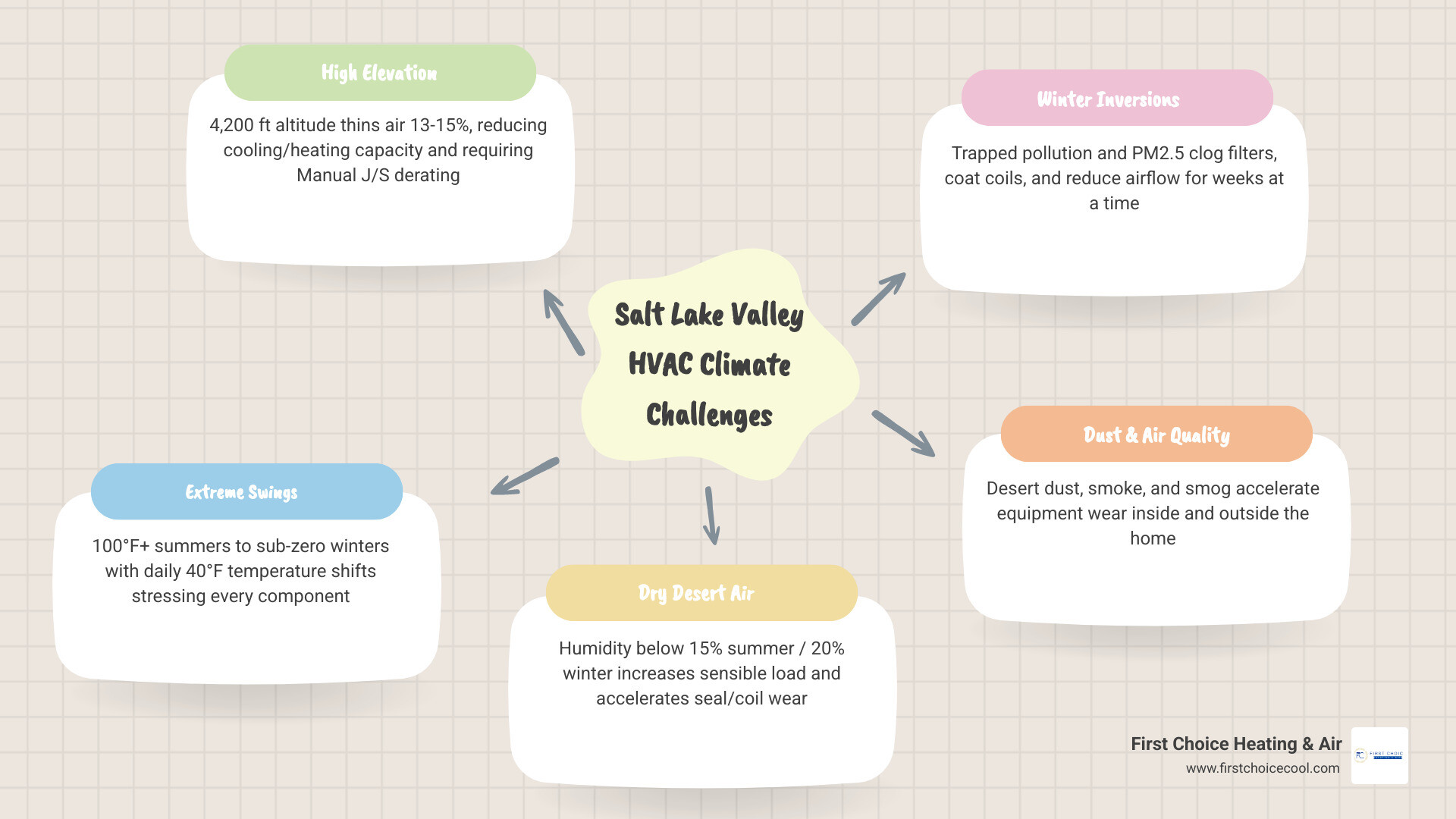
Why the Salt Lake Valley is one of the most demanding HVAC climates in the west comes down to a punishing combination of factors that few other regions face all at once:
- High elevation (~4,200 ft) – Air is 13-15% less dense than sea level, cutting your system’s cooling and heating capacity before it even starts
- Extreme temperature swings – Summers regularly top 100°F, winters drop below zero, and a single day can shift 40°F between morning and afternoon
- Relentless dry air – Humidity drops below 15% on summer afternoons and below 20% in winter, stressing seals, coils, and electronics
- Winter inversions – Cold air traps pollution and particulates in the valley for weeks, clogging filters and coating equipment
- Dust and air quality – Desert dust, wildfire smoke, and inversion smog accelerate wear on every component inside and outside your system
- Wide climate zone range – Salt Lake sits in IECC Climate Zone 5B, demanding strong heating and strong cooling performance from the same equipment
No single one of these challenges is unusual on its own. But the Salt Lake Valley stacks all of them together, and that is what makes it genuinely one of the toughest places in the American West to keep a home comfortable year-round.
If you live along the Wasatch Front and your HVAC system feels like it is always working harder than it should — running longer, costing more, breaking down faster — the climate is likely a big reason why. This guide breaks down exactly what your system is fighting against, and what it actually takes to keep up.
To truly understand why the salt lake valley is one of the most demanding hvac climates in the west, we have to start with the physics of thin air.
Our valley floor sits at an average elevation of 4,200 feet above sea level (with surrounding bench areas in places like Draper, Sandy, and West Jordan climbing even higher). At 4,200 feet, the atmospheric pressure is significantly lower, meaning the air is roughly 14% less dense than it is at sea level.
Because air conditioning and heating systems rely on the physical mass of air passing over heat-exchange coils to transfer thermal energy, thinner air means fewer air molecules are available to absorb and carry away heat. This creates a direct thermodynamic penalty:
- Cooling Capacity Loss: An air conditioning system rated for 36,000 BTUs (a standard 3-ton unit) at sea level will only deliver about 31,300 BTUs of actual cooling in Salt Lake City due to elevation-induced capacity loss.
- Equipment Derating: To compensate for this physical reality, HVAC equipment must be “derated.” For gas-fired heating equipment, the altitude derating is roughly 4% for every 1,000 feet of elevation above sea level. This means a furnace in the Salt Lake Valley loses about 16% of its heating capacity compared to its sea-level rating.
If an installer simply matches a system to your home’s square footage using standard sea-level charts, your system will be chronically undersized. This is why we perform meticulous load calculations using ACCA Manual J (to calculate the exact heat loss and heat gain of the home) and Manual S (to select and derate the equipment specifically for our high-altitude environment). Without these precise calculations, systems run constantly, wear out prematurely, and fail to keep up during peak weather events.
Why the Salt Lake Valley Is One of the Most Demanding HVAC Climates in the West for Airflow
The challenges of high altitude do not stop at capacity loss; they directly interfere with how air moves through your home’s ductwork. Because the air is thinner, standard blower fans have to work significantly harder to move the same mass of air. In fact, a blower fan must move up to 20% more volume (cubic feet per minute, or CFM) at 4,200 feet to deliver the same cooling or heating mass as a system at sea level.
This creates several downstream mechanical issues:
- Static Pressure Struggles: Thinner air alters the static pressure within your duct system. If your ductwork is not perfectly designed and balanced, the blower motor will experience excessive static pressure, leading to motor strain and premature failure of Electronically Commutated Motors (ECM).
- Reduced Heat Transfer: With fewer air molecules passing over the indoor evaporator coil, the rate of heat transfer drops. This can cause the refrigerant inside the coil to run colder than designed. If airflow is restricted even slightly by a dirty filter, the coil can quickly drop below freezing, leading to ice buildup on your AC unit—even when it is 100°F outside.
- Refrigerant Pressure Anomalies: Standard diagnostic charts used by sea-level technicians do not work here. The lower atmospheric pressure changes the relationship between refrigerant temperature and pressure, meaning our technicians must apply altitude-adjusted pressure offsets to ensure your system is charged correctly.
Extreme Temperature Swings and the Dry Desert Moisture Deficit
The Salt Lake Valley is characterized by a high-desert climate, which brings massive diurnal (daily) temperature swings. It is not uncommon for our service areas in Salt Lake County and Utah County to experience 40-degree temperature shifts in a single 24-hour period. A mid-summer day might start at a crisp 62°F at sunrise and skyrocket to a blistering 102°F by late afternoon.
This rapid fluctuation puts incredible stress on HVAC control systems, ductwork, and structural materials. Your system must go from completely dormant to running at maximum capacity in a matter of hours, causing rapid thermal expansion and contraction in metal ductwork (often heard as popping or banging sounds) and stressing electrical components like capacitors and contactors.
Furthermore, our region is locked in a long-term megadrought—with the past two decades marking the driest period in the Southwest in over 1,200 years. This dry desert moisture deficit means our afternoon relative humidity frequently plummets below 15% in the summer.
In humid climates, air conditioners spend a massive amount of energy pulling water out of the air (latent heat load). In Utah, our cooling load is almost entirely “sensible heat”—meaning we are purely lowering the temperature of dry air. While this dry air makes evaporative cooling a viable alternative for some, it also means our indoor air can become painfully dry. In the winter, indoor relative humidity levels can drop below 10%, causing dry skin, respiratory irritation, static electricity buildup that can shock and damage sensitive HVAC control boards, and wood damage to floors and furniture. Managing this dry air requires specialized humidification strategies as part of regular Home Maintenance routines.
Why the Salt Lake Valley Is One of the Most Demanding HVAC Climates in the West for System Sizing
To make matters more complicated, Utah’s average temperature has increased by more than 2.5°F since the beginning of the 20th century, rising at twice the global average over the last 50 years. This upward trend means our summers are longer and hotter, while our winters still bring extreme cold snaps and heavy mountain-adjacent snowfall.
Salt Lake City experiences an average of 60 days per year with temperatures above 90°F, with record highs reaching 107°F. Conversely, winter temperatures average 30°F, frequently plunging into the single digits or below zero during severe cold fronts.
| Season | Average Peak Temperatures | Atmospheric Challenges | HVAC System Impact |
|---|---|---|---|
| Summer | 90°F to 105°F+ | Sub-15% Relative Humidity, High UV Radiation | Extreme sensible cooling load, high condenser pressures, rapid thermal expansion |
| Winter | 0°F to 35°F | Valley Inversions, Heavy Particulate Matter, Sub-20% RH | High heating demand, rapid filter clogging, condensate freeze risks, high static electricity |
This dual-extreme profile means your HVAC system cannot be a “one-trick pony.” It must be engineered to handle both massive heating loads in the winter and intense cooling loads in the summer.
Dust, Inversions, and Air Quality: The Durability Threat
One of the most unique and destructive aspects of the Salt Lake Valley climate is our winter inversion season. From November through February, cold air settles on the valley floor while warm air caps it from above, trapping vehicle emissions, wood smoke, and industrial pollutants. This creates a dense layer of smog laden with fine particulate matter (PM2.5).
This seasonal phenomenon is a major durability threat to HVAC systems:
- Dormant Equipment Contamination: During the winter, your outdoor air conditioning condenser sits dormant. The heavy, particulate-laden air of the inversion settles over the unit, coating the aluminum fins and internal components with a fine, greasy layer of soot and dust. When spring arrives, this buildup acts as an insulating blanket, preventing the condenser from rejecting heat efficiently and forcing the compressor to run at dangerously high pressures.
- Indoor Air Quality & Filter Clogging: To combat poor outdoor air quality, homeowners run their systems with closed windows, recirculating indoor air. However, without high-efficiency filtration, PM2.5 particulates infiltrate the home and clog standard fiberglass filters within weeks. During inversion events, we recommend upgrading to MERV 11 or MERV 13 filters and checking them every 30 days.
- Desert Dust Storms: In the spring and summer, dry winds sweeping across the Great Salt Lake Desert carry massive plumes of fine dust into the valley. These dust storms pack condenser coils with dirt and can seize up outdoor fan motors if they are not regularly cleaned and lubricated.
Navigating System Selection: Central Air, Heat Pumps, and Evaporative Coolers
Choosing the right HVAC system in the Salt Lake Valley involves navigating significant tradeoffs between upfront costs, operating efficiency, and comfort.
- Central Air Conditioning: The traditional choice for many Utah homes. Central AC provides reliable, whole-home cooling even on 105°F days. However, because standard single-stage central AC units run at 100% capacity regardless of whether it is 75°F or 105°F outside, they can short-cycle during milder spring and fall mornings, leading to uneven temperatures and high energy bills.
- Evaporative Coolers (Swamp Coolers): Historically popular along the Wasatch Front because they use up to 75% less electricity than refrigerated air conditioning. However, they are highly dependent on low outdoor humidity. When late-summer monsoon patterns push relative humidity above 50-60%, evaporative coolers lose their cooling power, leaving homes warm and humid. Additionally, they draw outdoor air directly into the home, meaning they pull in wildfire smoke, dust, and pollen during our increasingly smokey summers.
- Heat Pumps and Dual-Fuel Systems: Modern cold-climate heat pumps are rapidly becoming the preferred solution for our climate. By pairing an electric heat pump with a high-efficiency gas furnace (a dual-fuel or hybrid system), you get the best of both worlds. The heat pump handles cooling in the summer and highly efficient heating during the mild spring and autumn months. When winter temperatures drop below the heat pump’s optimal operating range, the system automatically switches to the gas furnace to handle the heavy heating load.
To make an informed decision on whether to repair your existing system or upgrade to a modern, high-efficiency alternative, check out our A-Z Guide to AC Repair vs. Replace.
Variable-Speed Technology as the Ultimate Solution
For homeowners seeking maximum comfort and efficiency in our bi-polar climate, variable-speed technology is the gold standard. Unlike single-stage systems that are either completely on or completely off, variable-speed systems use inverter-driven compressors and ECM blower motors that can modulate their output in tiny 1% increments (ranging from 25% to 100% capacity).
This modulation provides massive advantages in the Salt Lake Valley:
- Precision Temperature Control: By constantly adjusting to match the exact cooling or heating load of your home, variable-speed systems maintain indoor temperatures within half a degree of your thermostat setting, completely eliminating the “hot upstairs, cold downstairs” syndrome.
- Constant Filtration: Because variable-speed blowers can run continuously at ultra-low, whisper-quiet speeds, they keep air moving through your high-efficiency filters 24/7. This constant filtration is vital for keeping indoor air clean during dusty summer days and winter inversion events.
- Altitude Adaptation: Variable-speed blower motors are uniquely suited for high elevations because they automatically adjust their torque to maintain constant airflow, overcoming the static pressure challenges of thin mountain air without burning out.
Local Building Codes and Climate Zone Compliance in Utah
Utah’s geographic diversity spans Climate Zones 3B through 6B according to the International Energy Conservation Code (IECC). The Salt Lake Valley falls squarely within Climate Zone 5B, which carries strict regulatory and performance standards for HVAC installations.
Under local building codes (including Utah Title 15A), all new HVAC installations must comply with strict criteria:
- Manual J, S, and D Requirements: Contractors must submit official load calculations (Manual J), equipment selection sheets (Manual S), and duct designs (Manual D) to obtain mechanical permits in Salt Lake and Utah Counties.
- Duct Insulation Standards: Any supply ducts running through unconditioned spaces, such as uninsulated attics or crawlspaces, must be insulated to a minimum of R-8 in Zone 5B to prevent massive thermal losses.
- Duct Sealing and Leakage Limits: Code mandates that duct systems undergo leakage testing, with a maximum allowable leakage of 4 cfm25 per 100 square feet of conditioned floor area.
- Efficiency Standards: As of recent DOE updates, central air systems installed in our region must meet strict SEER2 (Seasonal Energy Efficiency Ratio 2) and HSPF2 (Heating Seasonal Performance Factor 2) minimums to ensure they can handle our demanding climate without placing an undue burden on our electrical grid.
Frequently Asked Questions about Salt Lake Valley HVAC
Why does my AC struggle more in Salt Lake City than at sea level?
Your AC struggles because the air at 4,200 feet is roughly 14% less dense than at sea level. Because thin air carries less mass, your air conditioner’s evaporator coil cannot transfer heat as quickly. This results in an automatic 10-15% loss in cooling capacity. If your system was sized using sea-level calculations, it will run continuously on hot days and struggle to keep the home cool.
Do heat pumps actually work during cold Utah winters?
Yes, but you must choose the right type. Standard heat pumps lose efficiency and heating capacity as outdoor temperatures drop below 32°F. However, modern cold-climate heat pumps are engineered with variable-speed inverter compressors that allow them to maintain high efficiency and deliver strong heating capacity even when outdoor temperatures drop below 0°F. For the absolute best performance along the Wasatch Front, we highly recommend a dual-fuel system that pairs a heat pump with a backup gas furnace.
How often should I change my air filters in the Salt Lake Valley?
While standard guidelines suggest changing filters every 3 months, the Salt Lake Valley’s unique environmental challenges require more frequent attention. During the winter inversion season and the dusty summer months, you should check your air filters every 30 days. If you use a standard 1-inch pleated filter, expect to replace it every 4 to 6 weeks to maintain proper airflow and protect your blower motor from high static pressure.
Conclusion
Keeping a home comfortable along the Wasatch Front is no easy task. Between the capacity-sapping elevation, wild temperature swings, dry desert air, and seasonal air quality crises, our local climate demands more from heating and cooling systems than almost anywhere else in the West.
At First Choice Heating & Air, we understand the unique physics and environmental challenges of the Salt Lake Valley. Headquartered in Bluffdale, UT, we proudly serve homeowners across West Jordan, Salt Lake City, Salt Lake County, and Utah County. We do not believe in cookie-cutter solutions. Our team of highly trained technicians uses precise, altitude-adjusted calculations to design, install, and maintain HVAC systems that are built to withstand Utah’s unique climate.
Whether you need a high-efficiency variable-speed upgrade, dual-fuel system installation, zoning solutions, or a comprehensive maintenance plan backed by strong warranties and competitive financing, we are here to help.
Ready to experience true, year-round indoor comfort? Contact First Choice Heating & Air today to schedule a professional consultation.