


Why Year-Round HVAC Performance on the Wasatch Front Comes Down to One Key Question
How a mini split handles both the hot summers and cold winters of the wasatch front is the question every Utah homeowner should ask before choosing an HVAC system. Here’s the short answer:
A mini split manages year-round Wasatch Front comfort by:
- Summer cooling — Running in reverse-cycle mode to pull heat out of your home, delivering efficient cooling even on 100°F+ July days, without the 30% energy loss that leaky ductwork causes in traditional systems
- Winter heating — Using heat pump technology to extract warmth from outdoor air even at temperatures as low as -13°F to -22°F, covering the vast majority of the Salt Lake Valley’s heating season
- Inverter compressor technology — Continuously adjusting output to match demand rather than cycling on and off, which saves energy and maintains steadier indoor temps through Utah’s dramatic seasonal swings
- Zone control — Letting you heat or cool only the rooms you’re using, instead of conditioning your whole home at once
If you live along the Wasatch Front, you know the climate doesn’t do anything halfway. Salt Lake City summers regularly push into the mid-to-upper 90s, while January nights can drop well into the single digits or below zero. Most traditional HVAC systems are designed with one season in mind. A properly sized mini split — particularly a cold-climate model — is built to handle both extremes from a single system.
That said, Utah’s elevation adds a wrinkle most homeowners don’t hear about. At 4,200 to 4,800 feet above sea level, thinner air reduces HVAC capacity by roughly 15 to 18%, which means sizing and installation decisions matter more here than almost anywhere else in the country.
This guide breaks down exactly how mini splits perform across every season on the Wasatch Front, what makes them well-suited (or not) for your home, and what to watch out for before you install one.
Year-Round Comfort: How a Mini Split Handles Both the Hot Summers and Cold Winters of the Wasatch Front
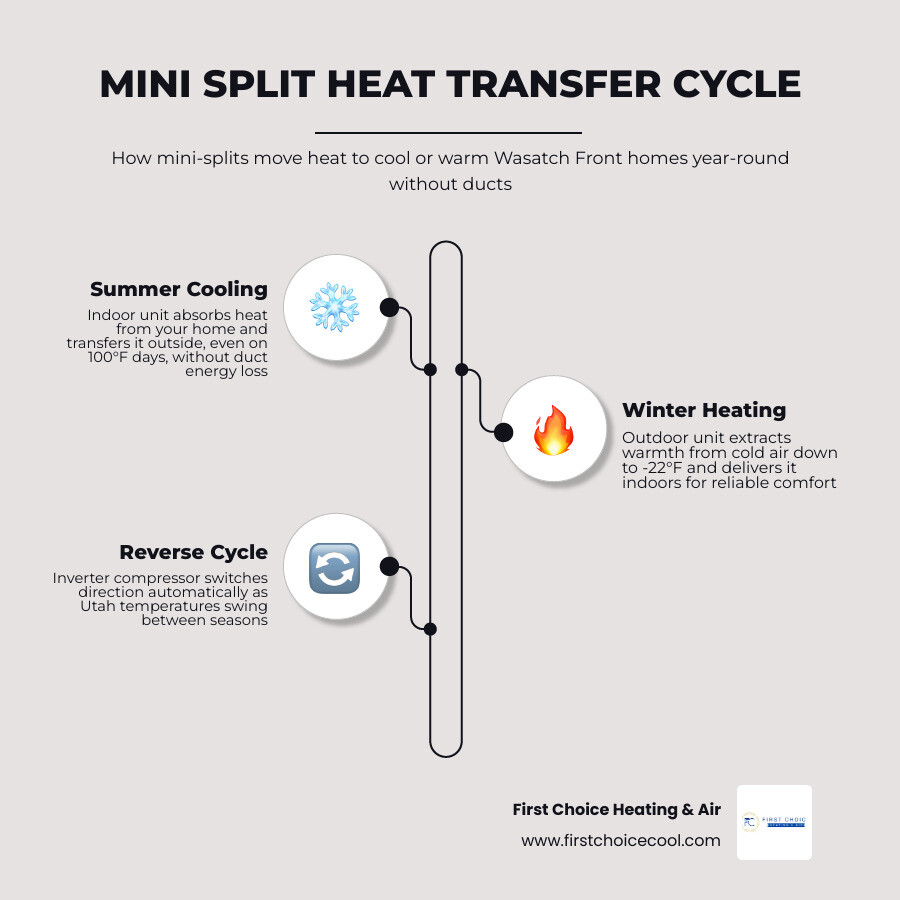
To understand how a mini split handles both the hot summers and cold winters of the Wasatch Front, we have to look at how these systems transfer heat. Unlike traditional furnaces that burn fossil fuels to create heat, or standard air conditioners that only run in one direction, a mini split is a two-way heat pump.
At its core, a mini split contains a reversing valve. This clever component changes the direction of the refrigerant flow depending on the season. In the summer, the system absorbs heat from inside your home and dumps it outside. In the winter, it reverses the process, extracting heat energy from the freezing outdoor air and moving it indoors.

The magic behind this year-round performance is the inverter-driven compressor. Traditional HVAC systems operate like a standard light switch—they are either 100% on or 100% off. When your home drifts away from the thermostat setting, the system kicks on at full blast, runs until it overshoots the target, and shuts off. This constant cycling wastes energy and creates noticeable temperature swings.
An inverter compressor, however, acts like a dimmer switch. It continuously adjusts its speed to match the exact heating or cooling load of your home. If your living room only needs a tiny amount of heat to stay cozy on an October evening in West Jordan, the compressor runs at a quiet, low-energy trickle. When a January blizzard rolls off the Great Salt Lake, the compressor ramps up to meet the demand. This steady, variable operation allows mini splits to deliver precise comfort through Utah’s rapid seasonal transitions.
Cooling Efficiency: How a Mini Split Handles Both the Hot Summers and Cold Winters of the Wasatch Front in July
When July arrives on the Wasatch Front, temperatures regularly climb past 95°F, and occasionally break into the triple digits. Keeping a home comfortable during these scorching stretches requires an air conditioning system that can work hard without sending your utility bills into the stratosphere.
This is where mini splits truly shine. Modern mini-split systems achieve outstanding SEER2 (Seasonal Energy Efficiency Ratio) ratings, typically ranging from 20 to 30+. For comparison, standard ducted central air systems usually hover between 14.3 and 26 SEER2.
The primary reason for this efficiency gap is the absence of ductwork. In a traditional central air setup, conditioned air travels through a network of sheet metal or flex ducts hidden in your attic, crawlspace, or walls. According to industry data, ductwork can account for 30 percent of cooling energy losses due to leaks, poor insulation, and conduction. By delivering cooled air directly into the living space from an indoor air handler, a mini split completely eliminates these duct-related energy losses.
Additionally, mini splits give you the power of zoning control. Instead of playing “thermostat Tetris” and cooling your entire home to keep a single upstairs bedroom comfortable, you can adjust the temperature of each individual room. If you spend your summer afternoons in a home office in Bluffdale, you can cool that specific room while letting the rest of the house stay a bit warmer, dramatically lowering your overall energy consumption.
Even if you are weighing whether to patch up your current system or invest in something new—a dilemma we cover in our AZ Guide to AC Repair vs Replace—mini splits present a compelling case for summer performance on the Wasatch Front.
Heating Reliability: How a Mini Split Handles Both the Hot Summers and Cold Winters of the Wasatch Front in January
For decades, the knock on heat pumps was that they couldn’t handle real winters. While that may have been true for older, standard models that struggled when temperatures dropped below 40°F, modern cold-climate mini splits are entirely different beasts.
Today’s advanced mini splits utilize specialized cold-climate technology (often referred to as hyper-heating). These systems feature vapor-injection compressors and advanced software that allow them to extract heat from outdoor air at incredibly low temperatures. In fact, modern cold-climate mini splits can extract heat from outdoor air even at -13°F to -22°F, easily handling 95% of the heating season in the Salt Lake Valley. Many of these units maintain 100% of their heating capacity down to 5°F and up to 80% capacity at sub-zero thresholds.
To keep running smoothly when the snow piles up, these systems utilize an automatic defrost cycle. When frost begins to build up on the outdoor coil, the system temporarily reverses itself for a few minutes to melt the ice away, using a built-in pan heater to prevent the meltwater from refreezing and damaging the fan blade.
While standard mini splits might require a supplemental heating source (like a backup furnace or baseboard heaters) during the absolute coldest, sub-zero nights of a Utah winter, cold-climate models are robust enough to serve as the primary heat source for many Wasatch Front homes.
The Altitude Factor: How Utah’s Elevation Impacts HVAC Performance
One critical factor that often gets overlooked by nationwide HVAC guides is elevation. The Wasatch Front sits at a high altitude—with Salt Lake City, West Jordan, and Bluffdale ranging between 4,200 and 4,800 feet above sea level, and bench communities climbing even higher.
Thinner air has a direct impact on heating and cooling performance. Because the air is less dense at high altitudes, there are fewer air molecules passing over the indoor and outdoor coils to transfer heat. This results in a natural reduction in the system’s heating and cooling capacity.
At elevations above 5,000 feet, a mini split’s cooling capacity can drop by 17% or more. At typical Salt Lake Valley elevations, we generally calculate an air density reduction of 15% to 18%. If an installer fails to account for this altitude derating, they will install an undersized system that runs constantly, struggles to maintain comfortable temperatures, and burns out prematurely.
To prevent this, we perform a precise Manual J load calculation that factors in our local elevation. This ensures your mini split is sized perfectly for the thin air of the Wasatch Front.
| System Rated Capacity (At Sea Level) | Actual Capacity at Wasatch Front Bench Elevation (approx. 5,000 ft – 17% Loss) |
|---|---|
| 9,000 BTU | ~7,470 BTU |
| 12,000 BTU | ~9,960 BTU |
| 18,000 BTU | ~14,940 BTU |
| 24,000 BTU | ~19,920 BTU |
Retrofitting Older Wasatch Front Homes Without Ductwork
The Wasatch Front is rich with historic charm, from the 1920s bungalows of Sugar House and Liberty Wells to the Victorian-era homes in the Avenues. While these homes boast beautiful craftsmanship, original plaster walls, and historic molding, they have one major drawback: they were never built for modern HVAC.
Retrofitting a ducted central air system into an older home is often a homeowner’s worst nightmare. It requires tearing open lath-and-plaster walls, sacrificing precious closet space to run bulky ductwork, and spending thousands of dollars on drywall repairs.
Mini splits solve this problem elegantly. Because they require only a small 3-inch wall penetration to connect the indoor air handler to the outdoor condenser via refrigerant lines, we can install them without damaging your home’s historic character.
Furthermore, older homes are notorious for uneven temperatures—the upstairs bedrooms often bake in the summer while the basement feels like an icebox. By installing a multi-zone mini split system, you can place individual air handlers in those problem rooms, giving you precise, localized temperature control without any structural demolition.
Essential Maintenance for Year-Round Efficiency in Utah
To keep your mini split running at peak efficiency through our dusty summers and snowy winters, regular upkeep is essential. Fortunately, much of this can be handled with simple Home Maintenance routines.
Here is your seasonal checklist for Wasatch Front mini-split care:
- Clean the Filters Monthly: Mini splits rely on high-volume airflow. In Utah, our dusty desert air, winter inversions, and summer wildfire smoke can quickly clog the small mesh filters inside your indoor units. Pop the front cover open every 3 to 4 weeks, slide the filters out, wash them in the sink, let them dry completely, and slide them back in.
- Keep the Outdoor Unit Clear: In the winter, make sure snow doesn’t drift around or bury your outdoor condenser. Restricted airflow will force the system to work harder, drop its efficiency, and potentially trigger error codes. Clear away any leaves, weeds, or debris during the spring and summer.
- Flush the Condensate Drains Annually: Utah is known for very hard water, often containing 300 to 400+ ppm of calcium and magnesium. This hard water can cause mineral buildup in the condensate drain lines of your indoor units. Flushing these lines annually prevents clogs that lead to water leaking down your walls.
- Schedule Professional Tune-Ups: We recommend having a professional service your system twice a year—once in the spring before the cooling season, and once in the fall before the winter chill sets in.
Frequently Asked Questions About Wasatch Front Mini-Splits
Can mini-splits handle sub-zero Utah winters without supplemental heat?
Yes, modern cold-climate hyper-heat models are designed to serve as a primary heating source even in sub-zero temperatures. These specialized units can operate efficiently down to -22°F. However, if you experience extended periods of sub-zero temperatures or live in a poorly insulated historic home, having a secondary heat source (such as baseboard heaters or a backup furnace) can provide peace of mind during extreme weather events.
Are there Utah-specific rebates or incentives for installing mini-split heat pumps?
Absolutely. Because mini-split heat pumps are incredibly efficient, they qualify for various financial incentives. Rocky Mountain Power offers rebates for homeowners upgrading to high-efficiency heat pumps. Additionally, federal incentives under the Inflation Reduction Act (IRA) provide tax credits up to $2,000 for qualifying energy-efficient heat pump installations. These incentives make upgrading to a ductless system more accessible than ever.
How quiet are mini-split indoor units during operation?
They are remarkably quiet. Because the noisy compressor sits outside your home, the indoor air handlers only house a small fan. Most modern indoor mini-split units operate as low as 19 decibels, which is quieter than a whisper or a rustling leaf. You will barely notice they are running, making them perfect for bedrooms, nurseries, and home offices.
Conclusion
When it comes to keeping your home comfortable through the extreme temperature swings of the Wasatch Front, ductless mini splits offer an unmatched combination of summer cooling efficiency and winter heating reliability. By eliminating duct loss, providing precise zoning control, and utilizing advanced inverter technology, these systems deliver year-round comfort tailored to our unique high-altitude climate.
At First Choice Heating & Air, we specialize in helping homeowners in Bluffdale, West Jordan, Salt Lake City, and across Salt Lake and Utah counties find the perfect climate control solutions. Whether you want to solve the “hot upstairs” problem in your multi-level home or fully retrofit a historic bungalow, we are here to help.
Ready to experience quiet, efficient comfort? Visit First Choice Cool today to schedule a consultation with our friendly, community-focused team!