


The Real Answer to How Often to Change Air Filters in a Dry Dusty Utah Environment
If you’ve been wondering how often to change air filters in a dry dusty Utah environment, here’s the short answer: much more often than the package says.
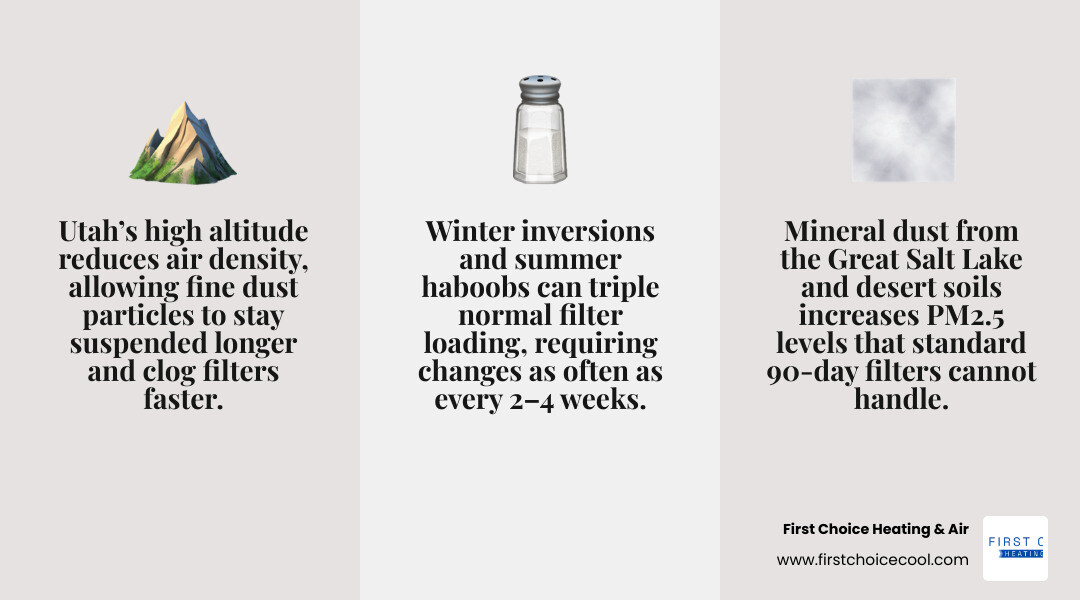
The standard 90-day guideline printed on most filter packages was written for mild, humid climates — not Salt Lake Valley at 4,300 feet above sea level. In Utah, filters can clog up to three times faster due to the combination of high altitude, Great Salt Lake mineral dust, seasonal inversions, and dry air that keeps particles suspended in the air longer than in wetter climates.
Here’s a quick-reference schedule for Utah homeowners:
| Household Situation | Recommended Filter Change Frequency |
|---|---|
| Average home, no pets | Every 45-60 days |
| One pet | Every 30-45 days |
| Multiple pets | Every 20-30 days |
| During summer dust season | Every 30 days |
| During winter inversions (Red Air days) | Every 30-45 days |
| Near active construction | Every 20-30 days |
| During wildfire smoke events | Every 2 weeks |
| After a major dust storm or haboob | Inspect and replace immediately |
So if your HVAC filter has been sitting in place for 90 days this past Utah summer, there is a very real chance it stopped doing its job weeks ago — and your system has been working overtime to compensate. High energy bills, weaker airflow, and added wear on your equipment are often the first signs that a filter is long overdue for a change.
Simple how often to change air filters in a dry dusty utah environment glossary:
- ac tune-up for wasatch front homeowners
- how often should you service your air conditioner in a hot dry utah climate
Why Utah’s Arid Climate and High Altitude Accelerate Filter Clogging
To truly understand why air filters clog so quickly along the Wasatch Front, we have to look at the unique physics of our local geography. If you live in Salt Lake City, West Jordan, Bluffdale, or anywhere else in Salt Lake County or Utah County, your heating and cooling systems are battling environmental factors that simply do not exist in other parts of the country.
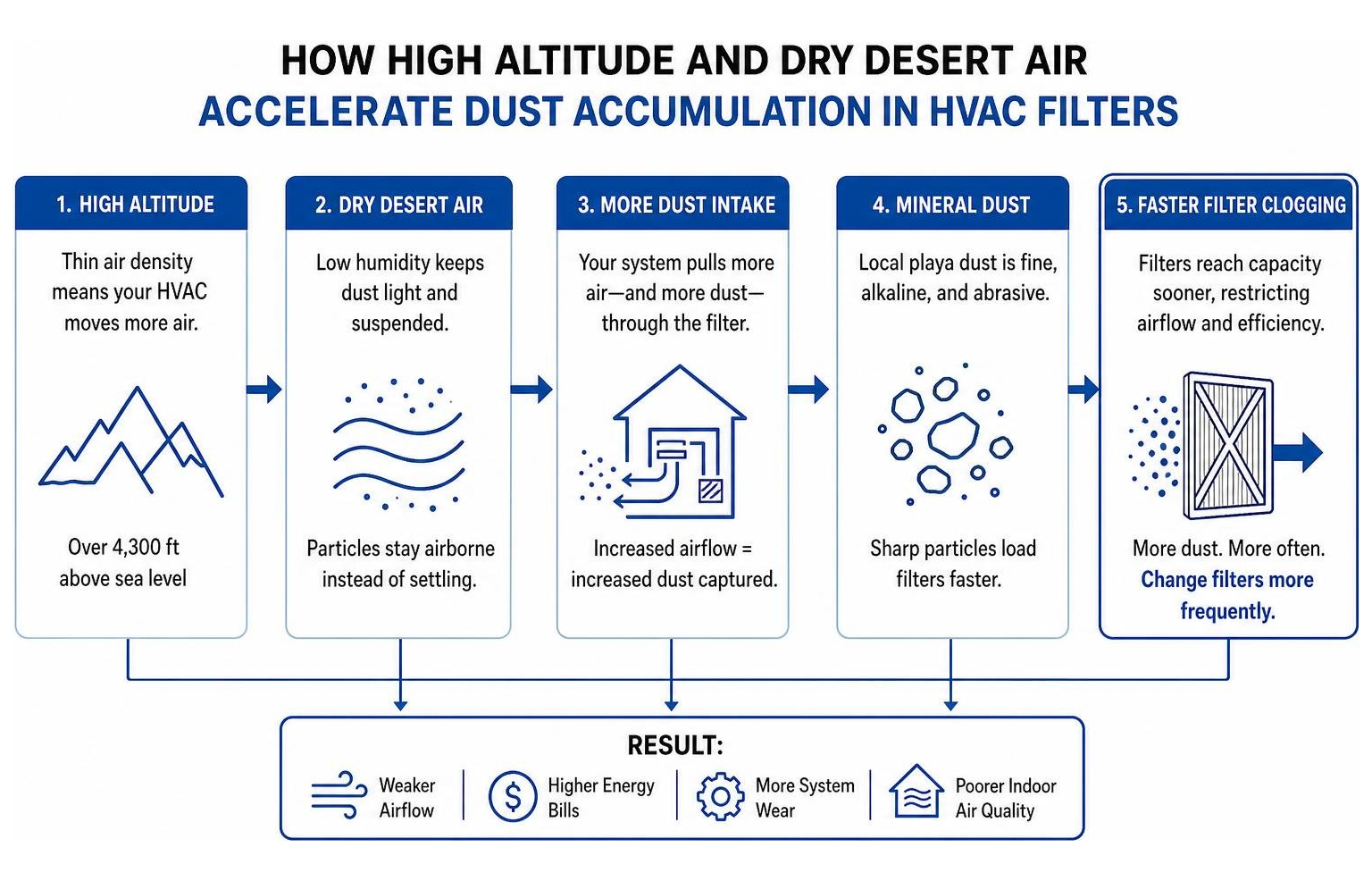
First, let’s talk about altitude. At over 4,300 feet above sea level, the air density in the Salt Lake Valley is only about 82% of what it is at sea level. Because the air is thinner, your HVAC system has to work significantly harder to keep your home comfortable. In fact, local systems must move 15% to 20% more air volume to deliver the same amount of heating or cooling as a system located on the coast. Because your system is moving a much larger volume of air through your ductwork to achieve the same climate control, it is pulling a proportionally larger volume of airborne dust and debris directly through your filter.
Second, our dry air behaves differently than humid air. In humid regions, moisture in the air binds to dust, pollen, and pet dander, making these particles heavy so they settle onto floors and furniture. In Utah’s arid climate, where summer relative humidity routinely drops below 15%, these particles remain bone-dry, lightweight, and completely suspended in the air. They float freely through your living spaces until they are eventually sucked into your return air vents.
Finally, we have to consider what is actually floating in our air. The Great Salt Lake is surrounded by vast playa flats containing highly alkaline, abrasive mineral dust. When the wind kicks up, this fine, powdery dust is carried directly into our residential neighborhoods. Unlike standard organic household dust, this mineral-heavy dust is sharp and abrasive. If your filter is clogged or low-quality, this dust can slip past the filter edges—a dangerous phenomenon known as the “blow-by effect”—and physically pit, score, and degrade your system’s internal metal components.
To learn more about how our unique climate affects your heating and cooling equipment, check out our guide on All About Dry Desert Heat in Utah and AC Strain.
How Often to Change Air Filters in a Dry Dusty Utah Environment
Because of these demanding regional factors, waiting 90 days to swap out your filter is a recipe for system strain and poor indoor air quality. In a dry, dusty Utah environment, your filter acts as the primary shield protecting both your lungs and your expensive HVAC equipment.
When a filter becomes saturated with dust, it creates a massive restriction in airflow. Your blower motor has to run longer and work much harder to pull air through the clogged media, which dramatically accelerates wear and tear on the system. By shifting your mindset from a strict calendar schedule to a condition-based schedule, you can protect your equipment and keep your utility bills low.
For the vast majority of homes along the Wasatch Front, the sweet spot for filter replacement is every 30 to 60 days. However, your exact timeline depends heavily on your household dynamics. If you have a single dog or cat, their shedding fur and dry dander act like a magnet for airborne dust, shortening your filter’s lifespan to 30 to 45 days. If you have multiple pets, or if you live in rapidly growing areas like Herriman, South Jordan, or Lehi where active construction is constantly kicking up drywall dust, concrete silica, and raw soil, your filters can become completely choked in as little as 20 to 30 days.
Understanding Why Changing Your Air Filters Is Important is the first step toward maintaining a healthy, efficient home in our demanding climate.
How Often to Change Air Filters in a Dry Dusty Utah Environment During Summer Peak
During the peak of a Utah summer, your air conditioner might run anywhere from 12 to 18 hours a day to fight off the dry, intense heat. This continuous operation means your filter is constantly trapping airborne particles, causing it to load up with dust at an accelerated rate.
Summer in Utah also brings dry south winds, late-afternoon thunderstorms, and occasional haboobs (intense dust storms). A single severe windstorm can deposit three months’ worth of outdoor dust into your home’s return air ducts in a single afternoon. If you ignore your filter after one of these weather events, your air conditioner will quickly begin to struggle.
The combination of high runtime and heavy dust loads makes monthly filter checks absolutely essential from June through September. Keeping a fresh filter in place during these scorching months is one of the easiest ways to maximize the lifespan of your cooling system. For a complete look at protecting your system during the hottest months of the year, read The Ultimate Checklist for Average Lifespan of Central Air Conditioner in Hot Dry Utah Climate.
How Often to Change Air Filters in a Dry Dusty Utah Environment During Winter Inversions
In the winter, Utah homeowners face a completely different environmental challenge: temperature inversions. Along the Wasatch Front, our unique valley geography acts like a giant bowl. Cold, heavy air becomes trapped on the valley floor beneath a layer of warm air, sealing in vehicle emissions, wood smoke, and fine particulate matter (PM2.5) for days or even weeks at a time.
These prolonged “Red Air” periods have a direct impact on your indoor air quality. Because we keep our homes sealed tight against the winter cold, these microscopic PM2.5 pollutants find their way indoors and circulate continuously through your furnace.
During inversion season, your furnace filter is your home’s main line of defense against these tiny, lung-irritating particles. Because PM2.5 particles are so small, they quickly pack the microscopic gaps in your filter media, reducing airflow and forcing your furnace to work harder to heat your home. Checking your filter every 30 days during the coldest winter months (typically December through February) ensures your heating system remains safe, efficient, and capable of cleaning your indoor air. For more tips on winter filter care, explore our guide on Maintaining a Pristine Furnace Filter: An Absolute Essential.
Choosing the Best MERV Ratings for Utah Homes
When shopping for replacement filters, you will see a rating system known as MERV, which stands for Minimum Efficiency Reporting Value. MERV ratings range from 1 to 20, with higher numbers indicating the filter’s ability to capture smaller, finer particles. However, choosing the highest possible MERV rating is not always the best choice for residential systems in Utah.
Let’s break down the different options and how they perform in our unique climate:
- MERV 1 to 4 (Basic Fiberglass Filters): These are the cheap, semi-transparent filters you often see in bulk packs. While they are very inexpensive, they do almost nothing to improve your indoor air quality. They are designed only to stop large debris, like carpet fibers and pet hair, from entering your system. Fine Utah dust and PM2.5 particles will pass straight through them, coating your internal HVAC components in a layer of grime. We generally recommend avoiding these.
- MERV 8 to 11 (Pleated Synthetic Media): This is the ideal sweet spot for most homes along the Wasatch Front. These filters are made of dense, pleated synthetic fibers that provide a much larger surface area to capture dust without choking your system’s airflow. A MERV 11 filter will easily capture fine dust, pollen, dust mites, and pet dander, providing excellent indoor air quality while maintaining safe static pressure for your blower motor.
- MERV 13 and Higher (High-Efficiency Filters): While MERV 13 filters are fantastic at capturing exceptionally fine particles, including wildfire smoke and some bacteria, they are also highly restrictive. Because our thin, high-altitude air already puts extra physical strain on blower motors, pairing an older or undersized HVAC system with a highly restrictive MERV 13 filter can restrict airflow too much. This can lead to system malfunctions, frozen coils, or blower motor burnout.
If you want to upgrade to a higher-efficiency filter, it is always a good idea to consult with an HVAC professional to ensure your system’s ductwork and blower can handle the added resistance. To learn more about how these ratings work, check out our guide to Understanding HVAC Filter Ratings.
Consequences of Neglecting Your HVAC Filters in the Desert
Skipping filter replacements might seem like a minor oversight, but in an arid environment like Utah, it can quickly lead to expensive system failures and skyrocketing utility bills.
When a filter is completely caked in dust, the volume of air passing over your system’s indoor coils drops significantly. In the summer, your air conditioner relies on a steady stream of warm indoor air to keep the refrigerant inside the evaporator coils from getting too cold. Without that airflow, the moisture that naturally condenses on the coils will rapidly freeze solid. A frozen evaporator coil completely blocks air from circulating into your home, and if the system continues to run, liquid refrigerant can flood back into your outdoor compressor, destroying it.
In the winter, a clogged filter causes heat to build up inside your furnace’s heat exchanger. To prevent a fire, safety sensors called limit switches will shut the furnace down entirely—a process known as short cycling. Over time, this constant rapid heating and cooling will crack your heat exchanger, which is an expensive repair that can also leak dangerous carbon monoxide into your home.
Beyond catastrophic component failures, neglecting your filter is incredibly hard on your wallet. According to data from the U.S. Department of Energy, simply replacing a dirty, clogged filter with a clean one can reduce your air conditioner’s energy consumption by 5% to 15%. When your system doesn’t have to fight a wall of dust to move air, it runs shorter cycles, consumes less electricity, and keeps your home much more comfortable.
To learn more about how restricted airflow impacts your home’s living spaces, read our article on How Poor HVAC Filters Impact IAQ.
How to Check and Replace Your Air Filter: A Step-by-Step Guide
Checking and replacing your air filter is one of the easiest and most effective DIY home maintenance tasks you can perform. You don’t need any specialized tools, and the entire process takes less than five minutes.
To make sure you get the best performance out of your system, use these step-by-step instructions:
- Perform the Light Test: If you aren’t sure whether your filter needs to be replaced, take it out and hold it up to a bright light source or the sun. If you can see light passing clearly through the filter fibers, it still has life left in it. If the light is completely blocked by a gray layer of dust, it is time for a fresh one.
- Turn Off Your HVAC System: Always turn your thermostat to the “OFF” position before removing your old filter. If the system turns on while the filter is out, the powerful suction from the blower motor will pull loose dust, pet hair, and debris directly into your unprotected fan and coils.
- Locate and Note Your Filter Dimensions: Open your return air grille or the filter slot on your furnace cabinet. Take note of the exact nominal dimensions printed on the side of your current filter (for example, 20x25x1). Always buy the exact size specified; a filter that is even slightly too small will allow dusty air to bypass the filter entirely.
- Check the Airflow Arrow: Look closely at the outer cardboard frame of your new filter. You will see one or more printed arrows indicating the direction of airflow. When installing the new filter, these arrows must point in the direction that air travels—toward the blower motor or furnace cabinet, not out toward your living room. Installing a filter backward reduces its efficiency and can cause the cardboard frame to collapse under pressure.
- Ensure a Tight Seal: Slide the new filter gently into place, making sure there are no gaps around the edges. If your filter slot has a cover or door, make sure it is securely latched to prevent unconditioned, dusty basement or attic air from being pulled into your ductwork.
For homeowners looking for an even more robust solution to desert dust, upgrading to a comprehensive filtration system can make a world of difference. Learn more about your options by reading Improve IAQ with Whole Home Air Filtration.
Frequently Asked Questions about Utah Air Filters
Can I wash a disposable pleated filter?
No, you should never attempt to wash a disposable cardboard-framed pleated filter. These filters are constructed from specialized paper and synthetic fibers that rely on static electricity and a precise physical structure to trap microscopic dust.
Exposing them to water will immediately destroy the structural integrity of the fibers and ruin the cardboard frame. Furthermore, trapped moisture inside a wet filter is highly likely to encourage the growth of mold and mildew once reinstalled in your dark, warm HVAC system, blowing spores directly into your home’s breathing air.
Does a dirty filter really increase my energy bill?
Yes, absolutely. When your air filter is clogged with dust and debris, your blower motor has to draw significantly more electrical current to pull air through the restriction.
Additionally, because the restricted airflow slows down the rate at which your home heats or cools, your system will have to run much longer cycles to satisfy the temperature setting on your thermostat. This combination of higher electrical draw and extended run times can easily add 5% to 15% to your monthly heating and cooling costs.
What happens if I ignore my filter during a wildfire or dust storm?
Ignoring your filter during a major air quality event is a recipe for system failure. During active wildfire seasons or severe windstorms, the concentration of fine particulates in the air rises dramatically.
Wildfire smoke carries sticky, microscopic ash particles that can quickly coat your filter in a fine, glaze-like layer, choking off airflow in a matter of days. If you do not inspect and replace your filter immediately after these events, the lack of airflow can cause your air conditioner’s coils to freeze solid or cause your furnace to overheat and shut down completely.
Conclusion
Living in a beautiful but dry, dusty place like Utah means our homes require a little extra attention to keep running smoothly. Knowing how often to change air filters in a dry dusty Utah environment is one of the simplest, most cost-effective ways to protect your home’s comfort, keep your energy bills low, and ensure your heating and cooling systems last for many years to come.
At First Choice Heating & Air, we are proud to provide community-focused, reliable HVAC services to our neighbors in Bluffdale, Salt Lake City, West Jordan, and throughout Salt Lake and Utah Counties. Whether you need help selecting the perfect filter for your system, want to upgrade your home’s indoor air quality, or are ready to schedule your seasonal system service, our friendly local team is here to help.
To keep your system running at peak efficiency all year long, read our guides on Regular AC Maintenance for Optimal Performance and How Often Should You Service Your HVAC System.
Ready to experience the difference of truly local, professional service? Contact First Choice Heating & Air today to schedule your next maintenance check or system tune-up!