


Why Your AC Keeps Turning On and Off in Wasatch Front Summer Heat
If your AC keeps turning on and off in Wasatch Front summer heat, you are most likely dealing with one of these five common problems:
- Thermostat placement issues – Your thermostat is reading false temperatures due to nearby heat sources or direct sunlight
- Incorrect system sizing – An oversized unit cools too quickly and shuts off before completing a full cycle
- Dirty or clogged air filter – Restricted airflow causes the evaporator coil to freeze, triggering a safety shutoff
- Low refrigerant levels – A refrigerant leak causes pressure drops that force the system to shut down repeatedly
- Failing electrical components – Worn capacitors or contactors interrupt the compressor’s ability to run a full cycle
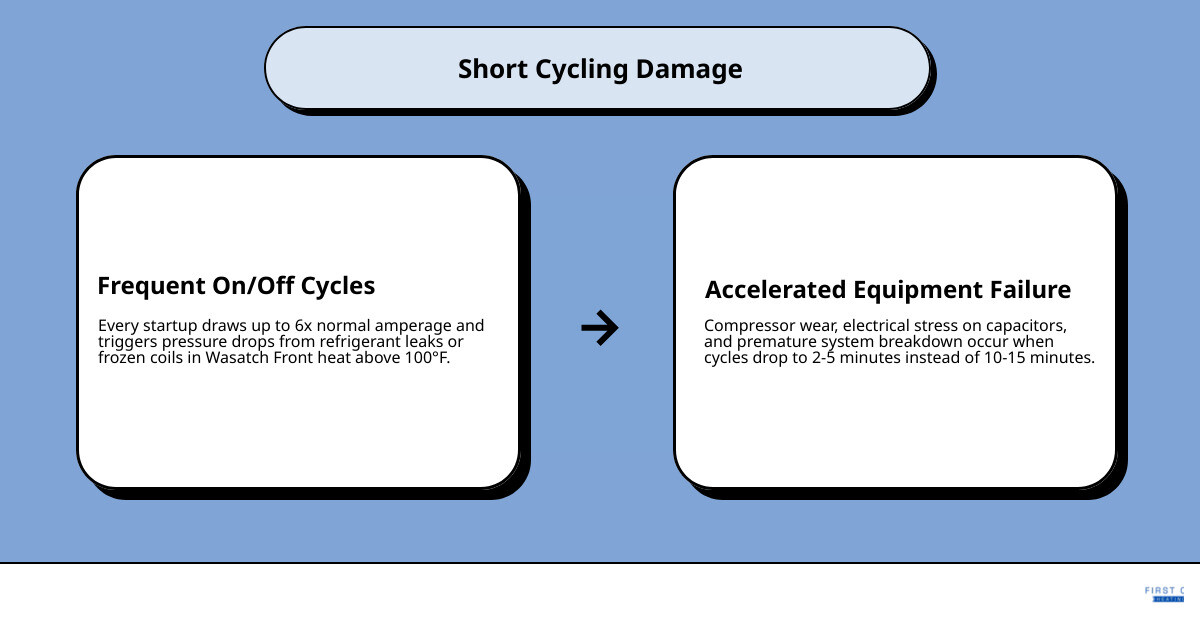
A healthy AC system should run approximately 10 to 15 minutes per cycle, completing roughly three full cycles per hour. When your system is turning on and off every two to five minutes, something is wrong — and ignoring it makes the damage worse fast.
Along the Wasatch Front, summer temperatures regularly climb above 100°F while humidity drops below 15%. That combination puts enormous stress on residential AC systems, and most breakdowns in Utah happen in July and August — right when you need reliable cooling the most. The repeated startup surge alone is damaging: every time a compressor kicks on, it draws up to six times its normal running amperage. Do that dozens of extra times per day and you are burning through equipment lifespan at an alarming rate.
Discover more about ac keeps turning on and off in wasatch front summer heat what is wrong:
- ac troubleshooting before calling a pro
- why is my ac blowing warm air during a utah summer heat wave
Understanding Short Cycling in Utah’s Unique Climate

Living along the Wasatch Front—from Salt Lake City down to Bluffdale and West Jordan—means dealing with some of the most unique environmental conditions in the country. While our high-desert climate brings beautiful mountain views, it also presents a brutal “stress test” for residential air conditioning systems. To understand why your air conditioner is turning on and off so rapidly, we have to look at how Utah’s specific climate forces your system to work harder.
First, consider our elevation. Cities in Salt Lake County and Utah County sit between 4,200 and 4,800 feet above sea level. At this altitude, the air is thinner, meaning its density is roughly 15% to 18% lower than at sea level. Because thin air carries less heat per cubic foot, your air conditioner must move a significantly higher volume of air to achieve the same cooling effect as a system installed on the coast. When anything restricts this fragile airflow, the system quickly crosses a tipping point into short cycling.
Second, we must address the “winter inversion dust” and dry summer soils. During our cold winter months, valley inversions trap fine particulate matter close to the ground. This heavy dust settles over everything, including your outdoor condenser unit. When summer arrives, our arid climate—where relative humidity routinely drops below 15%—keeps fine dust and pollen suspended in the air. This airborne debris is drawn directly into your AC’s outdoor condenser coils, acting as a thick layer of insulation.
When your condenser coils are caked in Utah dust, they cannot reject heat efficiently. The compressor begins to overheat, and built-in thermal overload switches shut the system down to prevent a total meltdown. Once the compressor cools down a few minutes later, the system restarts, only to overheat and shut down again. This creates a destructive, endless loop of rapid on-and-off cycling. To prevent this, it is crucial to understand How Often to Service Your AC in Hot Dry Utah Climate to keep your system clean and optimized for our local atmosphere.
AC Keeps Turning On and Off in Wasatch Front Summer Heat: What Is Wrong?
When your ac keeps turning on and off in wasatch front summer heat what is wrong is a question that requires looking at both physics and mechanical wear. In the HVAC industry, this rapid starting and stopping is known as “short cycling.” Under normal conditions, an AC unit cools your home using long, steady cycles. These sustained runtimes are essential because they allow the system to reach peak operating efficiency and evenly distribute cool air throughout your home.
When an AC short cycles, it never completes a true cooling run. Instead, it turns on, runs for a brief window of two to eight minutes, shuts down prematurely, and then restarts shortly after. This erratic behavior has serious consequences for your home and your wallet:
- Skyrocketing Energy Bills: Your AC compressor draws the vast majority of its power during the first 60 seconds of startup. When your system starts up several times an hour instead of running a few sustained cycles, your energy consumption spikes dramatically. In Utah, where air conditioning already accounts for roughly 70% of residential electricity use during peak summer, short cycling can cause utility bills to surge.
- Severe Compressor Wear: The compressor is the heart of your cooling system. Constant starting and stopping subjects the internal valves, bearings, and motor windings to extreme thermal and mechanical stress, drastically shortening its lifespan.
- Uneven Temperatures: Short cycles do not allow enough time for air to fully circulate through your ductwork. You will likely experience a “sauna-to-icebox” effect, where some rooms remain uncomfortably hot while others feel chilly.
If your system is exhibiting these symptoms, exploring professional Solutions for AC Short Cycling is the best way to protect your equipment and restore comfort.
Thermostat Placement: AC Keeps Turning On and Off in Wasatch Front Summer Heat What Is Wrong
Your thermostat is the brain of your HVAC system, telling it exactly when to turn on and when to shut off. However, if that brain is receiving incorrect information, the entire system will malfunction. This is known as “phantom temperature reading,” and it is a leading cause of short cycling.
If your thermostat is installed in a poor location, it will misread the actual temperature of your home. Common trouble spots include:
- Direct Sunlight: If a west-facing window lets afternoon Utah sun shine directly onto your thermostat, the sensor will think your home is much hotter than it actually is. The AC will kick on, blow cold air, quickly cool down the immediate area around the thermostat, and shut off—only to turn back on minutes later as the sun continues to bake the wall.
- Proximity to Heat Sources: Kitchen appliances, lamps, televisions, and even warm drafty areas near entry doors can trick your thermostat into thinking the room is warm.
- Supply Vent Drafts: If your thermostat is located directly in the path of a supply register, it will be blasted by freezing air as soon as the AC turns on. The thermostat will register that the target temperature has been met within minutes and shut the system down before the rest of your home has cooled.
System Sizing: AC Keeps Turning On and Off in Wasatch Front Summer Heat What Is Wrong
In the HVAC world, bigger is definitely not always better. Unfortunately, nearly 90% of central air conditioners are installed or sized incorrectly, with approximately one-quarter of residential systems being oversized for the homes they serve.
When an AC unit is too large for your square footage, it behaves like a sports car in a school zone: it accelerates too fast and has to slam on the brakes. The massive cooling capacity allows the system to satisfy the thermostat in a matter of minutes. However, because it shuts down so quickly, it fails to perform one of its most important secondary jobs: removing moisture from the air. This leaves you with cold, clammy rooms, hot spots in areas far from the thermostat, and a system that destroys its own components through constant cycling.

To determine the correct size for your home, we never rely on simple rules of thumb. Instead, we perform a comprehensive Manual J Heat Load Calculation. This engineering standard evaluates your home’s exact square footage, attic insulation R-values, window orientations, ceiling heights, and local climate data to determine the precise BTU capacity your home requires. If your system is experiencing sizing issues, you can learn more about how this impacts overall performance by reading up on Common AC Problems.
Dirty Air Filters and Restricted Airflow
One of the most common—yet easily preventable—causes of short cycling is restricted airflow. Your air conditioner operates by extracting heat from your indoor air. To do this, a blower fan pulls warm air from your home through a return grille, passes it across the freezing evaporator coil, and distributes the cooled air back through your supply vents.
When a return filter becomes clogged with dust, pet dander, and Utah pollen, the volume of air passing over the evaporator coil drops significantly. With no warm air to absorb, the temperature of the refrigerant inside the coil plummets below freezing. Condensation on the coil quickly turns to ice, physically blocking what little airflow remained.
To protect the compressor from liquid slugging (which occurs when unevaporated liquid refrigerant flows back into the compressor motor), your system is equipped with safety freeze stats and high-limit pressure switches. When these sensors detect freezing temperatures or abnormal static pressure, they cut power to the compressor. Once the ice thaws slightly and pressures normalize, the system attempts to run again, creating a rapid, destructive loop of starting and stopping. Regular filter maintenance is your first line of defense against this issue, which is why understanding Why Changing Your Air Filters is Important is so critical for Utah homeowners.
Low Refrigerant Levels and Electrical Failures
If your system has adequate airflow but still turns on and off rapidly, the problem may be electrical or chemical.
First, let’s look at refrigerant levels. Your air conditioner does not “consume” refrigerant; it circulates it in a closed loop. If your system is low on refrigerant, it means you have a leak. When refrigerant levels drop, the pressure inside the copper lines falls below safe operating parameters. Your AC is equipped with a low-pressure safety switch designed to protect the compressor from running dry and burning out. When the system starts, the pressure drops below the threshold, triggering the switch to shut the unit down. Once the system is off, the pressure slowly rises again, resetting the switch, and allowing the cycle to repeat.
Second, failing electrical components can mimic short cycling symptoms:
- Weak Capacitors: The run capacitor acts like a temporary battery, providing the continuous electrical torque needed to keep the compressor and outdoor fan motor spinning. If a capacitor is failing or losing its capacitance due to extreme summer heat, it may drop offline mid-cycle, causing the compressor to stall and shut down prematurely.
- Pitted Contactors: The contactor is an electrical switch that physically closes to send high-voltage power to your outdoor unit. Over time, the silver coating on the contactor points can pit, burn, or weld, causing intermittent electrical connections that turn the system on and off erratically.
Ignoring these electrical warnings can lead to catastrophic component failures. Be sure to familiarize yourself with the Common Signs Your AC Needs Repair before a minor electrical issue turns into an expensive compressor replacement.
Homeowner Troubleshooting: Steps to Take Before Calling a Pro
Before you pick up the phone to schedule a professional service call, there are several straightforward troubleshooting steps you can perform yourself to narrow down the issue:
- Inspect the Air Filter: Pull your air filter out and hold it up to a light source. If you cannot see light passing through the fibers, replace it immediately. During peak Utah summers, filters should be checked monthly.
- Verify Thermostat Settings and Location: Ensure your thermostat is set to “Cool” and the fan is set to “Auto” rather than “On.” Make sure there are no heat-producing appliances, lamps, or electronics sitting directly beneath or near the thermostat.
- Check Your Supply and Return Vents: Walk through your home and verify that at least 80% of your supply registers and all of your return grilles are completely open and unobstructed by furniture, drapes, or toys. Closing too many vents increases static pressure and restricts necessary airflow.
- Examine the Outdoor Condenser: Ensure there is at least a two-foot clearance of clear space around your outdoor unit. Clear away any weeds, overgrown bushes, or windblown debris. If the aluminum fins are caked in dirt, gently rinse them down with a garden hose using low pressure (never use a pressure washer, as it will bend the delicate fins).
- Look for Ice: Check the thick copper refrigerant line entering your outdoor unit. If you see ice buildup or frost on the line or on the indoor evaporator coil, turn your system off at the thermostat immediately and set the fan to “On.” This allows the ice to melt safely without running the compressor dry.
If you are dealing with a system that is running but not cooling your home effectively, follow our handy guide on How to Fix Warm AC Air in 5 Easy Steps to get your comfort back on track.
Frequently Asked Questions About AC Short Cycling
How long should a normal AC cooling cycle last?
On a typical summer day along the Wasatch Front, a properly sized, healthy air conditioning system should run for approximately 10 to 15 minutes per cycle, undergoing about three complete cooling cycles per hour. During extreme heatwaves where outdoor temperatures exceed 95°F, it is completely normal for your system to run much longer—or even continuously during the hottest part of the afternoon (typically between 2 PM and 7 PM)—to maintain your indoor thermostat setting.
If your system is running constantly without cooling your home, you may want to read our detailed guide on How to Fix AC Running Constantly in Salt Lake Valley Homes to understand the difference between normal high-heat operation and a system struggling with mechanical issues.
Can a dirty air filter cause my AC to turn on and off rapidly?
Yes, absolutely. A heavily soiled air filter acts as a physical barrier to airflow. When air cannot flow freely across your indoor evaporator coil, the temperature of the coil drops below freezing, causing condensation to turn to ice. This ice buildup triggers your system’s built-in safety switches (such as freeze stats or low-pressure sensors) to cut power to the compressor to prevent permanent damage. Once the system shuts down and the pressure or temperature rises slightly, the safety switch resets, and the system attempts to run again—resulting in rapid, repetitive short cycling.
Is short cycling dangerous for my air conditioning unit?
While short cycling does not pose an immediate physical safety hazard to your family, it is incredibly dangerous to the health and lifespan of your air conditioning equipment. Each time your compressor starts up, it experiences a massive electrical and thermal surge, drawing up to six times its normal running amperage.
This repeated high-current startup puts extreme stress on your compressor motor, fan motors, run capacitors, and electrical contactors. Left unaddressed, short cycling will rapidly destroy these critical components, leading to premature system failure and expensive repairs. If your outdoor unit is starting to make unusual sounds during these frequent startups, refer to our troubleshooting resource on Why AC Compressor is Making Loud Noises to identify potential mechanical damage early.
Conclusion
If your AC keeps turning on and off in Wasatch Front summer heat, ignoring the problem will only lead to higher energy bills, uncomfortable indoor temperatures, and eventually a costly system breakdown during the hottest weeks of the year. While basic troubleshooting like changing your air filter or rinsing your outdoor condenser can resolve minor airflow issues, complex problems like refrigerant leaks, electrical failures, and system sizing issues require professional expertise.
At First Choice Heating & Air, we have proudly served homeowners across Salt Lake County and Utah County—from our home base in Bluffdale to West Jordan and Salt Lake City—for years. As a community-focused team, we are dedicated to providing honest diagnostics, professional system sizing, and reliable repairs backed by strong warranties and flexible financing options.
Don’t let a short cycling AC burn itself out in the summer heat. Contact First Choice Heating & Air today to schedule a professional diagnostic visit and restore reliable, efficient comfort to your home!